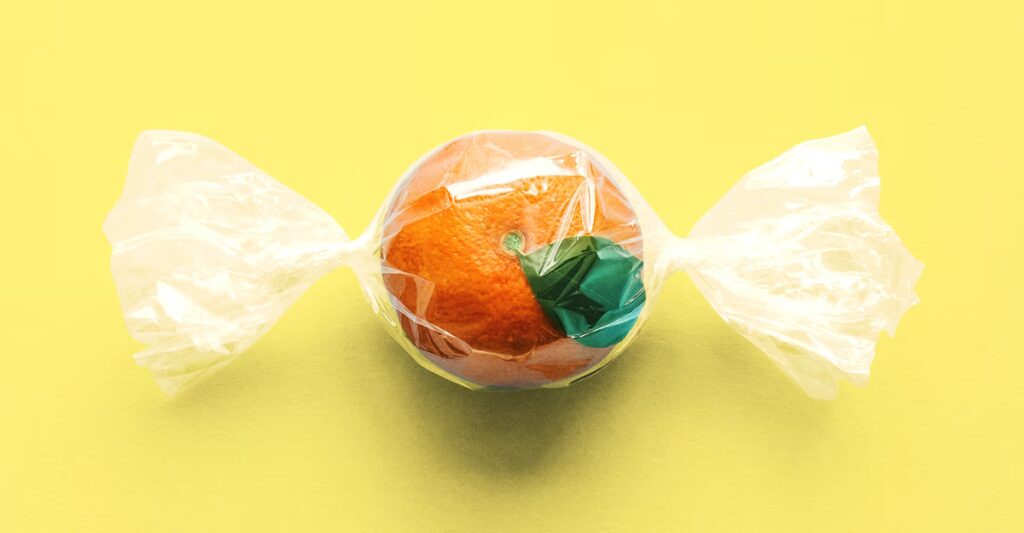
If it is possible, in this fascinating age, to be a celebrity fruit, the Sumo Citrus is definitely a celebrity fruit. The mandarin-satsuma-orange hybrid, originally developed in Japan and brought to American grocery stores in 2011, is by far the most popular new member of the citrus family, accounting for almost a third of the entire sector’s recent growth. This winter, like the winter before, my local Trader Joe’s displayed piles of them in prime position, and many times the store would be half sold-out before sunset. Sumos are discovered anew every season on social media, where people talk about their adorable bumpy heads, their generous size, and—oh!—their sweetness.
Of course. As soon as you taste one, you understand. The eye-widening, tongue-coating syrupyness; the sticky dribble down your chin; the sensation of eating candy that is, somehow, also fruit, a feeling that is a teeny tiny bit like you are robbing a bank at breakfast. Food scientists measure sweetness using the Brix scale, which indicates the percentage of a given dissolved solid (sugar, basically) in a fruit’s juice. The average grocery-store mandarin orange—the kind that lived, oblivious and happy, in fruit bowls across the United States until relatively recently; the kind that doesn’t have a robust online fandom—falls somewhere from 8 to 11 degrees Brix. Sumos have been known to reach up to 18.
[Read: The fruit aisle is getting trippy]
The American grocery-store produce aisle is sweeter than it has ever been, crammed full of fruit a lot like the Sumo, created for an eating public that has repeatedly demonstrated it wants sweet, and will pay for it. Driscoll’s Sweetest Batch berries are notably sweeter (and notably more expensive) than the company’s traditional ones; last year, they accounted for $400 million in sales. Fresh Del Monte, meanwhile, has the Honeyglow, a pineapple that bears the slogan “When we say sweet, we mean sweet.” Cotton Candy grapes are a $100 million concern, one that now has competition from a slew of other designer grapes with similarly ultra-sweet flavor profiles and kindercore, trademarked names: Candy Heart, Sweet Sapphire, Gum Drops.
But even the non-name-brand fruit is sweeter than it used to be, and is getting a little more so all the time. This year’s Sweetest Batch will be regular-degular grocery-store berries in five years, and the Sweetest Batch will be replaced by an even-sweeter-est batch—sugar bombs, everywhere you look, enabled in equal part by scientific advancement and by consumer appetite. Today’s grapefruit are less bitter than the ones your grandparents ate, having had the naringin—the compound that creates bitterness—largely cultivated out of them. Stone fruits are being bred for sweetness too.
The chef and cookbook author Alison Roman told me that she recently noticed that the blueberries she was feeding her toddler were sweet and wan, with no acidity. Claire Saffitz, another recipe developer, has found something similar with contemporary watermelon: “so incredibly sweet,” she told me, but also, somehow, less watermelony. Some years ago, zookeepers in Melbourne , noticed something alarming—the red pandas in their care were developing tooth decay. The problem, as it turned out, was this: The zookeepers were feeding the animals commercial fruit in an attempt to mimic the diet they’d have in the wild, and it was so high in sugar that it was rotting their little teeth. Humans had manipulated nature to such a degree that nature could not keep up.
Sweetest Batch, Sumo, and just about every other fruit on the market are the products of selective breeding—the tedious, iterative work of smushing different varietals’ DNA together over and over, letting the desirable genes survive and the less desirable ones die off. That process is playing out all across the industry. “They’re starting to premium-ize the best, and then that raises the whole,” Courtney Weber, a berry horticulturist at Cornell’s College of Agriculture and Life Sciences, told me. “Everything is just getting better.”
Better can mean bigger, brighter, more nutritious, more disease resistant—but in the grocery store, better typically means sweeter. In this country, at least, people tend to choose sweet fruit when given the choice, and these days people have many more choices than they used to. In 1862—when Henry David Thoreau described wild apples in this magazine as “sour enough to set a squirrel’s teeth on edge and make a jay scream”—fruit was just something that grew on trees, not a multibillion-dollar global business. To the degree that people ate farmed fruit at all, they got it from small farms, with breeding operations that were casual and relatively unscientific.
But over time, the industry grew, farming was professionalized, and the product was standardized. More recently, varietals became lucrative intellectual property (hence all those trademarks), and for-profit breeders began, naturally, looking for the most commercially viable “eating profile”—nature’s sour unruliness bent to humanity’s will. By 1992, the patent for the Pink Lady apple noted its sugar content and “high quality dessert type fruits”; now new apples are advertising their “irresistible sweetness.”
As technological advancement enabled the production of ever-sweeter fruit, cultural changes enabled the appetite for it. Humans have always liked sweet, but in recent years, MAHA, modern parenting orthodoxy, diet culture, and new nutrition research have conspired to turn all kinds of people off processed sugar. Fruit feels virtuous, even if it no longer tastes that way (in an email to me, Driscoll’s described Sweetest Batch berries as “indulgent” and “nutritious” in equal measure, noting both their “intensely sweet, candy-like flavor” and their vitamin content). In a snack-addicted and convenience-obsessed culture, fruit is, more and more, being pitched as portable food, presliced and plastic-wrapped in single-serving portions—and if you’re competing for taste buds with Nerds Gummy Clusters, there’s a lot of incentive to try to taste like them. (Zespri’s SunGold kiwifruits, which have been bred for higher sugar and less fur, advertise themselves on every clamshell as a “nutritious sweet snack.”) Recently, Kate Lebo, a baker and writer, began noticing that in the grocery store, fruit was being “presented to me as candy, as something that was a convenient food I could just unwrap and shove into my mouth without thinking very much about it.”
[Read: What your favorite grocery store says about you]
Lebo doesn’t really like sweet fruit. “Sweetness without acid is boring,” she told me. “It’s insipid.” There’s a reason 2-year-olds and red pandas love it. “It’s just kind of one-note—and not that interesting,” Roman said. “If something’s too sweet, you’re sort of missing the point of what makes it good.” Cotton candy isn’t a flavor: It’s just spun sugar.
When Lebo teaches pie-making classes, she tells her students that if an apple, or any fruit, tastes good out of hand or makes sense in a lunch box, it is not a good baking apple. She, like the other chefs I spoke with, prefers more complex fruit: Sugar is easy to add, but flavor does not come in a bag. “You want something that kind of hurts a little bit when you take a bite, it’s so sour, if you can even find that,” she said. “And you can’t at the grocery store.”
What you can find is a much wider variety and much higher quality of fruit than you once could. “It’s incredible what the berry industry has done in the last 20 years,” Weber, the Cornell horticulturist, told me. A likely thing for a member of the berry industry to say, but, he’s right, of course. Thanks precisely to efforts such as Driscoll’s, berries are not only sweeter but bigger, more beautiful, and much more abundant than they were even in recent history. When Saffitz, the recipe developer, was a kid, not so long ago, “there were, like, three apples in the supermarket.” Now there are dozens—and pomegranates and blood oranges and pert glossy blackberries, even in winter, even in the middle of nowhere. “People complain—it’s like, Oh, they don’t look like they did when I was a kid,” Weber said. “You didn’t get them when you were a kid. You only got them in the middle of summer, when they were picked in a local field. And of course, that’s going to be better. But that’s not reality, right?”
The reality is that in many ways, today’s grocery-store fruit is less like a once-living thing and more like a high-end electronic. It is rigorously tested for quality and consistency—the company that invented Cotton Candy grapes has employed secret shoppers to ensure that its name-brand fruit is never sold with a Brix degree lower than 19. It is developed over a period of years by obsessive geniuses who are optimizing for beauty and functionality (possibly on a gorgeous corporate campus in California). It is designed, above all, to sell.
[Read: Why is everything spicy now?]
Sweetness is, from a genetic standpoint, “probably the least complex of the flavors,” Weber told me. In the context of industrial agriculture, complex is usually a bad thing. Fructose comes in big, hearty branches of oxygen, hydrogen, and carbon; esters, the microscopic compounds that make melon melony and grapes grapey, are much more fragile. They don’t necessarily survive well in the cold, or for long, and the process by which fruit gets from a farm in Chile to an acai bowl in Kentucky is nothing if not cold and long.
Acid may be the antidote to what Lebo would call insipid sweetness, but it is risky. People like it in balance, but they really, really dislike it when it goes too far—and something as unpredictable as a few unfortunately timed rainy weeks during the growing season can halt sugar production and make fruit sourer. “The danger is all acid and no sugar,” Weber told me. “People would prefer sweet with acid, given the choice. But if you’re in the fruit-selling business and you sell somebody something that’s sour, you’re going to lose money.” Sweetness is, simply put, safe—on the commercial market, and on the way there. It is easier to breed for, easier to control, easier to advertise, easier to describe, easier to love.
The quince is a relative of the pear and the apple, but much less sweet. Lebo, the pie baker, loves them. About five years ago, she was looking to buy a quince tree for her yard, and she kept noticing something. With most of the cultivars she found, she told me, “what the growers wanted me to get excited about was how sweet the quince was, and that is not what attracts me to that fruit at all.” What attracts her to quince, actually, is the opposite: its sourness, an astringency that is nearly inedible raw but that transforms into something sublime and floral when the fruit is cooked.
This is the essence of quince, and quince is one of our most essential fruits, dating back to antiquity. Charlemagne demanded that their trees be planted in his imperial orchards; Edward I installed them near the Tower of London in 1275. Many scholars now believe it was a quince, and not an apple, that Eve ate in the Garden of Eden—that gave her all that forbidden knowledge, that showed her the world in its sharp complexity, its pleasure and pain. It is supposed to be sour. It is supposed to require some elbow grease.
The wild apples of Thoreau’s time are mostly gone. Maybe the quince that Lebo loves will be, too—ancient genes bred out and discarded in favor of something new. This is what we wanted. We traded complexity for convenience. We wanted watermelon in January, and we got it. We fed our families. We felt good about it. Saffitz doesn’t want to be overly negative, she told me—as someone who really loves fruit, she’s aware of how lucky she is to get such a variety of it at the grocery store in her town. But, she told me, “I miss fruit tasting like fruit.”
The post Fruit Is Candy Now appeared first on The Atlantic.