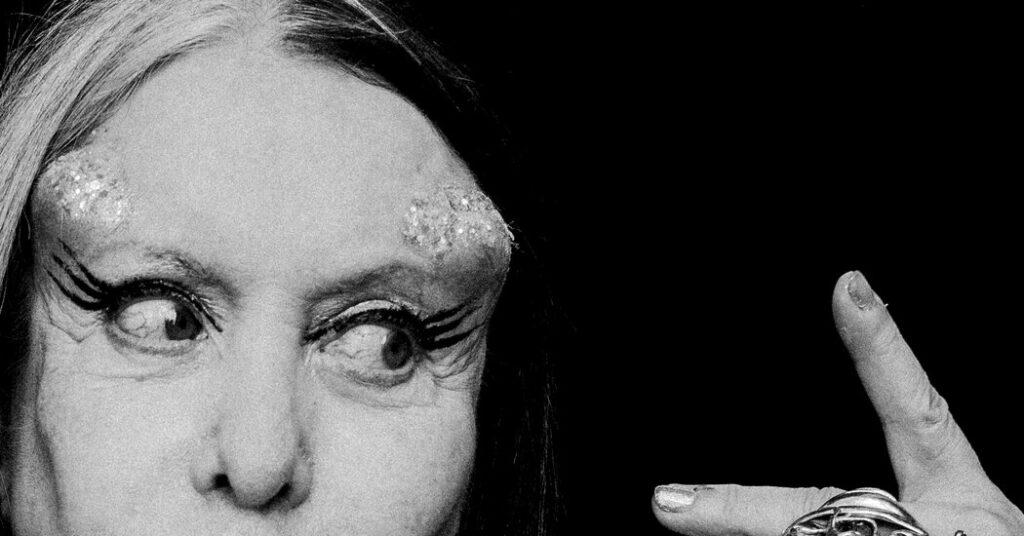
In the 1990s, the French multidisciplinary artist Orlan submitted to a plastic surgeon’s knife, fully conscious and with a camera rolling, to give her face the features of some famous women from art history: Mona Lisa, François Boucher’s “Europa” and Botticelli’s “Venus.”
She became an international sensation with that project, “The Reincarnation of Saint Orlan,” which later included getting horn-like cheek implants in her forehead. The idea, she said, was to disrupt aesthetic conventions, but she wasn’t exactly critiquing plastic surgery culture. “In future times,” she declared, with undeniable prescience, “we’ll change our bodies as easily as our hair color.”
Orlan’s decades-long interrogation of the human form led the Louve museum in Paris to chose her as this year’s guest lecturer for its “Artist Lessons,” and she is giving three presentations through September that explore how the body is represented in art, but also idealized, altered and censored.
On Friday, she will present the second lecture in the series, “Naked and Hairless,” an examination of nudes. Orlan will draw on artworks from the Louvre’s collection, including some of its most famous: the “Winged Victory of Samothrace” sculpture, Théodore Gericault’s “Raft of the Medusa,” and Eugène Delacroix’s “Liberty Leading the People” — which Orlan said was recently blocked on social media because Liberty’s breast is visible.
Her first lecture, in May, was called “The Museum and Art History: Stem Cells of Our New Images” and also explored the intersection of art, science and medical technologies. She has created what she calls “bio-art,” performances like “Harlequin’s Coat,” in which she worked with a lab to cultivate her cells in petri dishes and then turned them into video projections. Lately, she has branched out into artificial intelligence and robotics, developing a humanoid robot with her face and voice.
Speaking in a video interview from Paris last week, Orlan said her aim in the lectures was ultimately to explore an artist’s relationship to art history and the ways in which our perceptions of beauty change. The conversation has been edited for length and clarity.
In your lecture on Friday, you’re discussing “taboos surrounding the body.” What are those taboos?
The second lecture is called “Naked and Hairless,” because all images of women in the Louvre are hairless. In almost all of the depictions of the female body in art, there was no question of including body hair. If body hair was shown, it was seen as dirty or sexual.
What relevance do the paintings and sculptures in the Louvre have to contemporary culture?
Currently, certain artists using A.I. are saying that they are creating new images. I observed that all images are old, very old, thousands of years old. These so-called new images are merely new interpretations, developments created using new tools. My goal is to examine art history and museums as sources of information and inspiration.
When I go into a museum, I say that I’m art-sexual — because I love art, it turns me on. But I see everything with a critical eye, so I have come to tell the story of art history in a different way. I look at how art is shaped by preconceptions, and by pressures and censorship, and the theme of social political and religious control over the body.
How do you present the material? Is it a PowerPoint lecture or more of a performance?
I usually give talks where I speak directly and exclusively about my work, but this time I’ve studied intensely together with the curators of the Louvre. I studied instances of censorship in art history, and also the various forms of censorship across different mediums.
I’ve also used videos which make use of artificial intelligence, where, for example, you might see different images of Adam and Eve, who at first are absolutely happy, and who, suddenly, once they’ve taken a bite from the apple, become ashamed. So the apple changes our perception of our body, and we are taught to be ashamed of it.
Your own body has been your canvas for your artistic work since the 1990s, including in the plastic surgery project. Do you ever get any work done these days?
No, I don’t do that anymore, and I don’t plan to. What I wanted to do was ask a question about this social phenomenon that was cosmetic surgery in the ’90s which I examined with a critical distance, because, in fact, I am not against cosmetic surgery. But I am against all the effects of standardization that it brings about.
And so actually I created my surgical performances to disrupt cosmetic surgery’s routine practices of enhancement and rejuvenation. I had implant that are usually used to raise the cheekbones placed on my temples — these bumps. These horrors have become my tools of seduction.
Plastic surgery has changed so much since the ’90s, and surgical enhancements are much more common these days. What do you think of this trend?
When it comes to cosmetic surgery, I think it can actually be used to create a self-portrait. That is to say, it’s like creating a business card you want to show to other people. I’m always in favor of this sort of empowerment. I’m always in favor of the idea of reinventing oneself, of reshaping oneself and, indeed, not just accepting what nature has given us. For me, what we’re born with is the mask. It’s a mask I want to take off.
You used a biological metaphor in the title of your first lecture, calling art history the “stem cells” of new images. That’s provocative, too, referencing a controversial area of medical science. Why did you choose that term?
I’m very interested in stem cells. I’ve worked a lot with the sciences, doing bio-art. I’ve grown my own cells; I’ve cultivated my vaginal and oral flora, as well as my gut flora. Whether it’s in art or in science, there’s always a lot of hesitation when it comes to innovations, as soon as we do something that isn’t established, something we aren’t used to.
Forgive me for asking, but you’re 79 now, and I wonder if becoming an older woman has made you think differently about using your own body for art?
We all have more than one body: We have the body of a baby, the body of a teenager, a teenage boy or girl, the body of an adult, the body of an elderly man or woman. These are absolutely mind-blowing transformations. Nature shows us the path of transformation, and I have come to deeply accept this lesson from nature — since I myself have transformed.
But I don’t want to get rid of my own body. I’d really like it to eventually become an interactive installation. For example, by modifying my body, and by preserving it.
How would you like to preserve it?
Through the technique of plastination. It’s the principle of replacing the water and the fat in the body with silicone. There’s this doctor, Gunther von Hagens, who has invented a procedure to preserve bodies, which he uses in this exhibition that travels the world, “Body Worlds.” That’s what I’d like to do.
In the meantime, I’m circulating a petition. It’s a petition against death, and it’s on my website, as an international campaign against death. Will you sign it?
I’m not sure whether we can defeat death with a petition …
Maybe. If everybody signed the petition, maybe we might have a chance.
The post This Artist’s Face Is Her Canvas, and Her Calling Card appeared first on New York Times.