Grant Christensen is a professor at the University of Alabama Law School. Anne E. Mullins is a professor at Stetson University’s College of Law.
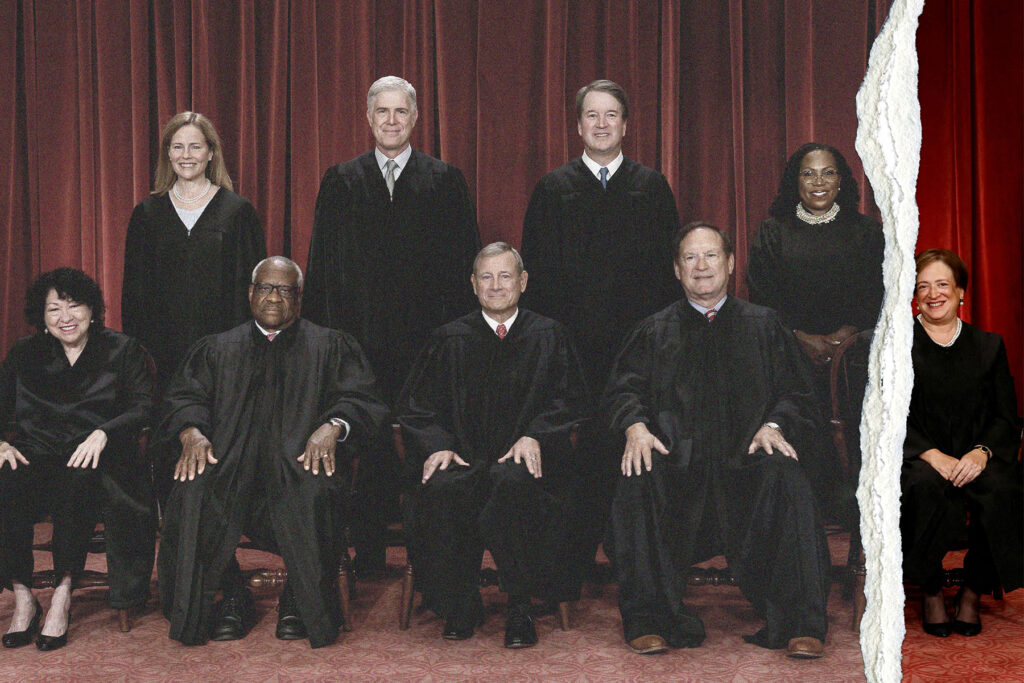
Last month, Justice Elena Kagan did something she had never done before. She dissented alone. After nearly 16 years on the Supreme Court, she was finally on the lonely side of an 8-1 ruling in Havana Docks Corp. v. Royal Caribbean Cruises.
Supreme Court decisions with a single dissenting vote are uncommon. Since 2000, fewer than 1 in 11 cases have been decided this way. Recent terms see an average of six such cases. Unanimous decisions, meanwhile, are the most common. Kagan’s dissent leaves Justice Amy Coney Barrett as the only member of the current court who has yet to dissent alone. Justice Clarence Thomas, the current court’s most prolific solo dissenter, has written more than 50.
As justices are increasingly reduced to ideological blocs, a lone dissent becomes their most visible act of self-definition. Without the armor of a group, these dissents offer a clear view into a particular justice’s philosophy, untainted by perceived politics. These acts of judicial vulnerability reveal what a justice values most.
In an institution built on collaboration, standing alone can come at a cost. Dissenting risks both collegiality and strategic advantage, which means the justice’s conviction must overcome the pressure to conform. In the first-ever recorded dissent, in 1807, Justice William Johnson said having the support of another justice contributed to his willingness to stand apart.
This pressure for consensus is baked into the court. A unified Supreme Court is generally seen as more authoritative, which strengthens its legitimacy. As a result, an institutionalist such as Kagan is far less likely to dissent alone than a maverick like Thomas. The chief justice is particularly unlikely to do it. Chief Justice Earl Warren didn’t write his first lone dissent until his 14th year on the bench and wrote only five in his entire 15-year tenure. William H. Rehnquist wrote 68 lone dissenting opinions in the 14 years he was an associate justice but only nine in the 19 years he served as chief.
Chief Justice John G. Roberts Jr.’s sole lone dissent came in the 2021 case Uzuegbunam v. Preczewski, where he would have limited access to the federal courts for plaintiffs seeking nominal damages when the underlying claim was moot. The Supreme Court, he wrote with uncharacteristic scorn, should not “encourage litigants to fight over farthings.” Even in his lone dissent, Roberts sought to protect the institution of the federal judiciary.
A justice who stands alone can be vindicated years later. When Plessy v. Ferguson upheld segregation on the basis of “separate but equal” in 1896, Justice John Harlan offered the sole dissent.
“Our Constitution is color-blind,” Harlan wrote, “and neither knows nor tolerates classes among citizens. In respect of civil rights, all citizens are equal before the law.” Fifty-eight years later, the court would agree when it unanimously overturned Plessy in Brown v. Board of Education.
Harlan was not the only lone dissenter to foretell the future. Justice Harlan Stone penned the lone dissent in the 1940 case Minersville School District v. Gobitis, which held that a public school district could compel students to salute the American flag and recite the Pledge of Allegiance. Just three years later, the Supreme Court overturned Gobitis in a 6-3 ruling in West Virginia State Board of Education v. Barnette. In 1988, Justice Antonin Scalia stood alone in Morrison v. Olson and articulated the unitary executive theory that is now central to separation-of-powers debates.
Kagan’s 16-year wait to join the ranks of the lone dissenters is a testament to her institutionalist temperament. She stood alone when the court, in her view, departed from the architecture of legal reasoning. Havana Docks featured a plaintiff whose rights in the Port of Havana were seized by the Cuban government decades ago. Those rights were set to expire in 2004, and the defendant cruise lines used the docks from 2016-19. The majority, however, held that the cruise lines could be liable for damages to the plaintiff because they used property “tainted” by Cuba’s confiscation.
“The key to getting this case right,” Kagan wrote in response, “is understanding the nature of the property interest that Havana Docks once held in the docks.” Then came a property lesson. “The majority’s approach ignores basic principles of property law. As every first-year law student learns, ‘property’ is defined by reference not just to spatial boundaries, but also to temporal ones.” The majority, she continued, “inexplicably privileges the spatial.”
This is not a fiery dissent but a pedagogical one. It defines the property interest, identifies its boundaries and applies the statutory language.
Kagan’s dissent may not become a majority view anytime soon — or ever. But, like the many solo dissents that came before, it articulates a principle the justice is unwilling to surrender, even for the sake of unanimity. In that sense, Kagan’s lone dissent is less an act of defiance than of preservation for the judicial principle she values. Perhaps one day, the Supreme Court will agree.
The post Solo dissents are uncommon. Justice Kagan just made her first. appeared first on Washington Post.