Sometimes it’s clear why a bad movie didn’t work: half-baked premise, poorly cast actors, janky editing, insufficient budget. Sometimes it’s less clear what happened. “O Horizon” is the second kind of bad movie, with a bonus element: Its existence gets more baffling as you realize what it really is.
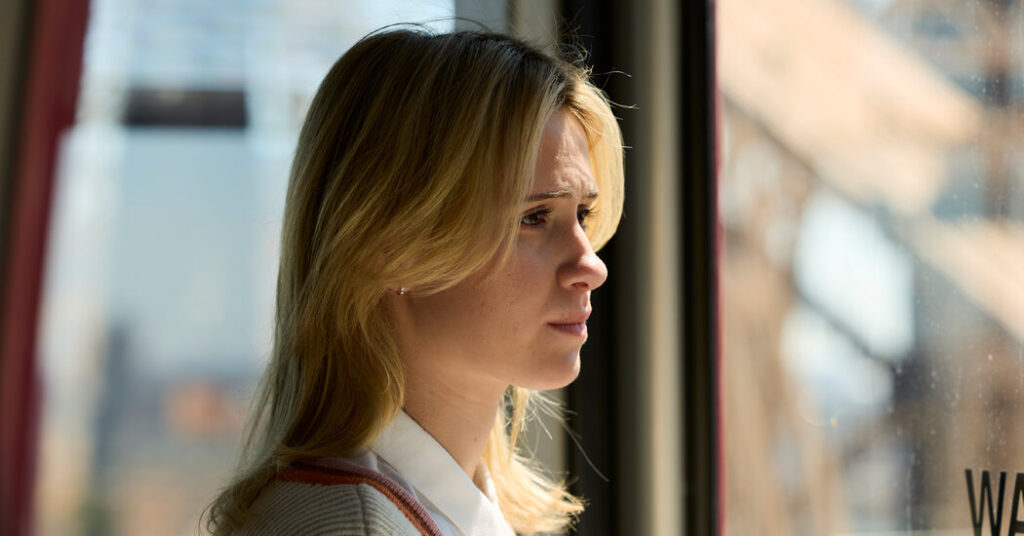
The basic idea of the film is intriguing if, at this point, not all that original. Abby (Maria Bakalova) is a neuroscientist who works for Dr. Sandra Williams (Alysia Reiner), a researcher whose work is so groundbreaking that she’s been shortlisted for the Nobel Prize. They’re mapping a monkey’s brain, trying to figure out how to create the sensation of a pleasurable experience in the monkey — eating a raspberry, for instance — without that experience actually taking place. If they can pull it off, presumably, they’ll be able to help humans do things like experience joy or overcome feelings of hunger or grief.
Abby has a vested interest in this, because she has recently lost her father, Warren (David Strathairn), to whom she was very close. Seeking comfort, she goes to the Seeking a Friend Store, a weird little joint run by a computer programmer named Sam (Adam Pally). Sam has figured out how to take images, videos and other mementos of a person — a celebrity, perhaps, or a dead loved one — and turn them into a facsimile of that person for his customer to chat with. He does so for Abby, who now can “chat” with Warren on the phone.
It’s sort of a Black Mirror premise, except things do not go in a Black Mirror direction. Instead, it’s more of a fable, with Abby learning about grief and letting go and also love and life and all of that.
But there’s a lot about the film that just feels off, somehow. Lines are delivered by almost all of the actors — including Strathairn, surely one of the best actors of his generation — as if they’re in a not terribly well-directed community theater production, with awkward breaks and pauses. While the film tries to explain the discrepancy between Bakalova’s Bulgarian accent and her father’s American one with a back story about the family having lived in Europe until she was a teenager, she handles a lot of the lines with an uncertain cadence, which makes that rationale seem unlikely. It’s a shame, since her emotional performance seems genuine, and she was a delight in “Borat Subsequent Moviefilm” and has turned in solid work in other films, like “Bodies Bodies Bodies” and “The Apprentice.”
Other elements of the film can be either distracting or seemingly underdeveloped. For instance, the world of the Seeking a Friend Store, full of posters of slightly altered movies — “Live Hard,” “A Beautiful Friend,” “Back in the Future” — seems intriguing, but largely disappears early on. And at one point, the singer Aimee Mann, playing a version of herself, appears as the owner of the cabin in the woods to which Abby has retreated for a breather.
For all of these reasons, while I was watching “O Horizon,” I assumed it was just a first-time effort by a new filmmaker who needed some experience. I was surprised to discover that the writer and director, Madeleine Rotzler, is an experienced filmmaker who had previously worked under her maiden name, Sackler. Her first film was shortlisted for an Oscar, and two others have been nominated for Emmys, with one win. Furthermore, while those awards were for documentaries, this is her second narrative film.
Though her documentaries have been about social issues like mass incarceration, she’s been criticized for brushing off questions about her family’s wealth, which comes from the opioid painkiller OxyContin, considered by critics to be the foundation of the opioid crisis.
This is mostly odd given the plot of the film. Reportedly, some members of the crew objected to the story during production, pointing out parallels to Sackler’s own life and her relationship with her recently deceased father, Jonathan Sackler, saying she was whitewashing his reputation. She denied those parallels. Regardless, Abby’s grief over Warren’s death is an idea that has appeared across a number of movies, given the ability of artificial intelligence to mimic dead loved ones.
But more strange is the idea of Abby’s research, the ethics of which the film touches on lightly but does not interrogate thoroughly. “O Horizon” concludes that experiencing grief is important and probably good, and that the monkey on whom they’ve been experimenting is exhausted.
Yet near the end of the film, a voice of wisdom says to Abby that “it’s impossible to know what the net impact of penicillin will have been at the end of time” — a very odd statement, and one that might raise an eyebrow given the broader context of the film. The movie never really suggests that removing pain from human experience would be a bad thing. Apparently, it’s just that the methodology is off. At its very best, that’s a bit of magical thinking.
O Horizon Not rated. Running time: 1 hour 47 minutes. In theaters.
The post ‘O Horizon’ Review: Trying to Skip Pain appeared first on New York Times.