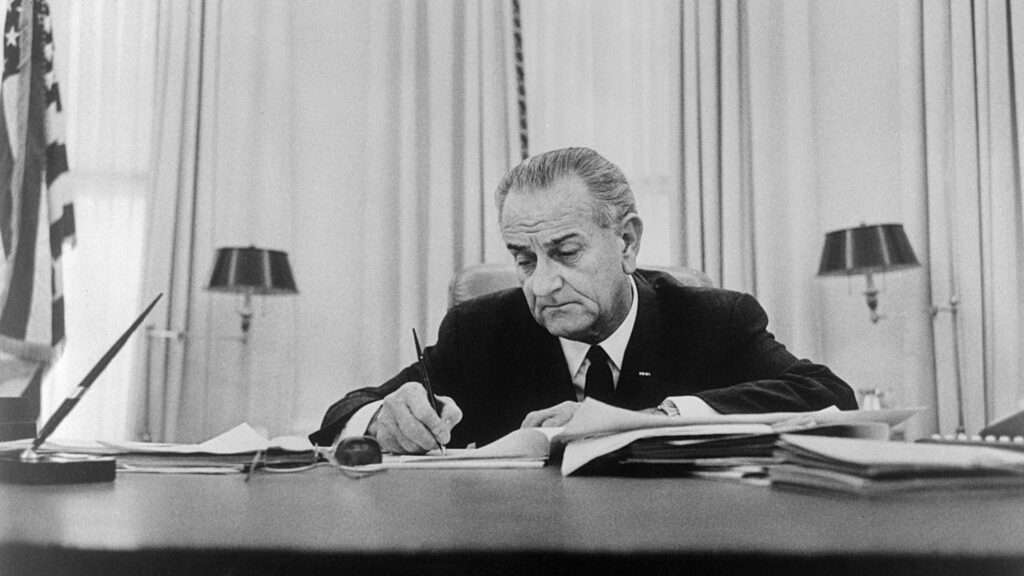
By all the grand machinery of history, President Lyndon B. Johnson should be remembered for his command of power. During his time in office from 1963 to 1969, Johnson was the architect of Medicare, the steward of the Great Society, and one of the most formidable legislators ever to occupy the Oval Office. He reshaped civil rights, poverty policy, education, and the modern role of government with a scale few presidents have matched.
But there is another way to understand Johnson, not through the laws he signed, but through the objects he handed people.
At the Lyndon Baines Johnson Presidential Library, tucked among the artifacts of American power, a museum placard offers a revealing detail: President Johnson loved to shower his family, staff, friends, constituents, and even strangers with gifts. Among his favorites were electric razors and electric toothbrushes.
In fact, Johnson had “give-away” items kept in the Oval Office, including electric toothbrush sets stamped with the Presidential seal. The ritual became so well known that White House staffers collected them. Rumor has it that historian Doris Kearns Goodwin, then a White House intern, amassed several before finally asking Johnson, “Why toothbrushes?”
Johnson’s answer was disarmingly simple: “Because I want people to think of me when they get up in the morning and when they go to bed at night.”
It is an unforgettable line—funny, vain, strategic, and surprisingly revealing. Johnson gave away electric toothbrushes not merely as gifts, but as instruments of memory. He wanted to live in the routines of other people. He wanted to be present not only in Washington, but at the bathroom sink.
The 36th president’s fixation on oral care reveals something more serious than vanity. It offers a window into how he understood power itself. Influence is strongest when it becomes routine. An electric toothbrush was not just a gift. It was political psychology in miniature—an object designed to make him unforgettable twice a day.
Johnson’s actions show what many policymakers today still miss: durable change comes not from spectacle, but from repetition. The strongest systems are the ones people live inside every day. Medicare mattered because it changed what aging meant in daily life. Food assistance mattered because it changed what appeared on kitchen tables. Civil rights legislation mattered because it changed who could walk through which doors.
And oral care belonged to the same logic. Health is not only won in hospitals. It is won in habits.
The toothbrush may be the most democratic tool in public health: cheap, portable, preventive, profoundly ordinary. Used consistently, it can prevent infection, preserve dignity, reduce disease, improve employability, and spare pain before it begins. It is not glamorous enough for political theater. Which is precisely why it matters.
Johnson seemed to understand that intuitively. Long before the White House, he had seen what deprivation looked like up close while teaching poor children in South Texas. He understood that neglect showed up in the body: in hunger, illness, hygiene, and the quiet indignities that shape whether a child is ready to learn or simply ready to endure. That lesson stayed with him.
So when Johnson handed someone a toothbrush, it was more than a gimmick. It was an extension of a worldview: that habits shape health, that routine shapes dignity, and that the smallest interventions can prevent the greatest suffering.
There is a lesson in that for modern public health.
Too often, America still treats oral health as an afterthought—segregated from medicine, detached from justice, and absent from too much of health policy. When we insure the body and neglect the mouth, as if disease politely stops at the teeth. It does not. Oral disease is linked to diabetes, cardiovascular illness, pregnancy complications, school absenteeism, lost wages, and preventable suffering. Yet we continue to treat a toothbrush as a consumer item rather than what it really is: a public health instrument.
That is what Johnson understood about oral health that America still doesn’t. The most effective tools of public health are not always dramatic. They are often small, repetitive, and easy to ignore.
Presidents are usually remembered for the wars they wage, the bills they sign, and the speeches they deliver. But sometimes history is hiding in strange places.
Sometimes it is sitting at the bathroom sink.
The post What Lyndon B. Johnson’s Toothbrushes Show Us About Public Health Today appeared first on TIME.