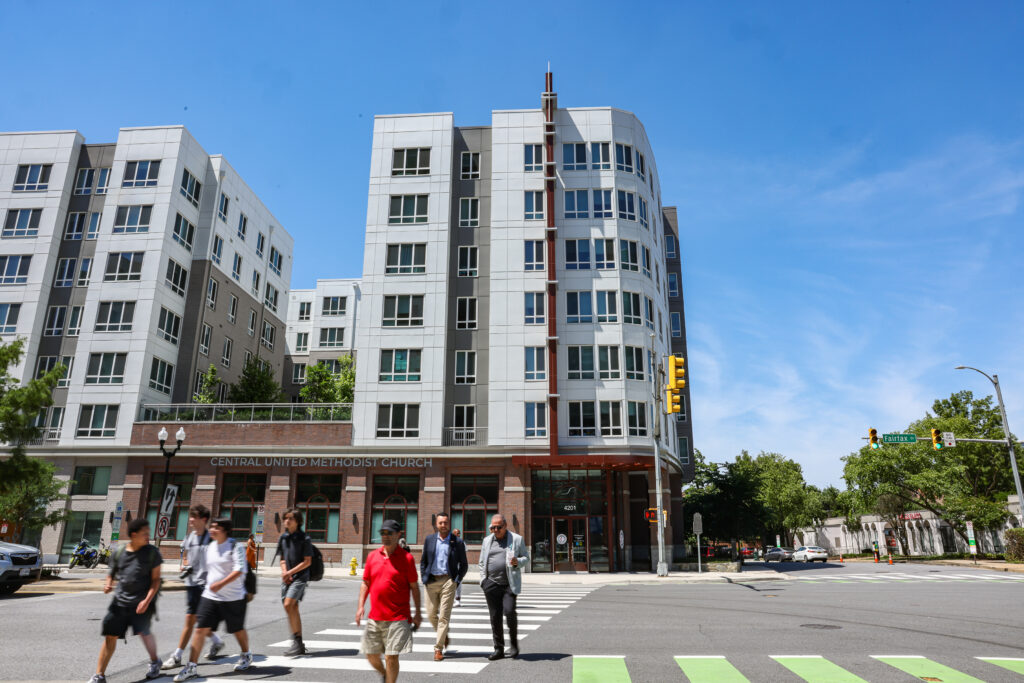
For a century, Central United Methodist did church the standard way. Its 95-foot steeple was a beacon in growing Arlington County, Virginia. Worshipers sat in wooden pews, and over the decades expansions were made to add a school and a gym.
But last year, the church completed a much more radical transformation, building an uber-modern, eight-story affordable housing tower on its property and tucking a sanctuary and space for vital community services onto the first floor.
The total makeover, priced at $84.8 million, reflects a striking national trend. In the past three or four years, the category the U.S. Census Bureau calls “religious construction” has boomed, spiking as the rest of nonresidential construction has nose-dived and then flattened.
In 2025 alone, spending on religious construction rose 17 percent, the fastest growth of any private nonresidential category, the bureau said. Almost everything else built — offices, hospitals, factories, shops — was flat or in decline.
The surge comes in an era of major flux in how Americans find and express their religious and spiritual values. The percentage who say religion is “very important” to them stands at 45 percent, its lowest point since Gallup began asking, in 1965. Fewer than 1 in 3 adults told Gallup that they go to religious services each week.
The vast majority of Americans — 70 percent — still are affiliated with a faith. But what that means, institutionally, is changing as people find meaning-making communities online or in other expressions such as political activism.
That has demanded major pivoting by religious institutions. Experts say those forces are largely what is driving the religious construction boom, as institutions try to meet the moment. Also contributing to the trend are the pandemic, population shifts and a spate of new laws to make religious construction easier.
“Churches are experiencing some major shifts. The needs of people in these buildings are very different than they were 100 years ago when a lot of buildings were built,” said the Rev. Sarah Harrison-McQueen, pastor at Central UMC.
There has been a push in the past decade, she said, to recognize that “if you’re not using your building more than an hour a week, you’re wasting your resources.”
During the pandemic, many congregations halted construction and renovations as uncertainty over attendance and finances made it difficult to plan. Scott Thumma, who runs the Hartford Institute for Religion Research, said those stalled building campaigns began ramping up in late 2022 and have been arriving in waves ever since.
The pandemic shutdown also allowed congregations to step away from day-to-day life and assess what they really needed out of their buildings, Thumma said. It led some to acknowledge the shrinking of their more traditional activities and to find other uses for their property, leading to construction.
Many congregations realized during this period that their buildings needed upkeep work and launched post-pandemic capital campaigns, Thumma said. For some congregations, a shift to online giving when buildings were closed led to an increase in financial resources.
At the same time, several states passed laws making it easier for houses of worship to build affordable housing on their land. Virginia Gov. Abigail Spanberger (D) signed the Faith in Housing Act in April, following similar legislation in California in 2023 and Florida in 2025. States including Connecticut, Massachusetts and Illinois are weighing their own bills.
A Rutgers University report published in March documented 200 religious housing projects across the country between 2015 and 2025, producing nearly 10,000 affordable units. The pace accelerated from roughly six projects completed in 2015 to around 31 in 2024.
Another reason for the boom in church construction, according to Thumma, is a trend among larger churches to grow by opening smaller satellite campuses rather than building in the same spot. Experts say that opening smaller branches is logistically and financially easier than getting permits for an even bigger main building, and that smaller sites are better able to reach different language or cultural groups.
In the Northeast, Catholic populations are consolidating and moving to the Sun Belt. This hasn’t yet led to many new parishes, but experts say it is leading to expansions, updates and other new construction for existing congregations.
In Virginia, Central’s radical building transformation was fueled by some soul-searching years ago among the congregation, which sees about 55 people on an average Sunday. They pondered what they wanted the church’s role to be and the importance of its building, even as they noticed in a new way how many homeless people lived in the surrounding streets.
Once they decided to move forward in 2014 with affordable housing, it took a decade of rejected applications for tax credits, covid delays and neighborhood conversations before the project could happen. A good chunk of funding ultimately came from a pool that Amazon had given the state as part of its deal to build HQ2, its massive East Coast Hub, in Arlington. (Amazon founder Jeff Bezos owns The Washington Post.) The church covered about $11 million of the cost.
St. Gabriel Catholic Church, in Cave Creek, Arizona, in the Phoenix area, hopes to break ground next year on a 152-unit senior living facility next to the parish, on church property. With assisted living and some memory care, the project was driven by the idea that Catholics in particular need to attend worship in person, to receive Communion, and that being a golf cart’s ride away would deeply improve older congregants’ lives.
The project is being done with Acanthus Senior Living, which also plans to build four similar facilities in the fast-growing Phoenix diocese. Bart Shea, CEO of Acanthus, said 70 parishes around the country are interested in similar projects.
The arrangement took nine years of planning and was complicated in part because to get financing, the building had to be open to non-Catholics. The parishes will lease the land to the builder, who will pay them back 10 percent of profits.
“No one else was dumb enough” to take on the complexity, said Shea, a Catholic who said he’s haunted by his mother’s desire to go to Mass in her final days — a wish he was able to fulfill in only a limited way because of distance.
Shea said what’s driving these projects is the shortage in the country for appropriate housing for seniors.
Warren Wooten, assistant director for affordable housing for the city of Charlotte — and an active, lifelong churchgoer — said conversations about what to do with religious buildings “are really hot across the nation. It’s blowing up everywhere.”
Charlotte Mayor Vi Lyles in late 2024 established Faith in Housing, which helps faith-based groups create affordable projects. In May 2025, more than 400 people from 90 congregations came to a kickoff conference. As of now, Charlotte has 12 congregations going through an 18-week program to get ready for development.
“From what I’ve seen, there’s a really a huge variety of ways people are thinking about the reality that, ‘The way I’ve done church is fundamentally changing, and how do we as a faithful congregation respond well to those changes?’” Wooten said. “In some places, it’s a dying church. They don’t have the numbers, but they say, ‘We want to leave a legacy here.’”
Sometimes construction is about creating a new funding stream for the congregation’s next project, he said. Sometimes it’s a way to respond to new needs in the community, such as a rapid influx of immigrants. Some want to reimagine the church as a shared civic space.
That is part of what is happening in Arlington. Retirees Jeanie and Gene Cross were involved in getting Central remodeled, and now cook and serve food to the community twice a week at a new kitchen that looks more like a cafe, with big windows looking out at the street.
“We both have a belief that it is important to live the life your religion or value system teaches,” Gene Cross wrote in an email. “The building project at Central and the mission focus of our activities at Central and other areas are part of what we believe our faith teaches.”
The post Why religious construction is on the rise when most other building has stalled appeared first on Washington Post.