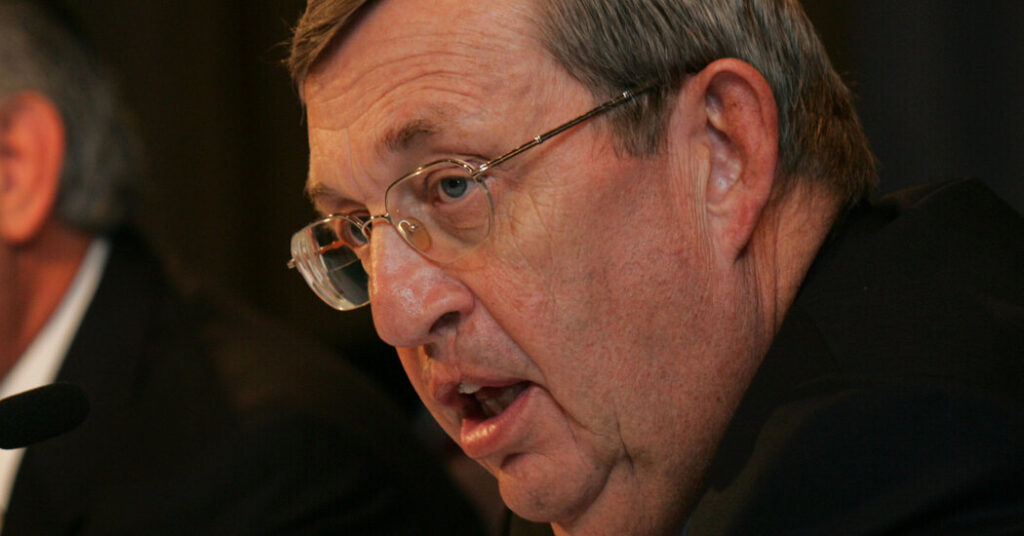
Lee R. Raymond, who as chief executive of Exxon Mobil wrung out costs to make that global oil company the most profitable in its industry while stoutly resisting the scientific consensus that burning fossil fuels was causing a potentially disastrous warming of the Earth, died on Saturday in Dallas. He was 87.
His death, at a hospital, was confirmed by his son Colin, who said the cause was complications of pneumonia.
Mr. Raymond’s agreement in 1998 to acquire Mobil — a transaction valued at about $81 billion, then the largest corporate merger ever — created the world’s biggest private-sector oil company in terms of annual sales, operating in 200 countries. The deal reunited the two biggest parts of John D. Rockefeller’s Standard Oil Trust, sundered in 1911 by federal trust busters in an effort to spur competition.
During his reign as chief executive, from 1993 to 2005, Mr. Raymond relentlessly cut costs, including eliminating a third of the executive jobs after the merger, and helped boost net income to $36.13 billion from $4.8 billion. The company’s market value increased fourfold to $375 billion.
Mr. Raymond shunned publicity. There was no discernible effort to make him seem endearing or personable to the general public or even to his own employees. He was known for making withering remarks in response to questions from employees or investment analysts.
“What you’re hearing today may seem boring,” he said at an analyst meeting in March 2005. “You’ll just have to live with outstanding, consistent financial and operating performance.”
At company headquarters in Irving, Texas, he worked in a hushed office suite known as the God Pod, where a painting of a tiger hung behind his desk. Some employees nicknamed him “Iron Ass,” according to “Private Empire: ExxonMobil and American Power,” a 2012 book by the journalist Steve Coll.
Before Mr. Raymond became chief executive, his biggest public role was taking charge of the company’s response after the Exxon Valdez tanker ran aground on a reef in Alaska’s Prince William Sound in March 1989. The accident spilled 11 million gallons of crude and blackened 1,500 miles of coastline.
Mr. Raymond, then Exxon’s president, oversaw the cleanup and, in 1991, helped negotiate a $1 billion settlement of federal and state legal charges arising from the spill. He accused environmentalists and politicians in Alaska of making the disaster worse by refusing to let Exxon spray chemical dispersants on the oil slick shortly after the spill.
In 1994, a federal jury in Anchorage ordered Exxon to pay $5 billion in punitive damages to about 34,000 fishermen and other Alaskans who said they were harmed by the spill. Exxon appealed, leading to another 14 years of litigation. In a 2008 Supreme Court ruling, the damages were reduced to $500 million.
In the early 2000s, as BP and Chevron courted public favor by touting their investments in alternative energy sources, Exxon took a hard line against government restrictions on fossil fuels and funded research challenging the consensus on global warming.
Mr. Raymond, a former high school debating champion who had a Ph.D. degree in chemical engineering, considered himself a scientist with standing to question that consensus. In a 2005 interview with the public television host Charlie Rose, Mr. Raymond said there was a “natural variability” to temperatures on Earth over millenniums.
“If we weren’t here, the climate would change,” Mr. Raymond said. “It has to do with sunspots, it has to do with the wobble of the Earth, and it has — there are all kinds of things that come and go. If you talk to a geologist, he will tell you the Earth, over its history, has been much warmer than it is now and much colder.”
Because wind, solar and other alternative energy sources were costly and could not replace oil and gas in the near term, he argued, Exxon should focus on finding and pumping more oil, including, if possible, in the Arctic National Wildlife Refuge in Alaska.
Environmentalists regularly denounced Exxon. “There is a spectrum of corporate behavior on global warming and Exxon is the epitome of denial and deception,” Kert Davies, then the research director at Greenpeace USA, told The New York Times in 2005.
Mr. Raymond also resisted corporate trends toward greater acceptance of gay rights. After Exxon acquired Mobil, the combined company rescinded Mobil policies banning discrimination on the basis of sexual orientation and ended a practice of providing benefits to same-sex partners. The moves prompted some gay and lesbian drivers to boycott Exxon service stations.
Under Mr. Raymond’s successor, Rex Tillerson, Exxon Mobil adopted more inclusive policies and acknowledged that human activity contributed to climate change.
Mr. Raymond seemed unbothered by the unpopularity of his views. “I’ve never had a focus group to decide what my persona is out there,” he told The Wall Street Journal in 1997.
Nor did he wish to discuss his personal life. During a court hearing on the Valdez oil spill in the 1990s, an Exxon lawyer asked Mr. Raymond to sum up his background. “I hope this doesn’t get too boring,” Mr. Raymond said. “It kind of bores me.”
Lee Roy Raymond was born in Watertown, S.D., on Aug. 13, 1938. His father, Clifford, a railroad engineer, encouraged the young man’s studious ways. In the 1997 interview, Mr. Raymond recalled his father’s alluding to a lack of opportunities in South Dakota and saying, “You have to get an education and get out of here.”
After excelling in high school debate and extemporaneous speaking, Mr. Raymond enrolled at the University of Wisconsin and graduated in 1960 with a bachelor’s degree in chemical engineering. He married Charlene Hocevar in 1961. They had three children, male triplets.
In addition to his wife and son Colin, he is survived by two other sons, John and Rob; and seven grandchildren.
Mr. Raymond earned his doctorate in chemical engineering at the University of Minnesota in 1963 and joined Exxon the same year as a production research engineer in Tulsa, Okla. He later headed operations in Venezuela. In the mid-1970s, he impressed his bosses by turning an unprofitable refinery in Aruba into a reliable source of profits.
After returning to the United States, he headed Exxon’s nuclear power business and oversaw the sale of a subsidiary selling office equipment, including Qyx electronic typewriters.
During his 12 years as chairman and chief executive, his compensation totaled more than $686 million, or $144,573 a day, according to an analysis done for The Times by Brian Foley, an independent compensation consultant.
That compensation amounted to “entrepreneurial returns for managerial conduct,” Charles M. Elson, a corporate governance scholar at the University of Delaware, told The Times in 2006. “Exxon was there long before Mr. Raymond was there and will be there long after he leaves. Yet he received Rockefeller returns without taking the Rockefeller risk.”
An Exxon Mobil spokesman at the time said Mr. Raymond’s performance justified his pay.
Mr. Raymond was a director of JPMorgan Chase & Co. and its predecessor, J.P. Morgan & Co., for 33 years before stepping down in 2020. He also was on the board of the American Enterprise Institute, a conservative think tank in Washington.
His hobbies included duck hunting and golf. In a 2013 interview with Investor’s Business Daily, he recalled having made three holes in one. On the corporate jet, he liked to drink milk with popcorn in it, Mr. Coll reported.
One of Mr. Raymond’s sons, John, co-founded Energy & Minerals Group, a private equity firm. “My father gave me three things,” John Raymond told The Journal in 2014. “He gave me work ethic, he gave me a good education and he gave me no money.”
Though Lee Raymond was known for his pugnacity, he had a softer side, according to Mr. Coll’s book: “He could be fiercely loyal to ExxonMobil colleagues and sometimes wept openly when subordinates faced illnesses or other personal struggles.”
The post Lee Raymond, Who Created Global Oil Behemoth Exxon Mobil, Dies at 87 appeared first on New York Times.