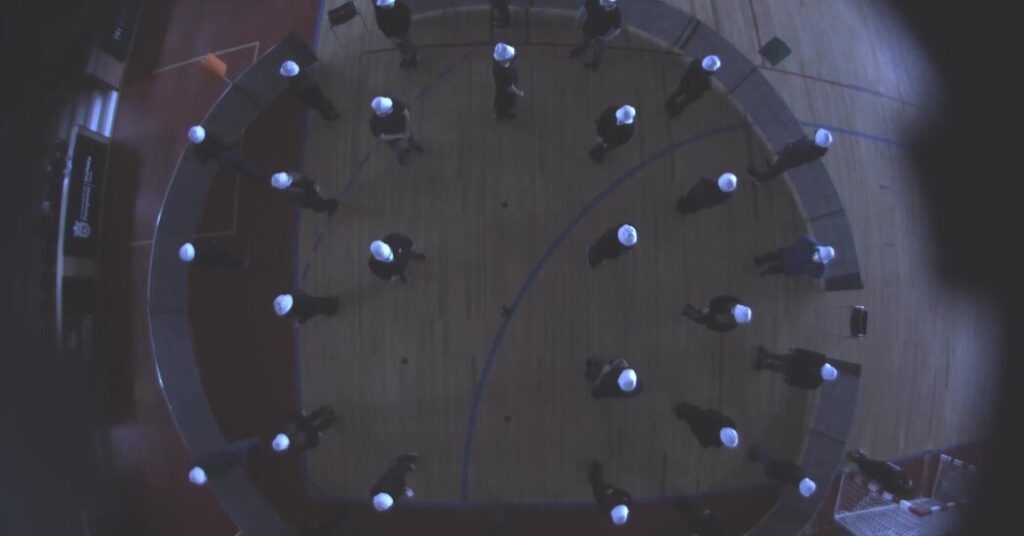
Iñaki Echeverría-Huarte, an applied physicist at the University of Navarra in Spain, was studying whether people maintain a certain distance between one another while walking when he noticed something strange. Across some 40 experiments, most of his participants spontaneously veered to the left.
Although this observation had nothing to do with his original research, it piqued his curiosity. “This was the first signal that something weird was happening,” Dr. Echeverría-Huarte said.
He and his colleagues assumed there must be a straightforward explanation. Perhaps the layout of the room, for example, was subtly directing people to list to the left. They began what they thought would be a simple investigation to find the answer.
Five years later, Dr. Echeverría-Huarte and his colleagues have exhausted most of their hypotheses and are no closer to solving the mystery. But what they have found, as reported on Wednesday in the journal Nature Communications, is a striking, innate tendency for people across demographics, cultures and conditions to veer in a counterclockwise direction.
“In principle, there is no reason for the fact that people prefer rotating counterclockwise,” said Iker Zuriguel, an applied physicist at the University of Navarra and a co-author of the study. Yet it’s clear they do.
Dr. Zuriguel and Dr. Echeverría-Huarte first searched in the scientific literature for an explanation as to why this might be so. They found a study showing that people who are lost usually wander in circles — but it did not specify the direction.
They found another paper showing that when people encounter a wall, those who are right-handed tend to turn left, while those who are left-handed do the opposite. Most of the participants in the original study were right-handed, so “the moment we saw that, we said, ‘OK, we have an answer,’” Dr. Zuriguel said.
To check, they ran their own trial. They separated participants according to whether they turned left or right when directed to approach a wall. They then asked the participants to walk around a small arena. To the researchers’ surprise, regardless of the wall-turning preferences or handedness, most chose left.
This baffling finding prompted them to undertake five additional experiments, each targeting a different hypothesis and involving a total of 573 participants. Yet again and again, they found the same result. In an open schoolyard, for example, the researchers instructed participants to roam at will while a drone recorded their movements. Within seconds, 80 percent of people were moving in a counterclockwise direction. “It’s not a gradual drift but rather a bias that emerges almost immediately,” Dr. Echeverría-Huarte said.
Dr. Echeverría-Huarte and his colleagues wondered if the behavior might be emerging collectively, similar to how pedestrians split into two opposite-moving lanes on crowded sidewalks. But when they tested participants alone, 75 percent still moved counterclockwise, suggesting that the tendency is individual.
Were there cultural factors behind that preference? Pedestrians, for example, typically walk on the same side as cars drive on in their country, and pedestrians also typically move in that direction if they encounter an obstacle. So the team ran experiments in Japan, where pedestrian lanes form on the left. Despite being convinced they would see the opposite pattern to the one in Spain, the researchers yet again observed participants moving counterclockwise, ruling cultural norms off the list.
Finally, they wondered if some unacknowledged social convention drilled into adults, but not yet present in children, might be at play. They reached out to researchers who had conducted a prior study in a Japanese kindergarten in which 52 children moved at random while music played. The Japanese researchers shared their videos of the children for analysis — revealing that most of them also moved counterclockwise.
Enrico Ronchi, who models emergency evacuations at Lund University in Sweden and was not involved in the research, said the findings “open up many new, interesting avenues in the field of crowd dynamics.”
He would be interested to see, for example, whether the counterclockwise bias holds up among people with disabilities, or in emergency evacuations.
Karol Bacik, an applied mathematician at M.I.T. who was also not involved in the research, said the new finding challenges our understanding of human locomotion. “The counterclockwise bias may have far-reaching consequences for everyday pedestrian traffic, but we simply have not looked for them yet,” he said.
Dr. Zuriguel and Dr. Echeverría-Huarte next plan to investigate new hypotheses about the counterclockwise bias using biomechanics, virtual reality, neuroscience or even animal behavior. “Fish are the canonical animal that move in circles,” Dr. Zuriguel said. “But whether they prefer rotating in one direction or the other, I don’t know.”
The post Nearly Everyone, Everywhere, Veers Left When Walking appeared first on New York Times.