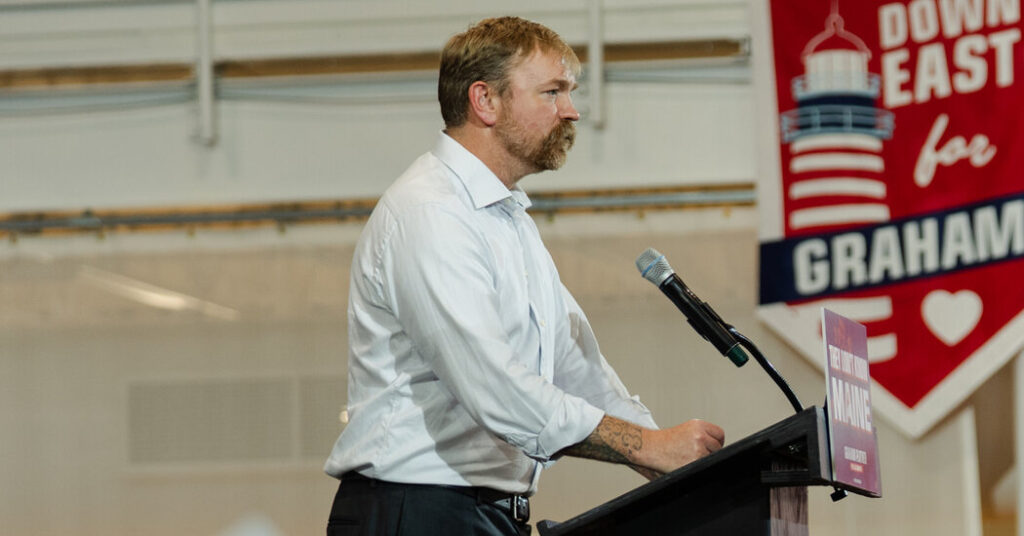
When Graham Platner delivered his victory speech on Tuesday night, after winning the Democratic primary in Maine, there was something different about his appearance.
Atypically for Platner, whose unvarnished image has been central to his Senate run, he wore a button-up dress shirt, tucked in.
Was this a new Platner? Not necessarily. He was back in a hoodie on “Morning Joe” the next day.
Still, it was a departure for the nominee, who from the beginning has presented in a take-me-for-who-I-am wardrobe. Platner, whose campaign has been aided by advisers including Morris Katz (who also worked with Mayor Zohran Mamdani and Senator John Fetterman), was nudged into running in part because of his untamed rhetoric and rough-hewed look.
As my colleague Joe Bernstein wrote in January, Platner fit the mold of “a gruff white guy who looked as if he had just walked off a job site,” one of the things Democratic operatives like Katz have sought out as they attempt to draw working-class voters back to the party.
But like most politicians, he can show a versatility when needed.
Platner seemed to acknowledge the unease swirling around his candidacy when he met with Democratic senators in Washington earlier this month. Platner arrived on the Hill in a lightly checked blazer and dress shirt, a more conventional outfit that seemed to reflect the gravity of what he was facing. It was perhaps also a recognition of a formality that endures in the Senate offices in Washington.
On Tuesday night, Platner again looked, for really only the second time, more like a traditional politician — albeit one in the still softly rumpled manner of his ideological peer Bernie Sanders.
The left is betting that working-class voters want to see versions of themselves running. The right seems less preoccupied with this notion: After all, a significant swath of Republican voters who could be classified as working class voted for a wealthy New York real estate magnate in a suit.
And of course, this proletarian packaging appears to play differently for different candidates. Though Platner and Mayor Mamdani both talk about upending inequality and promoting social programs, Mamdani has maintained his uniform of suits on the trail and in office, which in New York, made the young, previously little-known candidate appear more serious.
In rural-leaning Maine, Platner, who for several years has been an oyster farmer, campaigned in pocketed work shirts and tees with union insignia. He wore unremarkable jeans and trucker hats from Bourgeois Guitars in Lewiston and the Maine Outdoor School. When The New York Times photographed him at a town hall in April, his hair was flipped up, as if he had just taken that hat off seconds before.
Platner ingratiated himself to voters as a bearded guy in a Paul Bunyan flannel shirt who said things like: “In the state of Maine, almost everybody’s working class. Everybody works, everybody struggles.”
For some Maine voters, Platner’s image made him a compelling missionary for such a class-focused message. He didn’t look like a consultant parachuting in to tell them what their struggles were. In his sun-faded hat and boots, he looked like he might be familiar with such struggles himself. The clothes did not overshadow his populist messages, but they aided in making them go down believably.
He’s not the first candidate to put forth a homespun image. Erstwhile peanut farmer Jimmy Carter wore jeans all the way to the White House. When Beto O’Rourke appeared on the cover of Vanity Fair in an article about his presidential ambitions, he did so standing next to a pickup truck in jeans. More recently, John Fetterman won his Senate seat in Carhartt hoodies and shorts, a look that he brought with him to Washington.
For Platner, his pre-political wardrobe worked to articulate, in shorthand, that he was a working-class Marine veteran who had answered a political calling. His advisers bet his appearance would translate to voters as that slipperiest thing in politics: authenticity. (Especially regional authenticity.)
As new reports surface about Platner’s past, including what former girlfriends have described as “unsettling” behavior, and questions of whether Platner was aware a tattoo had Nazi connotations, his skeptics and opponents continue to wrestle with whether Platner’s image is authentic or artificial. Nonetheless, his supporters in Maine delivered him the Democratic nomination.
It was striking, watching coverage of his campaign, how many of the people in Platner’s audiences were dressed just he had on the trail. Platner though, on Tuesday night, looked a little more Beltway than he had before.
The post Graham Platner Tucks in His Shirt appeared first on New York Times.