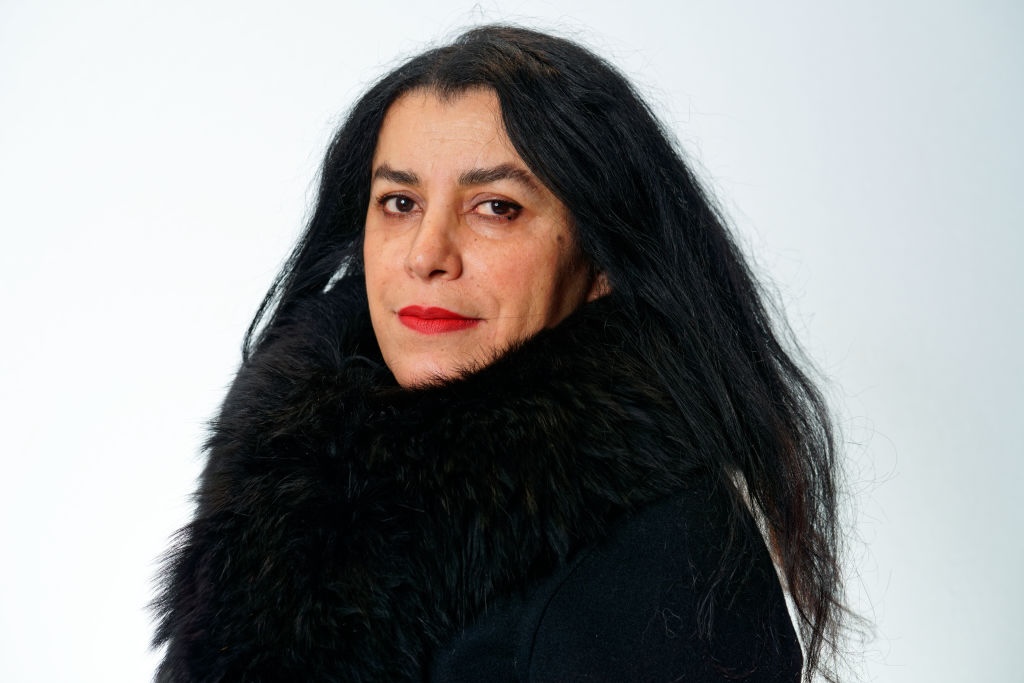
There are stories about post-Revolution Iran—and there are the stories of Marjane Satrapi, the trailblazing artist, author, and director who last week passed away at age 56 in Paris, “of sadness” over the death of her husband in 2025, according to Agence France-Presse.
Far too often, personal stories penned by Iranians tell of families whose comfortable lives in Pahlavi-era Iran are upended by the 1979 Revolution, and who begrudgingly leave the land of “roses and nightingales” to start anew in a West that no longer associates them with princes and poets, but mullahs and thugs. In Satrapi’s stories, Iranians bang their heads to Iron Maiden, discuss the sordid details of their sex lives over tea (the subject of her book Embroideries), challenge authority, play at being rock and roll stars on their tennis racquets, and boldly assert on the backs of their jackets that, contrary to what some might think, “punk is not ded.” In other words, although they certainly struggle under a tyrannical regime, they’re human and still manage to express themselves.
Satrapi’s Persepolis was among the first and finest memoirs about post-Revolution Iran, and is still incredibly relevant more than a quarter century after its 2000 publication. The two-part work—which Satrapi preferred to call a “comic book” instead of a graphic novel—followed “Marji” as she grew up in the eighties in Iran, studied in Europe, and returned to Iran before leaving in the mid-nineties for Paris, where she lived until her death. From the first page, Satrapi questions and lampoons the antediluvian and Draconian policies of the Islamic Republic, particularly with respect to women. As a schoolgirl, she loathes the headscarf, and, under the influence of her progressive mother and sage grandmother, matures into a young woman passionate about freedom, social justice, and calling out hypocrisy wherever she encounters it. “I didn’t even think that people would read it,” she told me in a 2017 podcast interview. “I was like, you know, who would be interested in that?”
Persepolis became a beloved classic amongst Iranians and non-Iranians alike. “It really hit hard,” says rock icon Iggy Pop, the voice of Satrapi’s uncle Anoosh in the English-language version of the 2007 Oscar-nominated film adaptation of the book, which Satrapi co-directed. “And yet the emotions expressed were very soft and human. Behind it all was a kind of relentless pursuit of justice.”
Its enduring relevance is not for the better. If there have been peaks and valleys in terms of social freedoms since 1979 (President Mohammad Khatami’s tenure being a higher point), Iranians are currently in an abyss. The Islamic Republic slaughtered tens of thousands of Iranians earlier this year without compunction and remains in power despite military intervention by America and Israel. It is more emboldened than ever—and the Iranian people are paying the highest price. Constant harassment by the “morality police”; crackdowns on parties (and expressions of joy in general); the suppression of “anti-Islamic” culture (including indigenous Iranian culture, especially that predating Islam); and the imposition of stringent dress codes—all of which Marji experienced in Persepolis—are still quotidian realities for Iranians.
“The enormous human suffering that is taking place [is] being pretty much ignored in the media conversation in the West,” says Pop. “There are people whose lives are being lost or ruined. She was able to shine a light on that to some degree.” Pop says the devastation of Iran accounts for the impression Satrapi first made on him. “She was wound up very tight,” he says. “She had very nice manners, but this was not an easygoing person. I realized later, as time passed, that this had everything to do with her loss of home because of insane political events. I think she was inconsolable.”
Though Persepolis isn’t what one would call a “political” work, that’s not to say Satrapi was apolitical. She produced a collection of illustrated stories, Woman, Life, Freedom (Zan, Zendegi, Azadi), in response to the eponymous 2022 female-led protests after the Islamic Republic’s murder of 22-year-old Mahsa Amini for not properly wearing her headscarf. And, just as Persepolis did not follow the blueprint of post-Revolution stories, Satrapi’s politics also defied convention. She was an outspoken critic of the Islamic Republic, protesting for instance outside its Paris embassy after the arrest of five Iranian teenagers who had danced to Rema and Selena Gomez’s “Calm Down” in a TikTok video in 2023. But Satrapi rejected the role of spokesperson or revolutionary leader that many successful Iranians in the diaspora are only too eager to assume. “What am I going to say about what is happening to the youth of Iran?” she asked on the podcast. “I think it’s unfair and [shows] a lack of decency … It’s very easy to assume the role of a cultural ambassador and authority on Iranian culture and society being in the West. I don’t … want to be the ambassador of anything… I don’t have any authority. I have an opinion, but this opinion should remain personal, because … instead of helping [Iranians], I will harm them.”
Pop says: “I think that as history unfolds she will be credited in a very large way for her activism”.
She put her money where her mouth was. In the first book of Persepolis is an episode in which Satrapi lies about being French—something she comes to deeply regret when remembering her grandmother’s words of wisdom about staying true to herself. A year before her death, Satrapi was awarded France’s Légion d’honneur, the country’s most prestigious civilian order of merit. In the true spirit of Marji, the girl who championed justice and freedom, Satrapi rejected the award, citing France’s “hypocritical attitude towards Iran” in a letter to the country’s then-minister of culture, Rachida Dati. That President Emmanuel Macron nonetheless referred to Satrapi last week as “a great artist who transformed an Iranian childhood into a universal fable” speaks volumes.
If Satrapi was worried about harming Iranians, her work was, and remains, a blessing to Iranians and lovers of Iran. She humanized and gave a voice to ordinary Iranians like yours truly. At a time when they were vastly underrepresented and people “were very ignorant,” as she told me, she drew attention to the injustices in her beloved Iran with not rancor or bitterness, but the wit of a child wise beyond her years … and a bit of rock and roll.
As Iggy Pop puts it, Satrapi was “a brave kid who did her best.”
The post Marjane Satrapi Always Defied Convention appeared first on TIME.