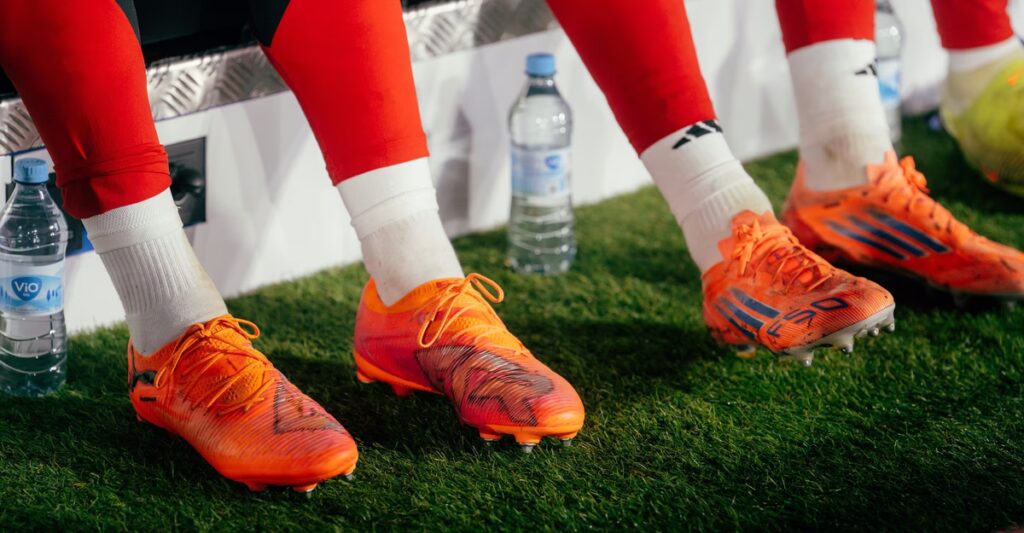
Every time the United States hosts a major international soccer tournament, the world’s finest players unite to complain about our god-awful fields. At the 2024 Copa América, the Argentine goalkeeper Emi Martínez—widely regarded as one of the best in the world—described the field in Atlanta’s Mercedes-Benz Stadium as both “a trampoline” and “a disaster.” Last year, Chelsea’s captain, Reece James, who played a Club World Cup match in New Jersey’s MetLife Stadium, called the pitch bad for the joints and the quality of gameplay. This year, MetLife Stadium will host the single biggest match in soccer: the World Cup final.
The United States’ poor record on grass has prompted fans and soccer analysts alike to speculate that turf will be the villain of this year’s tournament. FIFA doesn’t allow professional games it hosts to be played on fully synthetic surfaces, but the United States’ largest stadiums are mostly designed with artificial turf for NFL games. So, shortly after Canada, Mexico, and the U.S. won their joint bid to host the 2026 World Cup, FIFA began approaching grass researchers, who have since received millions of dollars to figure out how to turn American football stadiums into, well, football stadiums. You might call this effort the World Cup of grass science.
Slight differences in turf can make a major difference in elite play. Grass that’s even half a centimeter too long can generate unexpected friction that throws off the timing of passes. Grass cut too short can shift the game to a frantic pace. Last year, during a FIFA game held in Cincinnati, the strange physics of the turf contributed to a goal so absurd that analysts said it looked like “a glitch from a 2002 video game.” (A FIFA spokesperson told me in an email that the pitches for the 2026 World Cup represent a “significant evolution” over last year’s Club World Cup.) John Goff, who studies the physics of soccer at the University of Puget Sound, told me that if the ground is too hard, cleats can’t penetrate its surface properly and players slip. But if it’s too soft, players can’t get quick feedback through their cleats. They might lurch their body before their feet actually move, risking shin splints and knee injuries.
[From the November 1884 issue: Grass: a rumination]
In countries that really care about soccer, stadiums are open-air cathedrals to the sport. The grass is fed by the sun, its engineering so involved that the author of FIFA’s pitch-maintenance manual called the United Kingdom “the Silicon Valley of turf” in 2021. Stadiums close for part of the offseason so that the grass can be reseeded. Many stadiums were built from scratch to FIFA specifications for prior World Cups, including Qatar’s, Brazil’s, and South Africa’s. But in the U.S., few major stadiums are dedicated year-round to soccer, and no new ones are being built. Even our NFL stadiums are all-season, multipurpose entertainment receptacles. For example, Hard Rock Stadium, home to the Miami Dolphins, hosted two Shakira concerts days before a Club World Cup game last year. Machines were still installing the field 15 hours before kickoff.
This model means that many North American stadiums have had only months, or even days, to get their grass ready for the World Cup. In Houston, officials refused FIFA’s request that they move the city’s annual rodeo, which takes place on dirt and ended in late March; grass installation at NRG Stadium finished just last week. The first World Cup game there will take place on Sunday. (“FIFA is confident that the extended pitch construction timelines and dedicated exclusive-use periods leading up to the tournament will ensure the consistent delivery of high-quality surfaces across both stadiums and training sites,” the spokesperson said.)
The size and geographic distribution of this World Cup also present unique challenges. The tournament features 40 more games than usual and will be played in 16 stadiums that span nine different climate zones. “The grass in Toronto won’t grow in Miami,” John Sorochan, a professor of turfgrass science at the University of Tennessee, told me. The tournament’s first whistle will sound at 7,300 feet in Mexico City—so a team in his lab studied how to manage turf at altitude. Plus, five of the stadiums are at least partially covered, so they need a grass blend that can grow happily indoors for up to eight weeks.
To conjure a FIFA-grade stadium in mere days, American groundskeepers have historically relied on grass grown using an almost exclusively American tactic, called sod-on-plastic. Seeds are sprinkled onto a two-inch-deep layer of sand laid out on a plastic tarp, which forces the sod’s root system to grow sideways instead of down. Farmers slice the sod into strips about four feet wide, roll it up like a rug, and transport it in trucks kept at about 35 degrees Fahrenheit. In many cases, the grass is then rolled out onto a new layer of sand over the NFL’s artificial turf. Since the roots remain intact and start growing downward once installed on deeper sand, the green carpet is almost instantly play-ready—or so the theory goes.
But the execution has had issues. Too much rain, and sod-on-plastic won’t establish strong enough roots. Too shallow a sand layer can create the trampoline effect that Martínez complained about. During the 2024 Copa América, Weston McKennie, a midfielder on the U.S. men’s national team, described sod-on-plastic fields as excessively patchy. “It breaks up every step you take,” he told The Athletic. “It’s frustrating.”
The labs that FIFA partnered with have been working to give sod-on-plastic more structural integrity for this World Cup. Jackie Guevara, an assistant professor at Michigan State University, spent much of her Ph.D. growing plots of experimental grass blends, then ripping them apart. She found that seeding Kentucky bluegrass (common on sports fields) with roughly one-sixth perennial ryegrass (not so much) made the bluegrass much stronger. Most of the World Cup stadiums will now use Guevara’s blend, grown by sod farmers across the country under very specific conditions. Meanwhile, in Sorochan’s lab, a research technician developed and iterated on a machine that simulates the pressure an average World Cup player wearing an Adidas cleat would exert on a pitch, and the feedback they’d get. Sorochan’s team used the device, now deployed in every World Cup stadium, to measure playability at 77 high-traffic points on the pitches.
To improve stability, the grass for the World Cup has been studded with plastic fibers, sewn in about every five millimeters by a machine that looks like a Zamboni. Giant hot-pink LED grow lights from the Netherlands have been installed in stadiums with full or partial roofs across North America. They will be deployed between matches, speeding recovery on the parts of the pitch that will be covered when entertainers including Katy Perry perform throughout the tournament. Each stadium also has a bespoke irrigation approach and maintenance schedule. In MetLife Stadium, Ava Veith, a plant-science graduate student at Penn State, is on her hands and knees each day measuring the grass with a three-meter straight edge, documenting each time she hits a divot. The weather in New Jersey was oddly cold last week, so the grass got covered with a blanket each night. In Tennessee, researchers are still conducting last-minute research, Sorochan said: “What if there’s a power outage for two days and we couldn’t get the lights on the field? What’s gonna happen to the grass?”
Retrofitting the stadiums hasn’t been cheap. The Dallas Cowboys’ home stadium is almost 20 meters narrower than a World Cup pitch should be, so the luxury front-row seats had to be removed to make way for corner kicks. Yet installing natural turf has still been the Dallas host committee’s single largest expense.
[Read: The unhappy hosts of the World Cup]
After the World Cup ends, most cities will immediately rip up their gigantic new lawns. Perhaps FIFA will sell glass-encased tufts of it to fans, like it did after the Club World Cup last year. Vancouver might try to salvage its portion for a park. But ultimately, the grass scientists will have won if, after the turf’s short and expensive life, no one remembers it.
The post A Moment of Truth for American Grass appeared first on The Atlantic.