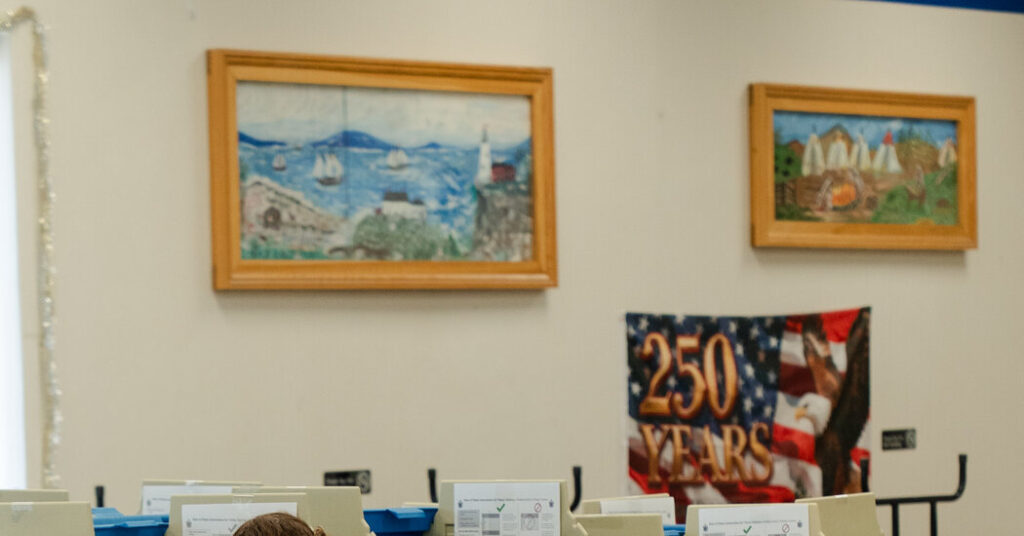
More than 12 hours after polls closed, multiples primary races in Maine — including for the Democratic and Republican nominations for governor, and for a Democratic congressional primary — had not yet not been decided by Wednesday morning.
But the delay was expected because those races featured large fields of candidates. Maine uses a ranked-choice voting system, sometimes referred to as an “instant runoff” election. If a single candidate fails to win at least 50 percent of the vote, the next step is ranked-choice tabulation, which can take more than a week.
According to the secretary of state’s office, the paper ballots and memory sticks from the election will be picked up by law enforcement officers from all 487 municipalities in the state and brought to Augusta, the capital. This is often the most time-consuming part of the process.
The delayed results in Maine follow a protracted vote-counting process in California, which set off unfounded and false claims of fraud from President Trump. But the counting process in Maine is far different from California’s. For example, Maine does not accept late-arriving ballots that were postmarked by Election Day, and its volume of mail ballots is a small percentage of the total in California.
The race to replace Gov. Janet Mills, a Democrat, has drawn little attention compared with the state’s marquee Senate race, in which Graham Platner, a Democrat and oyster farmer, will compete with Senator Susan Collins, the longtime Republican incumbent.
On the Democratic side, four candidates for governor are advancing to the second round of ranked choice: Shenna Bellows, Maine’s secretary of state; Troy Jackson, a logger from northern Maine and former state senator; Hannah Pingree, a former state representative who went on to work for the administration of Ms. Mills; and Dr. Nirav Shah, who led the state’s response to the coronavirus pandemic.
On the Republican side, Bobby Charles, who served in the State Department under President George W. Bush, had a sizable lead early Wednesday but will face two other candidates in the ranked-choice “instant runoff.”
Maine’s Second Congressional District is expected to host one of the most closely watched contests of the general election. The Democratic candidates moving to the next round of ranked-choice tabulation in that race are Joe Baldacci, a centrist Democrat and state senator, and two progressives waging competitive campaigns: Matt Dunlap, the state auditor; and Jordan Wood, a former congressional aide.
Most of the candidates were aware of the timing of the process, telegraphing it to their supporters in primary-night speeches.
“We’re watching the results closely, and while we’re optimistic, we’re obviously waiting until every vote is counted,” Mr. Baldacci said during a speech after polls closed. “And it might take days, maybe even weeks.”
Others are using the tabulation period to take a quick break.
“Obviously, you stay hopeful, but to be perfectly blunt, there’s nothing that I can do from here on out,” Mr. Jackson said during an interview with News Center Maine. “So Thursday, I’m going fishing for four days because I don’t want to sit around and wonder, I don’t want to sit around and agonize.”
As of Wednesday morning, roughly 80 percent of ballots had been counted in the races heading for the next phase of tabulation in Maine. While Maine is slower than some states — South Carolina had more than 95 percent of its ballots counted by Wednesday morning — it is still quicker than California, where the day-after total was below 60 percent in some major population centers.
The ranked-choice system uses successive rounds of counting, eliminating last-place candidates and awarding their votes to a voter’s next choice until one candidate receives more than 50 percent.
Once law enforcement officers have collected all of the election materials from across the state and brought them to Augusta, the data must be uploaded at the secretary of state’s office, including by scanning paper ballots from jurisdictions that did not use tabulators with memory sticks.
But after all the ballots and election materials are in place at the secretary of state’s office, the actual counting is fairly quick. Top election officials expect all ranked-choice tabulation to be completed before the Juneteenth holiday on June 19.
The post Why Complete Election Results in Maine Could Take More Than a Week appeared first on New York Times.