The children swiped fast across the colorful images. Their thumbs flicked from one square to the next, their eyes tracking the images, seemingly hypnotized, pausing only to show one another what had become their class’s viral sensation.
Held tightly in their hands weren’t smartphones, iPads or video game controllers, but motionless, low-tech stacks of paper stickers.
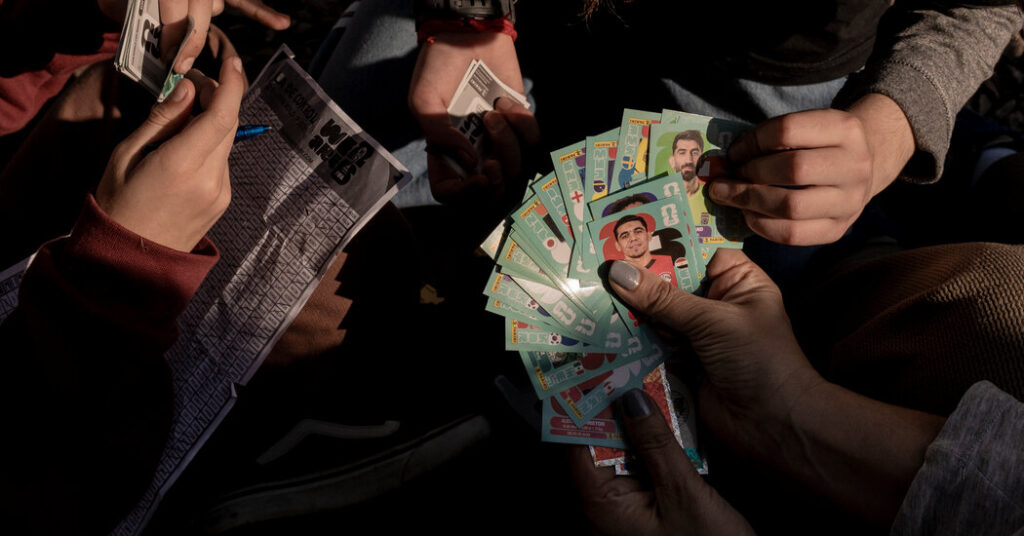
In the weeks leading up to the World Cup, Argentines were hunting to fill sticker albums with the faces of every player on every team competing in the tournament.
Driven in part by a contagious hype, the need to soothe World Cup anxiety in a soccer-obsessed nation and the persistence of an intergenerational tradition, Argentina has been swept by a collecting fever that seems immune to the digital revolution that has obliterated so many other analog pastimes.
For several weeks, Argentine children have left their smartphones untouched for long stretches as they have gathered to swap stickers in schoolyards, parks, supermarkets, shopping malls and below the same ombú trees where their parents and grandparents once met long ago to trade postal stamps and coins.
“This is like a social network,” Dana Blecker, a mother of two, said as she stood on a recent Saturday among a large crowd of elementary schoolchildren trading stickers at a Buenos Aires park. “But an alive social network.”
Barely managing to clench the tall stacks of stickers in their small hands, the children moved from one huddle to another, asking for specific players (“Do you have Julián Álvarez?” a top Argentine player) or nations (“Any from Scotland or Saudi Arabia?”).
Many held handwritten paper sheets on which, in their wobbly calligraphy, they had marked the players they were missing. It took a sophisticated game of bargain and bluff to fill an album — the children tried to hide their excitement over a much-needed sticker not to jack up its value.
Sometimes they solemnly shook hands after they closed a deal.
“I got a Messi!” David Papadopoulos, 13, cheered after swapping 35 stickers for one of Lionel Messi, the captain of the Argentine men’s national team and the most coveted sticker in the country.
Some parents also swapped stickers, the generational divides erased by an aggressive hunt for a two-inch sticky photo of Cristiano Ronaldo, the Portuguese soccer star. Others stood patiently for hours in the winter cold in Buenos Aires, relieved to see their children magnetically attracted to something else other than TikTok.
“To see him like this is amazing,” Estela Rosales, 43, said as her son, Lautaro, 10, flushed with excitement, exchanged stickers with another boy. “I don’t want to see him on a sofa or shut in a room on his phone.”
In Argentina, about 80 percent of children and teenagers use social media every day or nearly every day, according to a recent report by the United Nations Children’s Fund. Around the world, studies have found, excessive screen time among children can contribute to anxiety and depression and decrease attention time.
The authorities in Buenos Aires recently banned the use of phones during classes in schools because of concerns over dropping levels of literacy among children.
Ms. Rosales said she sometimes had to unplug her home’s Wi-Fi to get her son, Lautaro, off YouTube. But since his classmates started filling the soccer album, he did not want to be left out, and joined the sticker-trading operation. Lautaro never liked soccer, Ms. Rosales said, but now, for the first time, she noticed him peering at a soccer match on TV.
“It’s moving to see that they can also copy good things,” she said. “Not just video games and aggressive stuff.”
On a recent morning break at a high school in Flores, a working-class neighborhood in southern Buenos Aires, students flocked to the school’s library, turning reading tables into impromptu game zones where they traded stickers, flipped them, threw them and slapped them in rapid-fire card games.
There is a single official FIFA album that costs about $10 but has room for 980 stickers. Individual packs sell for $1.50, so trying to fill an album can start to add up.
To share the burden, six high school seniors in Flores teamed up to fill an album. Valentín Dieguez, an athletic 17-year-old — who “was the only one who had cash to buy the album,” according to his friend José Bethelmy Silva, also 17 — keeps the communal album in his house. He invited his friends over to add stickers to their album.
“I like to open the packs, glue the stickers, instead of lying down all day on my smartphone,” Valentín said.
Rafael Bitrán, a historian who is considered Argentina’s most prominent collector of stickers, said the evolution of soccer into an international spectacle, as well as the rise of a consumer culture, had contributed to the mass collecting frenzy. But he said the appeal of the activity revealed that something fundamental had not changed over generations.
“A child opening a pack is timeless,” he said. “The mystery of what is going to be inside is the same as 50 years ago,” he added. “It’s magic.”
Argentine child education experts said the sticker album frenzy is just a temporary respite from growing youth challenges like smartphone obsession, isolation and even gambling addictions. But some viewed the offline trend as a reminder that, when given the chance, children can still ditch their screens to engage with each other in person.
“It’s great that this is going viral,” said Marcela Czarny, who founded Chicos.net, a nonprofit focusing on the use of technology among children.
Panini, an Italian firm and the official distributor and publisher of the World Cup stickers album, declined to provide sales figures for the album and stickers, citing business confidentiality.
Panini launched its first FIFA-licensed album in the 1970s. Fans in Argentina have collected albums from the first Argentine victory in the World Cup in 1978 to the golden era of Diego Maradona in the 1980s to Mr. Messi’s heroics in Qatar four years ago, when he again led Argentina to World Cup triumph. This year, it will be the last time fans will see Mr. Messi play for the national team.
Even Argentines struggling to keep pace with a surging cost of living under President Javier Milei’s austerity measures are finding a way to make sure their children aren’t left out of collecting soccer stickers.
Gastón Iturre, 46, a father of five, works as a teacher during the day and drives an Uber in the evenings to make ends meet. He said he was trying to buy as many sticker packs as possible so his children could enjoy the soccer excitement without being burdened by their family’s financial struggles.
“It’s only for a month,” he said. “The World Cup blurs reality.”
The post The Low-Tech World Cup Craze Thriving in the Smartphone Age appeared first on New York Times.