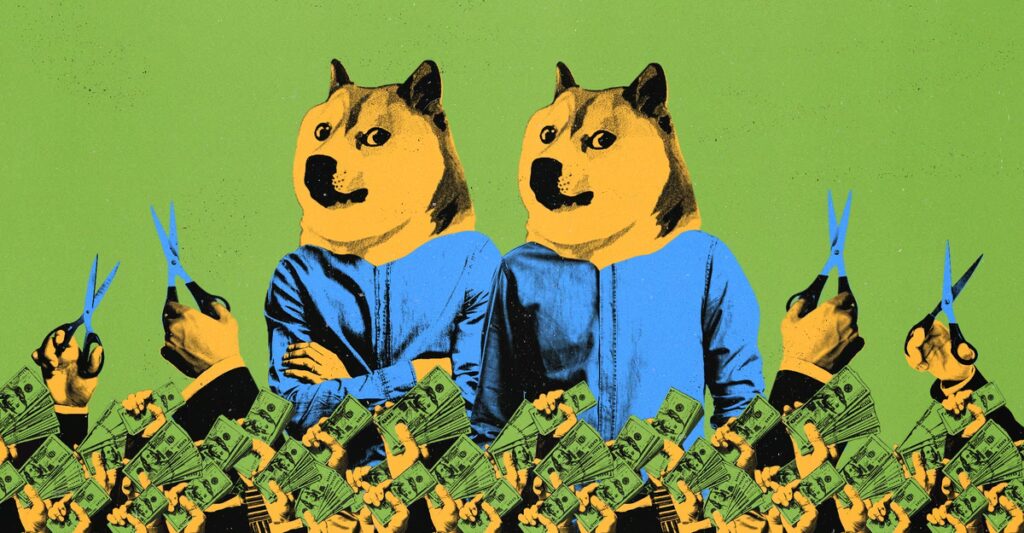
Shooters shoot. Builders build. And DOGE alumni make splashy announcements about entering complex industries with scant qualifications while promising to “root out waste.”
This, at least, is the premise of Special, a newly announced start-up co-founded by Justin Fox and Nate Cavanaugh, two former Department of Government Efficiency staffers who left the federal government “motivated to extend the ethos of our work at DOGE back into the private sector,” as they wrote on Special’s website. The company officially launched last week with funding from the Elon Musk–friendly contingent of Silicon Valley, including the venture groups Andreessen Horowitz and Human Capital. Special is also backed by investments from numerous Musk associates, including Steve Davis, Musk’s top lieutenant at DOGE. The company’s tagline is “You know it when you see it.”
On X, Special’s launch was touted by many of its investors and various hangers-on belonging to a loose tech-right coalition as the beginnings of a supposed “DOGE mafia.” “Incredible team meets amazing mission meets magical time,” Marc Andreessen posted; “Founders are special. Builders are special. America is @Special,” Katherine Boyle, Andreessen Horowitz’s head of American Dynamism, wrote on the platform.
It’s worth pausing here to examine the fundamental premise of Special as DOGE for the private sector. You might have a few questions, including but not limited to: Wait, I thought DOGE was supposed to be about taking private-sector business acumen and bringing it to the bloated public sector? Isn’t the private sector already run like the private sector? How is Special going to run the DOGE playbook inside these companies? Isn’t this essentially just what a consulting firm does? Or private equity? And then, of course: Wasn’t DOGE a deeply unpopular, failed experiment that saved a small fraction of its claimed savings while cutting more than 10,000 government contracts, including lifesaving international aid?
I reached out to Fox and Cavanaugh via Special’s website and their personal accounts but got no responses. According to its website, Special is a “new kind of holding company, building an AI operating system to transform critical American industries.” Special plans to acquire companies inside industries it thinks are broken and inefficient and then use a proprietary AI-powered operating system to “transform the efficiency of these businesses, root out waste, and deliver a great customer experience for American taxpayers.”
As to what that vague mission looks like in practice, Special announced that its first target is elder care, through a second start-up called Figure Health. The website for Figure Health offers little more in way of explanation, citing a three-pronged approach to its service: AI tools streamline operations at senior-care businesses; these businesses use the money saved to increase pay for their nurses; and that, in turn, leads to “better care for seniors.” In an interview last week, Fox seemed to suggest that the company’s tech aims to eliminate health-care busywork, such as note-taking. Figure Health’s website says it will have three locations, “coming soon,” in Dallas, Miami, and Chicago. The careers and locations links on the site appear not to work, redirecting back to Figure Health’s landing page. When I ran images of people featured on the website’s homepage in Figure Health–branded scrubs through an AI-image detector, they came up as “likely created by AI.”
In a blog post about the launch, Fox and Cavanaugh claim that Figure Health is under contract with a health-care company in Texas that “serves over 1,400 patients and employs hundreds of nurses.” They do not name the company. I emailed the contact address provided on Figure Health’s website but did not get a response.
With so few details to go on, I looked to Fox and Cavanaugh’s DOGE tenure to get an understanding of their qualifications. The pair were arguably not as high profile in the department as Musk lieutenants such as Davis or even young staffers such as Edward “Big Balls” Coristine, the then-19-year-old engineer who was granted access to federal payroll systems. (Cavanaugh is 30, and Fox is in his late 20s.) But Cavanaugh, at least, made a name for himself in the spring of 2025, when he was installed as the acting president of the United States Institute of Peace think tank as well as the acting director of the Interagency Council on Homelessness. According to Wired, he put most of both staffs on administrative leave and tried to gift the Institute of Peace’s $500 million building to the federal government. (A court case about the attempted transfer is ongoing; government lawyers defended the move as consistent with an executive order from Trump to reduce the institute’s work as much as possible.)
Fox and Cavanaugh both became better known this year when the American Historical Association published hours of deposition video related to a lawsuit over the mass termination of grants at the National Endowment of the Humanities. According to a court ruling that found those cuts unconstitutional, the two helped oversee those terminations, dividing the grants into categories such as “Craziest Grants” and “Other Bad Grants.” In the deposition videos, which went viral back in March, Fox and Cavanaugh occasionally struggled to define terms such as DEI and admitted to using ChatGPT to scan grants for terms that might be related to DEI in order to find contracts to cut, in keeping with Trump’s executive order to end what the White House dubbed “radical and wasteful government DEI programs.”
Fox and Cavanaugh include clips of their deposition in Special’s launch video—a loud, 65-second supercut that also features file footage of Musk, Theodore Roosevelt, Caitlin Clark, Kobe Bryant, Trump, Muhammad Ali, Steve Jobs, and Margaret Thatcher, set to a Jay-Z song. In the deposition scene, Cavanaugh is asked if he regrets that the people he helped terminate at DOGE lost important income. “No,” he responds, “I think it was more important to reduce the federal deficit from $2 trillion to close to zero.” Conspicuously absent in the edit is the follow-up question from the attorney deposing Cavanaugh, who asked whether DOGE actually managed to reduce the deficit. “No, we didn’t,” Cavanaugh replied.
Special, its AI-powered operating system, and even Figure Health may all be vaporware. It could be a gussied-up version of a private-equity company that plans to buy distressed businesses and flip them for profit, or perhaps Fox and Cavanaugh see a looming elder-care crisis as an untapped market opportunity. Maybe the two want nothing more than to provide better care to American seniors. Given the scant information about the company, I reached out to investors—including Davis; the CEO of Coinbase, Brian Armstrong; and a general partner at Andreessen Horowitz—for additional information, but none responded.
Any altruistic goals would seem undercut by Special’s own branding as the sequel to a Silicon Valley–led boondoggle in Washington. DOGE’s incursion into the federal government was marked by chaos—unnamed staffers, sometimes without proper clearances, barging into government buildings and berating employees while demanding unprecedented access into classified systems. The department was known to operate callously, firing people by email or locking them out of buildings. When it cut programs, it often did so indiscriminately or hastily. In February 2025, Musk said that DOGE had accidentally cut Ebola prevention, then restored it. The systematic dismantling of USAID has led to catastrophic humanitarian situations in Africa, including hampering the global response to the current Ebola outbreak.
DOGE proponents justified any outcomes as a necessary price to pay for eliminating the waste of taxpayer dollars. Special claims that DOGE collectively saved the country hundreds of billions of dollars, but as The New York Times reports, not only did DOGE fail to reduce federal spending by $1 trillion; spending increased on the department’s watch. A Politico analysis of DOGE’s savings last August found that the calculations were “based on faulty math” and revealed that DOGE saved less than 5 percent of what it has claimed. (At that time, the White House refuted Politico’s analysis and defended DOGE’s numbers. In response to a request for comment, Davis Ingle, a White House spokesperson, told me that “President Trump has made significant progress in making the federal government more efficient to better serve the American taxpayer.”)
In his deposition, Cavanaugh says at one point, “I have to believe that the dollars that were saved went to mission critical, non-wasteful spending.” He did not convey particular interest in finding out whether that belief was true or not. A lack of curiosity is a hallmark of the Muskian and Andreessenian way, where building is a universal good and the highest calling. To be a builder is to be high agency, to contribute benevolently to society, to be the man in the arena. (Roosevelt’s inclusion in Special’s sizzle reel is no accident.) In their post announcing Special, Fox and Cavanaugh call the company’s name “a tribute to those we believe are the greatest movers of society—the builders, the creators, the people who put it all on the line and go for it.” This brand of builder has a high tolerance for risk and isn’t afraid to list having empathy or self-introspection as vulnerabilities.
The builder moniker is also a clever way to deflect responsibility for one’s actions. Many builders see critics or writers such as myself as takers, drafting off of their hard work and effort only to belittle it. In their logic, to criticize a builder is to be reflexively anti-progress and to prefer stagnation over iteration. A builder might concede that DOGE did not succeed and still rationalize that the disruption and chaos were still better than the sclerotic alternatives. Admittedly, there is some logic to this mindset. Failure can lead to later success, provided it’s paired with the kind of humble introspection that people such as Andreessen dismiss as weakness.
It’s not just that DOGE was a failure or that its participants refuse to reckon with their role. It’s that the DOGE “builder” ethos is built on a foundational lie. DOGE was not a generative project; it was a destructive one—a smash-and-grab attempt, led by an unelected official who happened to be the world’s richest man, to seize control and precious data, and to turn the federal government into a political weapon. But for all its turmoil, DOGE helpfully illustrated how the term building can also be a euphemism for something else entirely: extraction.
In this sense, Special appears to be continuing in a particular kind of Silicon Valley tradition, offering a benevolent service that disguises the ways it takes from those who use it. Special has only been around a few days, so perhaps it’s unfair to judge Fox and Cavanaugh so soon. But as they themselves note, you know it when you see it.
*Illustration sources: Peter Dazeley / Getty; atiatiati / Getty; silvae / Getty; blackred / Getty; sakchai vongsasiripat / Getty; feedough / Getty.
The post The DOGE Bros Want Another Shot appeared first on The Atlantic.