The war between Iran and Israel and the United States has been an economic catastrophe for Iranians. Their country has lost at least 1 million jobs—possibly 2 million—since the war began. In the same period, almost 300,000 eligible Iranians have signed up for unemployment insurance, and job-seeking websites are so inundated with new applications that they keep crashing.
U.S. and Israeli strikes over the winter degraded Iran’s industrial capacity. At the same time, the blockade that the U.S. imposed on the Strait of Hormuz, in response to Iran’s seizure of control of the waterway, has made life difficult for businesses that rely on imports. So has the continued fall of the Iranian currency: A U.S. dollar now sells for 1.75 million Iranian rials.
The regime compounded these effects with its total shutdown of the internet, first during the mass protests in January and then during the war. Access is now mostly restored, but for many Iranians who relied on the internet for their work, the damage is already done. Iran might end up experiencing a double-digit economic contraction this year—a calamity with little precedent in its modern history.
[Yeganeh Torbati and Bozorgmehr Sharafedin: How Iran killed its economy]
Many Iranians I spoke with last week were acutely suffering. I have withheld their full names to protect them from reprisal for speaking to an American media outlet.
Sara, a 33-year-old graphic designer in Tehran, told me how she was faring economically: “Let me be honest with you,” she said. “I have no idea how I’ll survive.” Until last year, she made something of a middle-class living illustrating and designing book covers and restaurant menus. She had more customers than she had time for, and even though Iran’s currency was continually depreciating, “I had no problem affording the basics and even an occasional vacation,” she said. Now wartime uncertainty has meant that few Iranians are thinking about publishing books or opening restaurants.
“It’s the same news almost everywhere,” Majid, a 27-year-old computer engineer who was laid off during the war, told me. “No jobs and massively increased prices. It basically means we are fucked.” Alireza, a 33-year-old worker at a dairy factory in southern Iran, told me he was let go last month when his factory closed, and he has applied to collect unemployment.
I spoke with a man named Sadegh who sells laptops and other electronic goods. His sector depends heavily on products that pass through the United Arab Emirates. Since the war began, Iran has attacked the UAE repeatedly, including during the cease-fire, and Sadegh told me that the flow of imports from there has stopped. “We used to import 8 to 9 million mobile phones a year, but it has now dwindled to less than 50,000,” he told me. “Obviously this will lead to higher prices.”
The U.S. and Israel struck steel-production complexes in central Iran and petrochemical facilities on the Persian Gulf, putting tens of thousands of workers immediately out of work. The downstream effect of these strikes is even broader. Manufacturers of car parts and building materials, for instance, relied on domestic steel and can’t operate without it. Other industries, including those involved in producing food and medicine, relied on petrochemicals to produce crucial components, such as plastic pipes, an engineering expert told me.
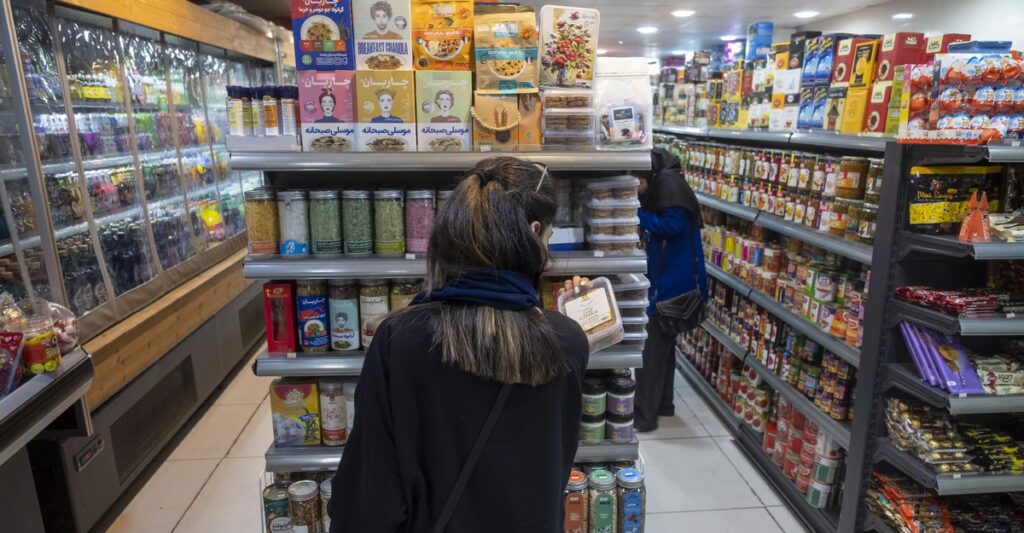
Iran’s inflation is now near 85 percent, according to official data. But the rate is much higher—130 percent—for food products. For edible oils, the inflation rate is 266 percent; for meat and chicken, 169 percent; and for eggs and dairy products, 161 percent. Bread, cigarettes, cars, and furniture have seen a similar triple-digit rise. Public transportation in Tehran has been offered for free during the war, but this is likely to end soon, and taxi and intercity bus fares are up 21 percent. This is not surprising, considering that gas, tires, and car parts have become ever scarcer and pricier.
The price increases have transformed people’s lifestyles. The unemployed dairy worker told me he had trouble affording even the most basic provisions, such as eggs and bread. A retired teacher I spoke with said she’d given up on cooking meat or chicken. Sara and Majid both said that they had considered canceling their phone plans or selling their furniture. Across Tehran, billboards now advertise installment plans to pay for basic goods. Many consumer products cost roughly what they might in the United States, but the mandated monthly minimum wage in Iran (after a recent 60 percent increase) is now about $100, and many workers earn much less than that because they rely on part-time and contract work.
The government has offered little relief, even to Iranians whose homes were destroyed in the war. It has extended loans to small companies (those employing fewer than 50 people) amounting to $125 per worker. But this hardly offsets the drop in consumer demand and the increase in the cost of doing business.
Some analysts outside the country emphasize Iran’s military resilience and downplay its economic vulnerability. Just last week, the anthropologist Narges Bajoghli and the political scientist Vali Nasr argued in Foreign Affairs that Iranians’ economic woes are less salient than they were before the war—that the Islamic Republic has succeeded in reducing the gap between regime and society in part because popular economic complaints have been “subordinated” to the exigencies of conflict.
[Karim Sadjadpour: The vulture’s advantage]
But economists and ordinary citizens inside Iran seem to see this rather differently—and to know that unless Iran takes measures to reverse its economic decline, it will continue to face political crises.
Writing in the Iranian press, many economic experts acknowledge the hole the country finds itself in and advocate that Iranian negotiators strike a deal with the U.S. that not only ends the American blockade but also promises to lift international sanctions on Iran. They point out that the country also needs structural economic and political reform to address its endemic corruption and economic mismanagement. The economist Mohammad Mehdi Behkish wrote in a Tehran daily about the urgency of getting the U.S. blockade lifted and restoring relations with the UAE, if Iran is to regain access to basic goods and avoid social unrest. Another economist, Zahra Karimi, made a plea in an op-ed earlier this month for regular trade with advanced countries so that Iran can access the technology and machinery it needs for its growth.
Iran has withstood immense military pressure for months and claims triumph on the battleground. But its tattered economy remains its Achilles’ heel.
The post The Crisis Iran’s Leaders Can’t Ignore appeared first on The Atlantic.