Federal immigration enforcement is set to receive billions more in funding after congressional Republicans approved a measure that would fund it until the end of President Donald Trump’s term.
The House on Tuesday voted along party lines, 214-212, to pass a $70 billion bill that would fund Immigration and Customs Enforcement and Border Patrol. The Senate approved the measure last week, so the bill now only needs Trump’s signature.
Its passage breaks a monthslong partisan impasse in Congress over immigration policy. Following the deaths of Alex Pretti and Renee Good at the hands of federal agents in Minnesota earlier this year, Democrats sought to block additional funding for ICE and Border Patrol—at least not without codifying reforms to immigration enforcement. The result: a 75-day partial government shutdown affecting the Department of Homeland Security (DHS).
That shutdown largely ended in April, when Trump signed a bill funding DHS agencies that didn’t fall under immigration enforcement, as both parties in Congress tried to negotiate the details of separate funding for ICE and Border Patrol. But those negotiations collapsed, and the GOP eventually resorted to the budget reconciliation process, which allowed them to pass legislation to fund the agencies while bypassing a potential Senate filibuster.
Both chambers tried to pass the funding legislation early to meet Trump’s self-imposed June 1 deadline. But that plan was overshadowed by the President’s request to secure $1 billion for his White House ballroom project and a since-scrapped $1.8 billion fund that critics claimed would have been doled out to Trump’s supporters and allies, including potential participants in the Jan. 6 Capitol attack; both measures sparked disagreements within the GOP and prompted rare pushback.
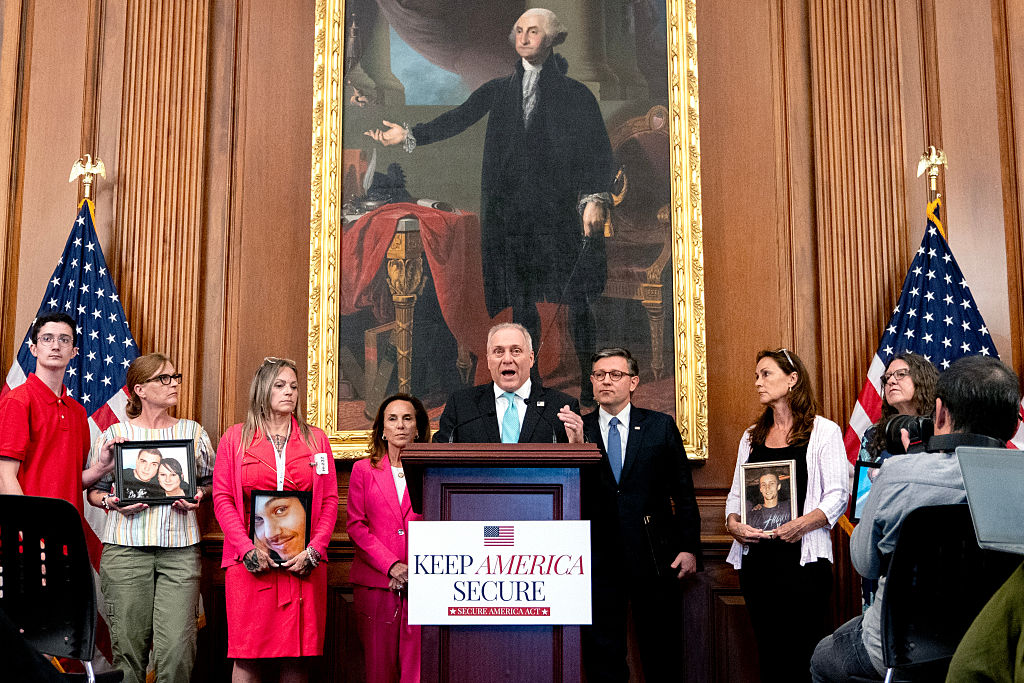
But Republicans united to pass the immigration funding on Tuesday. Speaker Mike Johnson said the House vote ended “the Democrat Department of Homeland Security shutdown once and for all,” and that Republicans have “taken away” the Democrats’ ability to “take hostage” immigration-related funding for the remainder of the Trump Administration.
What’s in the bill?
While most measures grant funding only for a specific fiscal year, the legislation dubbed the “Secure America Act” provides lump-sum amounts that cover ICE’s and Border Patrol’s potential spending until Sept. 30, 2029, the end of that fiscal year.
The legislation further inflates ICE’s usual $10 billion annual budget. The agency already received a $75 billion windfall from Trump’s “One Big Beautiful Bill” Act last year, which made it the most heavily funded law enforcement agency in the federal government. But under the reconciliation package, ICE is set to receive another $38.5 billion to hire, pay, and train personnel over the three years—including $7 billion for Homeland Security Investigations agents.
Customs and Border Protection, meanwhile, will receive $22.6 billion to hire, pay, train, and equip border patrol agents and border support personnel. On top of this, $3.5 billion will be allocated for technology improvements needed for border security.
Another $5 billion will be made available for Homeland Security Secretary Markwayne Mullin to spend at his discretion.
The large funding allocation has raised concerns that Congress has virtually ceded oversight of immigration enforcement operations and spending. Sen. Lisa Murkowski (R, Alaska), the lone Republican to vote against the measure, wrote in a statement Friday that appropriating funding for three fiscal years instead of the usual one “reduces Congress’ ability to apply reasonable checks on immigration policy for the remainder of this Administration and into the next.”
What’s out?
To Democrats’ disappointment, the bill passed without imposing any new restrictions on how immigration agents should operate. Throughout the standoff, Democrats wanted to mandate body cams on officers, bar them from wearing masks during enforcement operations, and require judicial warrants before they could enter homes, among other reforms.
Moreover, with the package covering three fiscal years, Democrats cannot use future budget appropriations processes to exert pressure on these immigration agencies until after Trump leaves.
But the bill is not a total victory for the Trump Administration. It also excluded an originally planned $1.5 billion for the Justice Department, following the controversy over the $1.8 billion “anti-weaponization” fund, which the Administration has said that it will no longer pursue, though the bill has no clauses explicitly ruling it out.
Another $1 billion of additional funding for the U.S. Secret Service also failed to make the legislation. The funding would have been used for security-related upgrades related to the White House ballroom project, but even some GOP lawmakers scrutinized the addition. The Senate parliamentarian ultimately ruled that the additional funding violated the Byrd Rule, which prohibits “extraneous” provisions from being tacked onto reconciliation bills.
The post What’s In—and Not In—the Immigration Enforcement Funding Bill Congress Passed appeared first on TIME.