Times Insider explains who we are and what we do and delivers behind-the-scenes insights into how our journalism comes together.
As a space reporter for The New York Times, I follow what’s happening in the stars, including eclipses, meteor showers and brilliant displays of aurora borealis. But I live in Chicago, a city so bright it washes out the night sky. Many of these experiences are out of my reach.
So when I heard about a four-day stargazing jamboree in Michigan’s Upper Peninsula — the rugged northern part of the state — I knew I had to go.
The region is a Midwestern crown jewel for dark skies. But as much as its residents wish to protect that natural resource, many also lack the means to survive underneath those views. New opportunities are often tied to industrial development like mining, which some fear will bring light pollution that will shroud the stars.
The issue highlights a broader trend in the United States. More than 99 percent of Americans live under light-polluted skies, with views impeded by urban and industrial development that has vastly improved our quality of life. But that has also come with the loss of unfettered access to the stars, which some dark-sky advocates argue is a human right.
I visited the U.P. in September to report on the balance between economic growth and the preservation of natural darkness. Lush forests of beech and birch were just beginning to turn from summer green to the reds, pinks and yellows of fall — hues that, on some nights, are also spotted above, as ribbons of northern lights.
The sky was cloudy on my first night in town. The next evening, Emily Elconin, a Detroit-based photojournalist, and I met with a group of stargazers in Keweenaw County, the northernmost tip of the U.P. We made plans to drive to a popular dark-sky site by caravan, since cell service in the region was spotty, if available at all. Emily and I spent half an hour behind a line of vehicles moving north, on winding roads devoid of streetlights.
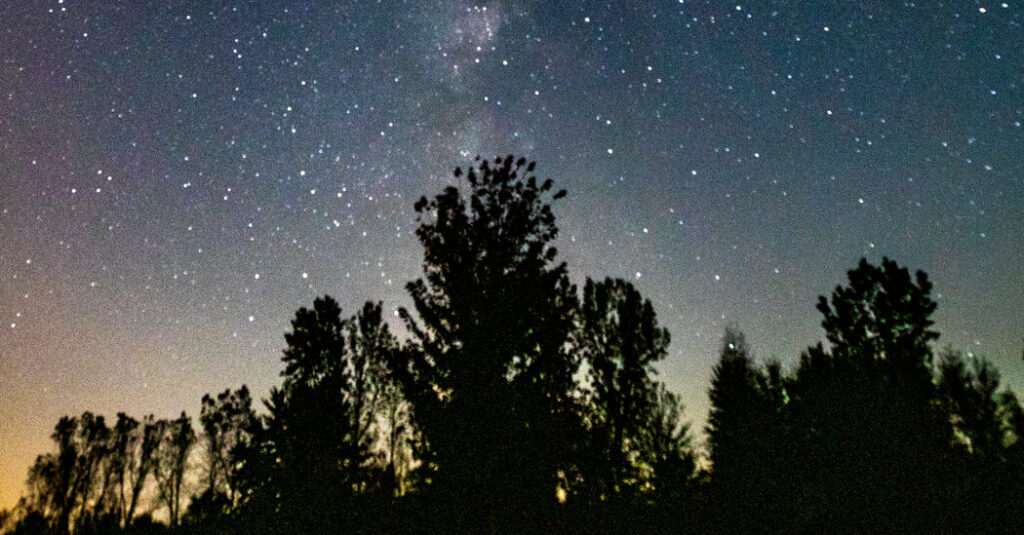
Once we parked, our anxiety at getting left behind immediately dissolved into awe at the heavens, which were jampacked with glittering stars and a patch of what looked like clouds. (We soon realized that was the Milky Way!) The sight was spectacular, even before our eyes adjusted to the night.
During my reporting, James Lowenthal, an astronomer at Smith College, described seeing the night sky in its full glory as akin to seeing a tree, the ocean or a rainbow for the first time. People “just can’t believe it,” he said. “They don’t know what they’re missing.”
That was certainly true for me. I couldn’t recall the last time I had seen the night sky like that — not while growing up in central Arizona, a state known for its vast, clear skies, nor when reporting from the Atacama Desert, one of the darkest places on earth, where clouds robbed me of the view.
My fascination with the universe began decades ago, stirred by the stars and planets I learned about in classrooms and planetariums as a child. That spark reignited in college, and eventually led me to pursue a Ph.D. in particle physics, during which I helped probe the secrets of nature through its tiniest constituents. But the daily tasks of that work were far removed from the way humans once experienced the cosmos. The particles I studied — neutrinos — were most tangibly lines in a code, and my efforts to help decipher the universe were confined to a laptop screen.
Seeing the dark sky in the Upper Peninsula reminded me of my early cosmic wonder, and also of why I became a journalist — to share that feeling with others. On a beach of Lake Superior, miles from city glow and cell service, I understood why our ancestors made art and told myths inspired by the night sky. I spent nearly an hour with other stargazers just looking up, pointing out constellations and meteors streaking across the sky, the way humans have done for thousands of years before us.
As we made our way back to civilization, Emily, a newfound astrophotographer, mentioned that she had never in her life seen so many stars. Like me, she was suburban born and bred, now living in a big city. “I’m hungry for more,” she wrote me later in a text. “I’m a changed woman, and now I want to see all of it.”
Katrina Miller is a science reporter for The Times based in Chicago. She earned a Ph.D. in physics from the University of Chicago.
The post A Dark Sky Paints the Stars in a New Light appeared first on New York Times.