In April, NASA’s Artemis II mission sent four astronauts — Reid Wiseman, Victor Glover, Christina Koch and Jeremy Hansen — to the vicinity of the moon for the first time in more than half a century.
That mission was also historic because of what the crew looked like. Mr. Glover was the first Black man to fly near the moon, and Ms. Koch became the first woman. Jeremy Hansen, the fourth Artemis II crew member, was the first Canadian.
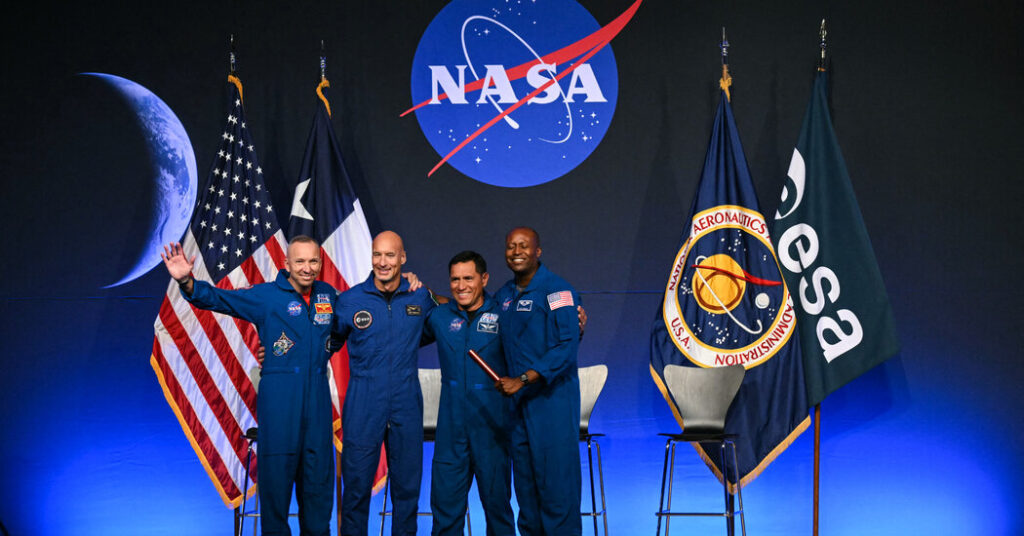
The Artemis III astronauts, which NASA named on Tuesday, will be Randy Bresnik, Luca Parmitano, Frank Rubio and Andre Douglas. Dr. Douglas is Black, Mr. Rubio was the first astronaut of Salvadoran descent to go to space and Mr. Parmitano, who is Italian, is the European Space Agency’s first representative on board an Artemis program mission. But there are no women on this crew.
“I don’t think anyone should be reading into this,” Jared Isaacman, the NASA administrator, said at a media briefing following the Artemis III announcement. NASA “put forth the best astronauts to undertake and complete the mission’s objectives.”
He did not provide insight into how the astronauts were chosen, but added that the last astronaut candidate class initiated by NASA had more women than men.
NASA once committed to land the first woman, the first person of color and the first non-American astronaut on the moon. But it removed that pledge from its website weeks after the Trump administration initiated a federal crackdown on diversity, equity and inclusion initiatives in early 2025.
The Artemis III astronauts will not go to the moon. Instead, they will fly to low-Earth orbit to test rendezvous and docking maneuvers with one or two lunar landers. These maneuvers will be used during a future moon landing, which NASA hopes to attempt in 2028.
Here’s what to know about the new crew.
Randy Bresnik, Commander
Randy Bresnik, the Artemis III commander, is the old man of the crew. He joined NASA in 2004, and he is the only one who flew on a space shuttle — a two-week mission on Atlantis in 2009 — before those vehicles were retired. Later, Mr. Bresnik was the lead astronaut on the “closeout crew” for the Space Shuttle Program’s final mission in 2011.
Mr. Bresnik also spent 4.5 months in orbit in 2017 as a crew member on the International Space Station.
Before NASA, he was a fighter pilot in the United States Marine Corps. Across several deployments, he logged more than 7,000 hours in various types of aircraft — and 3,600 hours in spacecraft.
From 2018 until his selection as part of the Artemis III crew, Mr. Bresnik has been serving as assistant-to-the-chief of the Astronaut Office for Exploration, helping to develop and test vehicles for the Artemis program.
Luca Parmitano, Pilot
Now the pilot for the Artemis III mission, Luca Parmitano became well known for a mishap during a 2013 spacewalk. After beginning a planned six-hour spacewalk, Mr. Parmitano’s helmet started filling with water because of an issue with his spacesuit’s liquid-based cooling system.
Mission Control quickly terminated the spacewalk, and despite the water in his helmet blurring his vision, Mr. Parmitano was able to safely return to the International Space Station.
After referencing the ill-fated spacewalk, Joseph Achbacher said during the crew announcement that Mr. Parmitano will bring “Italian ease” to the high-stakes Artemis III mission.
Mr. Parmitano will be the European Space Agency’s first representative on board an Artemis program mission. He began his career as a test pilot and then colonel with the Italian Air Force, and has since spent 367 days in space so far, including during his most recent mission: serving as the first Italian commander of the International Space Station in 2019-20.
“I’m very humbled by the task in front of us, but first and foremost I’m grateful,” Mr. Parmitano said.
Andre Douglas, Mission Specialist
After serving as a backup crew member for the Artemis II mission, Dr. Douglas will finally have a chance to go to space himself.
A native of Chesapeake, Va., he will serve as one of Artemis III’s mission specialists. Dr. Douglas was first selected as an astronaut in 2021 following a career serving in the U.S. Coast Guard and then as a senior professional staff member at the Johns Hopkins University Applied Physics Lab.
When Artemis III enters low Earth orbit, it will be Dr. Douglas’ first time in space. He is the only crew member for whom it will be the first time venturing beyond Earth.
“Mom, thank you so much for believing in me,” Dr. Douglas said during the crew announcement at NASA’s Johnson Space Center in Houston.
Frank Rubio, Mission Specialist
Mr. Rubio’s last trip to space was an extended adventure. In September 2022, he traveled in a Russian Soyuz capsule to the International Space Station, expecting to stay there for six months. But then, while docked to the space station, the Soyuz suffered a coolant leak. Dr. Rubio — a physician by training — had to remain on the station until a replacement Soyuz could be sent up.
That created a problem if the space station had to be evacuated. NASA did not believe the damaged Soyuz was safe enough for the astronauts. A temporary seat was created for Dr. Rubio on a SpaceX Crew Dragon spacecraft that was also docked to the space station.
Dr. Rubio finally returned to Earth in September 2023 after 371 days, the longest single continuous stay in space by an American astronaut.
Before joining NASA in 2017, he served as an aviator and a physician in the United States Army. He flew a Black Hawk helicopter during deployments to Bosnia and Afghanistan.
The post Meet the Astronauts of Artemis III appeared first on New York Times.