(3.5 stars)
Every Steven Spielberg film about the sky has felt like a question directed at the universe. “Disclosure Day” is a question aimed squarely at us, and it feels like he’s impatient for our answer.
Spielberg’s father once woke him in the middle of the night for a drive to a New Jersey park to witness a sky full of meteors. He’s been chasing that feeling of terror and wonder, when the universe reminds you that it is far larger than our understanding of it. “Disclosure Day,” which opens Friday, is his attempt to chase it one more time.
He calls it a bookend to “Close Encounters of the Third Kind,” and that framing is generous to both works. “Close Encounters” remains the superior work, a masterpiece drunk on wonder. But “Disclosure Day” is more in conversation with “Minority Report,” Spielberg’s 2002 summer blockbuster that challenged the mind and asked what humans would do with more information than we’re meant to have. “Disclosure Day” asks what it means when such information belongs to everyone on the planet.
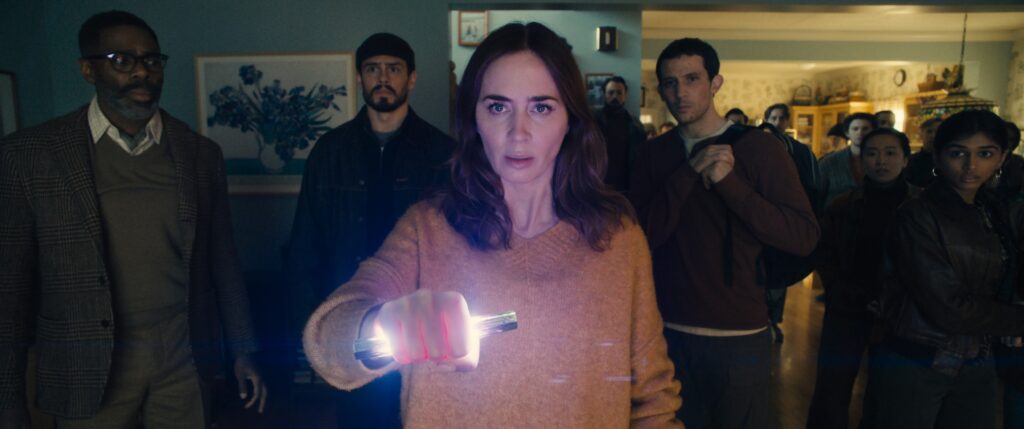
The film’s emotional anchor is Emily Blunt, playing Margaret Fairchild, a Kansas City journalist and meteorologist whose careful, professional and curated life begins to fall apart in spectacular and often hilarious ways. Something in her is suddenly rewired. She perceives people differently now, more completely, in ways that empower her as much as they unsettle her and everyone around her, including her hapless boyfriend, played by Wyatt Russell.
She is genuinely funny in ways only dramatic characters can be, because the comedy is rooted in her character’s sanity straining against an unbelievable situation. She tries to destroy her smartphone before she can be tracked and asks her bewildered partner to run it over, only for him to fail. She has to get out and reposition it herself. That gap between what she knows and what she can’t explain is the film’s comic engine, and Blunt runs it at full throttle.
Her performance is mercurial, moving effortlessly between terror, confusion and deadpan comic frustration. Spielberg characters have always felt so real that they’re like family, and Margaret is another classic lead.
Our other hero is Daniel Kellner (Josh O’Connor), a cybersecurity expert on the run who carries the film’s central revelation, that the government and its contractors are hiding the existence of aliens from the world. Spielberg, refreshingly, lets us know what Kellner knows early. The film is more concerned about transmission and transparency: How do you make people understand something that shatters everything they thought was true?
His girlfriend, Jane (Eve Hewson in the other standout performance), is a former nun who anchors these questions ably, but sadly she doesn’t stay very long in a story with a busy, rotating cast of heroes and villains — including the main antagonist, Colin Firth as Noah Scanlon, the head of defense contractor Wardex.
Firth and his rather large team of villainous agents feel busy but largely play one note as obstacles. The story gestures at the reasoning for Scanlon’s obsession with secrecy but doesn’t commit to it. The story and the camera are mostly concerned with the heroes, and they carry the film’s 145-minute run time.
The action sequences in service of this chase are Spielberg at his most kinetic. Spielberg’s longtime cinematographer, Janusz Kaminski (“Saving Private Ryan”), plants a camera inside a house as Kellner’s car tears through the wall. In a single shot, we watch him scoop up Jane into the vehicle while agents framed through the wall’s rubble run toward them and the audience. In the next cut, the car erupts out the other side, and the shot cranes from ground level to overhead as black cars swarm behind Kellner, compressing the chase into a single, vertiginous image. The danger transforms from human to systemic in one glorious sweep.
The third act leans on some convenient storytelling that relies on MacGuffin items and coincidences that announce themselves a little too loudly. But Spielberg’s concern here is emotional arrival, not satisfying plot mechanics. “Disclosure Day” feels like a story about what we owe each other in a world that’s spent generations organizing itself around comforting lies, and whether the truth will break or connect us. These characters, including Wardex defectors that assist the pair, believe with boundless sincerity that people deserve the truth.
It’s a film about how the upheaval of everything we know is not a tragedy in waiting but the opening to a new way to live. This is not a disaster film because Spielberg doesn’t believe disclosure is a catastrophe. His renewed interest in aliens and disclosure stems from a 2017 New York Times article on the Pentagon’s secret UFO program. It’s clear he has deep love for the real-life community of truth seekers. He refers to people who made contact as “experiencers,” a well-known term among believers.
Spielberg’s story isn’t conspiratorial. It’s a spectacular tale about what we see, what we hear, and how both can change what we believe and how we treat each other. By the final frame of this beautiful, immersive film, you realize it’s a plea.
PG-13. At area theaters. Contains some bloody images, violence and strong language. 145 minutes.
The post ‘Disclosure Day’ is Spielberg’s beautiful plea to all of us appeared first on Washington Post.