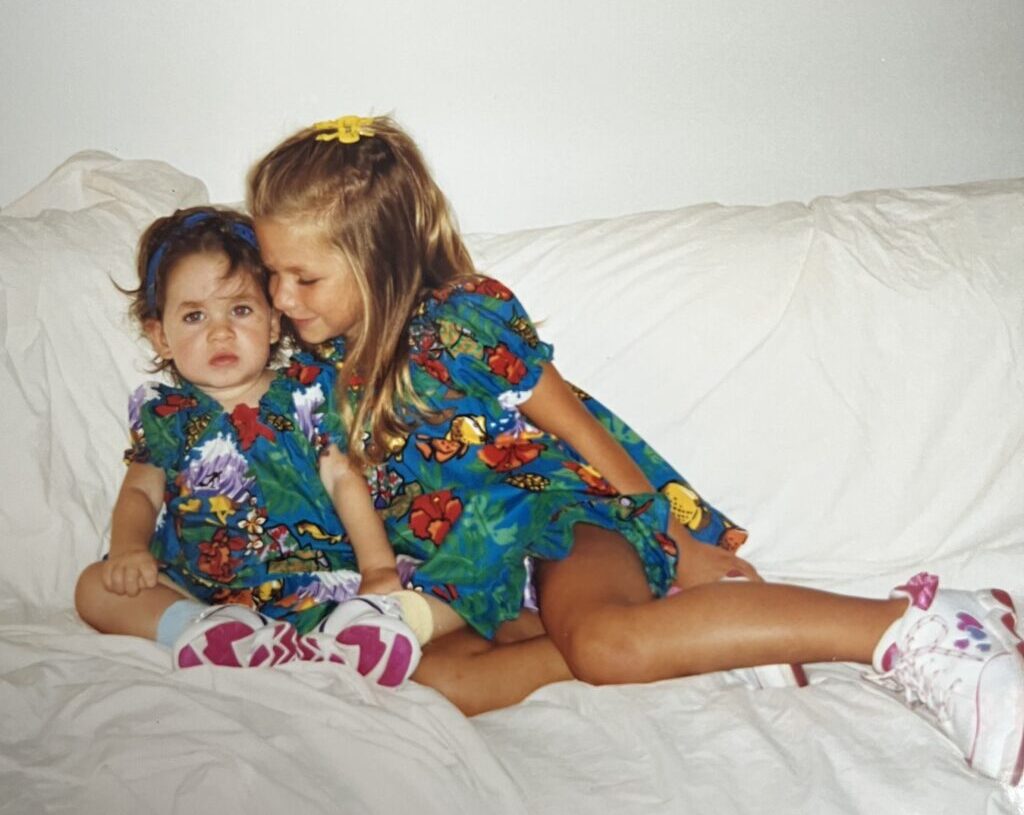
From a young age, I realized that my connection with my sister was fundamentally and profoundly different from my peers’ relationships with their siblings. Skye, who is two and a half years younger than I am (we’re 31 and 28), falls on the severe end of the autism spectrum disorder (ASD). This means she requires very substantial support, i.e., 24/7 care.
Skye is nonverbal, though that term can mean different things even among clinicians and researchers who specialize in autism. That’s, in large part, because there aren’t any universal clinical guidelines that define exactly what qualifies as nonverbal.
“It’s a mess,” said Catherine Lord, the George Tarjan Distinguished Professor of Psychiatry and Education in the David Geffen School of Medicine at UCLA, whose work focuses on autism and related disorders.
Part of the confusion is that some people who can say a handful of words are still classified as nonverbal, though the term minimally verbal may be more appropriate, Lord said. Some disability advocates also argue that nonspeaking is more accurate, as it pertains to words rather than other verbal noises or vocal stimming, a common self-soothing technique for people with autistic that involves making repetitive sounds or noises.
In Skye’s case, she used to trill “mamama” or “dadada” as a child, but as she got older, those inklings of speech have been replaced by audible groans, grunts and sighs.
Recently, one of my friends asked me, “How do you connect with Skye if she can’t talk?” I thought, Well, that’s easy — there are plenty of things we do together that naturally don’t require much speech. I’ve had the privilege of growing up with her and, to the best of my knowledge, learning what she needs from her body language and facial expressions.
But to someone who hasn’t, it can be hard to imagine how that type of connection is possible.
“A lot of the way we relate to people is through words,” said Walter M. Zahorodny, a pediatric psychologist at Rutgers New Jersey Medical School, who tracks autism prevalence in the New Jersey Autism Study (NJAS). Without words, it places greater emphasis on connecting with that person through “nonlinguistic means, techniques or interactions,” he added. “Sometimes it’s hard to understand the clues or the subtle signals, but if you spend time and you’re open, I would think the person will lead you to that.”
Which, I realized after talking to these experts, is what I’ve been doing my whole life without thinking twice about it.
While I may never know for sure whether our time together is as meaningful to her as it is to me, here are the things we do to bond, without anyone needing to say a word.
Going on sensory-based outings
When I go home to Columbus, Ohio, one of my favorite things to do with Skye is take her on a one-on-one outing. For years, our shared activity has been going to Polaris Fashion Place mall during off-peak hours so she wouldn’t feel overstimulated by shoppers and big crowds. We get an iced Starbucks green tea with a splash of lemonade and walk, her hand in mine, at our own slow, comfortable pace.
I’ll usually take her into a few stores, namely ones with soft blankets on display or those that offer other fun sensory opportunities. At Bath & Body Works, I carefully remove the tops of candle jars so she can smell each one.
I can tell by the way her brows furrow if she doesn’t like the candle I select for her to sniff. In those moments, I try to acknowledge that reaction by squeezing her shoulder or laughing softly, letting her know I understand that one wasn’t her favorite.
Apart from just acknowledging their emotions, Paige Siper, chief psychologist of the Seaver Autism Center for Research and Treatment at Mount Sinai in New York City, also recommended praising specific behaviors that make you feel connected to your loved one. “For example, if you lock eyes, even for a moment, you say, ‘I love it when you look at me.’ Or, if your loved one makes any sound, ‘I love hearing your voice!’ or notice moments of joy, ‘I love seeing your smile!’” she said.
When Skye and I go on our outings, I also make it a priority to let her know that I’m having a great time through my body language and facial expressions, as I’m not always sure that descriptive speech will resonate.
Watching her favorite shows and movies together
Some of my closest relationships are with the people I can sit next to without saying a word. I’ve always loved watching movies with my parents and Skye, so when she comes home after a long, activity-filled day at her center, I know the last thing she wants to do is another mentally and emotionally draining activity, such as going on an outing.
In those moments, it feels best to sit quietly beside her on the couch while she rocks in her cushioned recliner — something I know soothes her and calms her nervous system.
“Sometimes we feel better if we talk, but often we talk too much,” Lord said, noting that people who are minimally verbal or nonverbal may not always want to connect through conversation in the way neurotypical people expect. One of her patients, a man in his 30s who’s minimally verbal, prefers expressing himself through facial expressions because speaking requires significant effort. “For him, talking is work,” Lord said. “Whereas for me, talking is an expression of how I feel.”
For people like Lord’s patient and Skye, talking isn’t always the primary way to let someone know you’re present, that you care, and that you’re enjoying spending time with them. “Even if you’re both looking at something and you both like it, that counts,” she said.
Helping her with self-care
One of my favorite ways to connect with Skye is by helping her fill in the mobility gaps that prevent her from caring for herself independently. She also has cerebral palsy, so she needs someone to brush her hair, wash her face, brush her teeth and help her get dressed, for example.
Growing up, these small acts of service felt second nature to me, and candidly, I didn’t think about them. Now, as an adult, I look forward to these moments when I can jump back into old routines and help pick out Skye’s outfit or take the lead on what her hairdo will be for the day.
Something Siper said really resonated with me: “Brief moments of connection are incredibly powerful and can be unpredictable or inconsistent.” When I sit next to Skye on the couch, I’ll periodically reach over with a water cup and support it as she takes a sip, which might be one of the briefest interactions we share. I do this spontaneously, with no real cadence or rhythm, unless she lets me know she wants another sip by gently tapping my hand.
Over the years, I’ve learned I can often sense when she needs something, even if she can’t verbalize it. And in those small, effortless moments, I feel like we’re aligned.
The post My sister is autistic and nonverbal. Here are 3 ways I connect with her. appeared first on Washington Post.