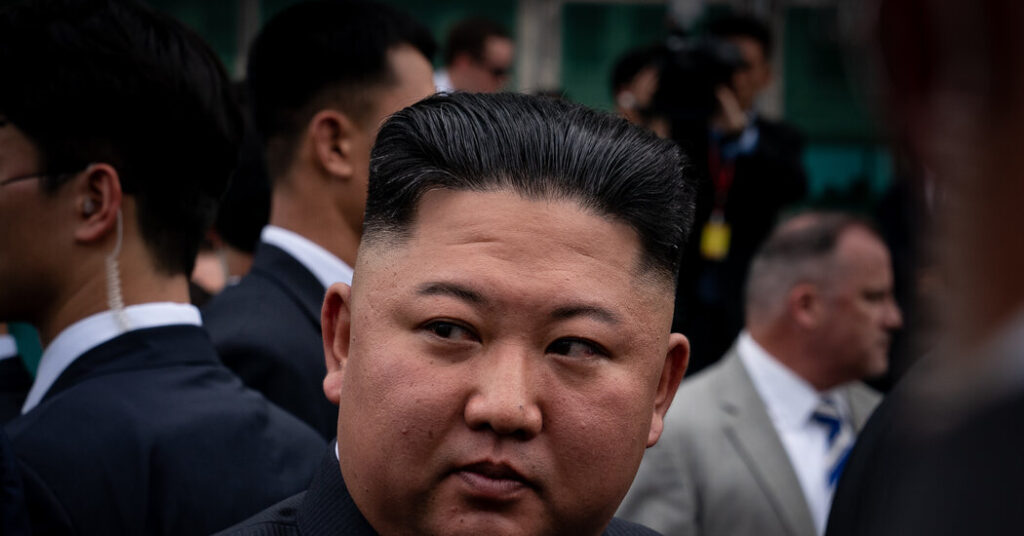
President Xi Jinping of China doesn’t make that many trips abroad. He also isn’t used to going to North Korea to see Kim Jong-un. Most of the time, Kim goes to Xi.
So it says something that Xi is in Pyongyang this week. He’s visiting at a time when Kim, by most accounts, is feeling pretty smug. His decision to develop nuclear weapons seems to have paid off — just look at Iran. So has his choice to invest in his relationship with Russia — which may be why China’s president is feeling the need to remind Kim who is the junior partner here.
How do we know all this? My colleague Choe Sang-Hun, our Seoul bureau chief, spoke with defectors, scrutinized state media and pored through leaked regime documents to get a sense of what’s happening inside one of the world’s most secretive countries. Today, he writes about how Kim became North Korea’s most powerful leader to date.
The triumph of Kim Jong-un
By Choe Sang-Hun
During the coronavirus pandemic, the North Korean leader, Kim Jong-un, made a teary-eyed apology on national television.
“I am really sorry,” he said. “My efforts and sincerity have not been sufficient enough to rid our people of the difficulties in their life.”
The apology shocked observers. This was North Korea, after all, where the supreme leader is traditionally revered as an infallible, godlike figure.
But times were dire, even in a country used to hardship. The coronavirus, food shortages and international sanctions were all taking a toll. Around this time, reports began emerging from North Korea of a nation sinking into despair — citizens who, as one analyst with internal contacts put it, “saw no way forward, didn’t know how they were supposed to live on.”
Today, Kim is in a very different mood. At his Workers’ Party congress this year, he triumphantly declared that North Korea was in a glorious and prosperous new era, a far cry from his weepy apology in 2020. People can now hope to have “both sweets and bullets,” the party said, referring to its policy of seeking both economic recovery and military prowess. North Korea is a de facto nuclear power, and Kim is viewed as the country’s most powerful leader to date.
And he couldn’t have done it without the war in Ukraine.
A surprising opportunity
The economic tailspin of the pandemic era was partly the result of Kim’s own actions.
Kim used the pandemic to tighten his grip on North Korean society. He shut down the border with China, clamping down on trade and smuggling. He targeted the informal markets where many once eked out a living trading Chinese goods and foreign entertainment smuggled in on thumb drives; the penalties for those consuming and distributing what he deemed anti-socialist content included execution by firing squad.
These moves helped stamp out foreign influence. They also meant that what few economic opportunities ordinary North Koreans had disappeared.
“We were not allowed to make money,” one defector, who fled to South Korea in 2023, told me. “He tightened the noose on his people, as if he didn’t want them to have a better life.”
But Kim was making plans to revive the economy — and, this time, to keep it under state control. He collected wages earned by North Korean workers in China, who continued to work for the government during the pandemic. He unleashed an army of hackers to steal billions of dollars’ worth of cryptocurrency.
Then Russia invaded Ukraine in 2022 — and Kim saw an opportunity.
North Korea’s munitions factories roared to life to supply the Russian war effort. About 16,000 North Korean troops have fought in the war. Workers were also sent to Russia to earn cash for the regime.
In exchange, Russia sent back new weapons technology, along with badly needed food, oil and tourists. The two nations even signed a mutual defense and cooperation treaty.
In 2024, North Korea’s economy is estimated to have expanded 3.7 percent, the highest growth rate in eight years.
The new Russia-North Korea partnership has undermined international sanctions efforts, which have been a crucial lever for influencing North Korea’s behavior in the past. It has also helped Kim gain leverage with China — by far North Korea’s biggest trading partner — which had earlier joined the United States in imposing severe sanctions.
China’s president, Xi Jinping, arrived in North Korea on Monday for a two-day state visit, his first in seven years. According to the Chinese government, during his meeting with Kim, Xi called for a united front between China and North Korea against American influence and offered to expand “practical cooperation” between the two countries.
Smartphone apps and spa resorts
There have been clear signs of economic improvement across North Korea in the past few years, although poverty endures outside Pyongyang.
Kim has finished some of his long-delayed pet projects, such as developing seaside, ski and spa resort towns. New apartment towers have gone up not only in Pyongyang but also in provincial cities.
In the capital itself, which was once dimly lit at night, neon signs blaze brighter than ever. High-rise apartment towers operate their elevators for at least a few hours a day, according to recent defectors and visitors. There are more gas stations and more privately owned cars. Families use smartphone apps to shop and order food delivery.
Any notion of renewing talks with President Trump on denuclearization or reconciling with South Korea seems long gone. Instead, Kim wants to be recognized as the world’s newest nuclear power. “North Korea has the most leverage today that it has had in the last 30 years,” one former Korea expert at the Pentagon said.
Addressing North Korea’s rubber-stamp parliament in March, Kim spoke of a “miraculous transformation.” He pointed to manifold increases in investment and sweeping, large-scale residential construction. And he underscored what all this newfound prosperity had bought.
North Korea, he said, “is no longer a country that is susceptible to threats from others.”
Read Sang-Hun’s full story here.
MORE TOP NEWS
-
Israel and Iran pulled back after exchanging airstrikes that brought the Middle East back to the precipice of full-blown war. Follow our live coverage.
-
The most powerful earthquake to strike the Philippines in 50 years killed at least 32 people and displaced tens of thousands.
-
Prime Minister Nikol Pashinyan of Armenia declared victory in a high-stakes election, overcoming a pressure campaign by Moscow.
-
Pope Leo met Spain’s prime minister, Pedro Sánchez, bringing together a powerful duo leading the opposition to President Trump.
-
Patrick Bruel, one of France’s most famous singers and actors, was taken into custody for questioning over allegations of attempted sexual assault and rape against 13 women.
WHAT ELSE IS HAPPENING
-
Why are birthrates falling? Two new studies blame the device you’re (probably) using to read this newsletter.
TOP OF THE WORLD
The most clicked link in your newsletter yesterday was a video about what we saw driving through Venezuela.
SPORTS
Basketball: Heavy security is expected at Game 3 of the N.B.A. finals in New York City, which President Trump and Mayor Zohran Mamdani will both attend.
Football: Florentino Pérez was re-elected president of Real Madrid in the club’s first member vote in 20 years.
MEMES OF THE DAY
An enduring lettuce and dancing badgers
Archivists at the British Film Institute have created a catalog of more than 400 online videos that document culturally significant internet moments over three decades. All the clips come from Britain, though they were seen around the world, like the early viral YouTube video “Charlie bit my finger” and the livestream of a lettuce that outlasted the prime ministership of Liz Truss.
MORNING READ
Last weekend, thousands of Colombians took to the streets wearing the national football team’s bright yellow jersey. But they weren’t just cheering on the team: They were showing their support for Abelardo De La Espriella, a right-wing presidential candidate who had urged them to wear the jersey, known as la amarilla, or “the yellow one.”
That made the jersey a partisan battleground. Critics say the uniform has been hijacked by the far right. Read more.
AROUND THE WORLD
A celebration of gender fluidity
The spiritual leaders of the star-shaped Indonesian island of Sulawesi, known as bissus, are considered a bridge between the earthly and celestial realms. They are thought to embody both male and female traits — and are one of five genders that their culture recognizes.
Bissus are called on to pray at weddings, births and deaths. To earn the blessings of the gods, they participate in a self-stabbing ritual known as the ma’giri, in which they display their powers by emerging unscathed. Our reporter met them at a rice-planting ceremony.
RECOMMENDATIONS
Listen: Check out this list of the best audiobooks of the year.
Assist: Here’s a five-point checklist to help aging parents manage their finances.
Watch: The anime film “Another World” is a dark fairy tale that explores reincarnation and the human condition.
Eat: Love them or hate them, peas are nutritional powerhouses.
RECIPE
Originating in Seville, Spain, gazpacho is more drink than food: something to sip when heat and hunger strike at the same time. Although this recipe’s ripe tomatoes try to steal the show, the olive oil is not an afterthought — it’s what makes the dish more than vegetable juice.
WHERE IS THIS?
Where is this swimming hole?
TIME TO PLAY
Here are today’s Spelling Bee, Mini Crossword, Wordle and Sudoku. Find all our games here.
That’s it for today. See you tomorrow! — Katrin
Choe Sang-Hun was our guest writer today.
We welcome your feedback. Send us your suggestions at [email protected].
Katrin Bennhold is the host of The World, the flagship global newsletter of The New York Times.
The post Kim Jong-un’s Triumph appeared first on New York Times.