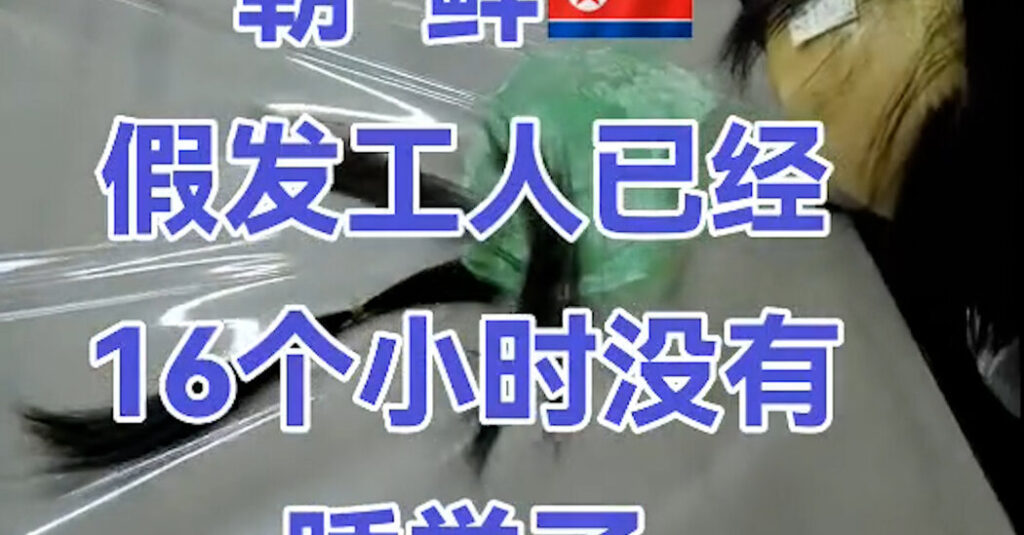
Quick deliveries of large orders for stuffed toys, fake eyelashes and crocheted bags that are made with cheap labor, including some workers who are on the job for 16 hours straight.
This is the pitch some Chinese businesses are making on social media to potential customers. But the products they are selling are made in North Korea, like in this video of a wig factory.
In the posts, which have proliferated in recent years, some Chinese entrepreneurs say that they own factories in North Korea and openly share contact information, splashing their account handles on videos of their products — in a clear violation of sweeping U.N. Security Council sanctions that bar nations from running “joint ventures or cooperative entities” in North Korea.
The videos have been viewed tens of thousands of times and offer a rare glimpse into factory life in North Korea. They are also a sign of the renewed ties between the neighbors — official trade between the countries has jumped recently and the Chinese leader Xi Jinping arrived in Pyongyang on Monday for a summit with his North Korean counterpart, Kim Jong-un.
The New York Times reviewed 34 social media accounts and over 400 posts that promoted goods made in North Korean factories on Douyin, China’s version of TikTok, and Xiaohongshu, which is also known as Red Note. The Times used satellite imagery and other online footage to verify where the videos in this article were recorded. People behind two of the accounts that posted the videos declined to comment and the others did not respond.
The social media accounts touted the same marketing line: thousands of cheap and skilled workers. As one post put it in Chinese, with a smiley-face emoji: “Good value for money.”
“Chinese entrepreneurs are returning to North Korea to run joint ventures,” said Lee Sang-Yong, research director at Daily NK, a Seoul-based website specializing in North Korean affairs. “While the rest of the world was not paying much attention, bilateral trade has quietly recovered to prepandemic levels.”
North Korea is not completely cut off by U.N. sanctions. Firms can export items like wigs and tungsten ores, as long as they are not part of a joint venture with foreign companies. Official trade between North Korea and China reached nearly $1 billion in the first four months of this year, jumping about 23 percent from the same period a year ago, according to Chinese customs data.
Much of the factory activity appears to be happening in the northeastern city of Rason, near North Korea’s borders with China and Russia. Pyongyang designated the city as a special economic zone in 1991, aimed at attracting foreign investment — particularly from China — to build and run factories using low-cost North Korean labor.
It was not possible to determine if the social media videos have actually led to orders. But as contract manufacturers, many North Korean factories do not have a robust domestic supply chain. The country has “relied heavily on importing raw materials and intermediate goods from China, then manufacturing and reselling finished products by leveraging its relatively abundant labor force,” said Yi Ji-sun, a research fellow at the Institute for National Security Strategy in Seoul.
Many of the social media posts emphasized the handiwork of the large work force. A video at one factory shows more than 150 men and women assembling false eyelashes, using small tools to nimbly weave the fabric and hammer the lashes onto a base. The caption reads, “North Korea Rason eyelash factory.”
When the product is ready, workers prepare for export by packing boxes labeled with the quantity and the name of the lash style, “Mega Volume” or “Crisscross,” in Chinese characters. Businesses pitched the rapid turnaround of large orders as a key advantage of working with North Korean factories. A video posted last August shows a table covered with more than 200 boxes, with the caption “Shipping out today.”
U.N. sanctions bar nations from buying textiles, including “fabrics and partially or completed apparel products,” from North Korea. However, posts showed a variety of goods that appeared to violate the ban, including hand-knit bags and crocheted toys.
One account hawked a traditional Chinese dress called qipao with the caption, “New pieces fresh off the frame by North Korean embroiderers. Seeking their destined owner.”
The social media posts also offer a look at life inside North Korean factories. The laborers work and live under military-style discipline. They eat at communal dining areas and participate in collective exercises.
Government propaganda slogans hang on the factory walls, continuously reinforcing loyalty to Mr. Kim.
North Korea has historically likened its foreign investment strategy to “putting up mosquito nets” — a policy designed to catch external capital while blocking foreign cultural influence. The remote geography of the Rason Special Economic Zone serves this purpose, allowing Pyongyang to isolate foreign investors from the general population.
To prevent the spread of outside information, the regime favors ethnic Chinese investors over Chinese business people of Korean descent who could communicate with locals, according to South Korean officials and analysts.
Jiawei Wang is a video journalist for The New York Times based in Seoul.
The post Videos Show Chinese Businesses Hawking North Korean Labor appeared first on New York Times.