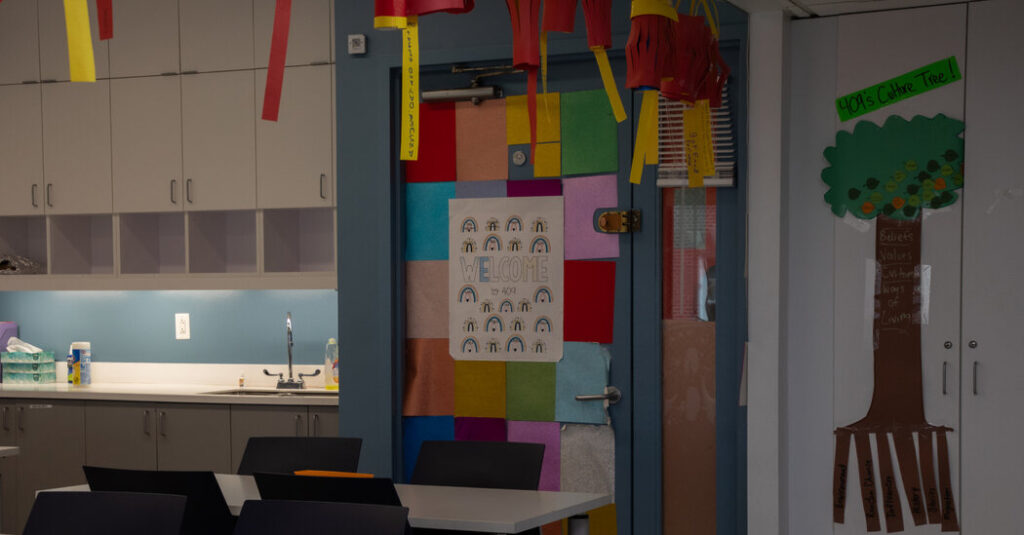
Last year, I visited a seventh-grade math classroom in a public school in the Bronx. Twenty students sat bent over laptops, working with an A.I. tutor on story problems about converting fractions to decimals. A teacher moved around the room, checking a dashboard that tracked how many tries each student needed to reach the right answer.
On the surface, the classroom was working. Students were engaged, and most of them, eventually, were getting to the right answers.
When I looked closely, though, many of the students were lost. They didn’t understand fractions conceptually. Each time one of them made a mistake, the A.I. tutor backed up and suggested another step, but it never identified the underlying gap in understanding. The teacher could not see it either. Her dashboard showed which students were stuck, but not why.
The core intellectual work of teaching is noticing why a child’s understanding breaks down and then knowing what to do. It might mean pausing the class for a mini-lesson or pulling out fraction tiles for one student who needs to visualize the math. In the class I visited, that work had been handed to a tool that could do neither. No one was arguing about strategy or turning to the kid across the table to ask, “Wait, how did you get that?” Each child sat alone. Silent, in front of a screen, clicking away.
The cost of this silence is both cognitive and social. When artificial intelligence anticipates every step before a student even recognizes a hurdle, it strips away the productive struggle on which learning depends. Students need to wrestle with confusion to build their own understanding. The neuroscientist Mary Helen Immordino-Yang and her colleagues have shown that deep learning, the kind that sticks, happens when students connect what they are learning to bigger ideas and to their own lives. Replace dialogue and struggle with isolated screen time, and we disrupt the neural circuits that allow students to build knowledge.
Most of us sense this intuitively. Yet the current trend in K-12 educational technology is the “one-to-one” A.I. tutor, backed by significant investments from technology companies. Early research shows some gains in procedural skills. But efficiency is not the same as understanding.
When we isolate a student with an A.I. tutor, we cut her off from the relationships that drive learning. At Bank Street College, we train teachers to use a “developmental-interaction approach,” which recognizes that children learn best in the context of trusting relationships. When a student struggles, a clearer explanation from a bot is rarely enough. The child needs to hear another student explain it in a way that doesn’t quite make sense to her yet, argue back and figure out where they actually disagree. And she needs a teacher who understands her. Someone who can tell a student who is lost from one who is bored, or read her hesitation and know whether it is a language barrier or the normal fumbling before a breakthrough.
Doubling down on isolation is dangerous. We are already witnessing a collapse in teen mental health, as Jonathan Haidt has warned us, driven by a “rewiring of childhood” that replaced play and community with screen time. If schools embrace one-to-one A.I. tutoring as the norm, they will deepen that crisis, exchanging the in-person interactions children need for yet another screen.
For a generation, American schools have been shaped by standardized tests that measure a narrow band of skills. Because the tests carry high stakes, teachers teach to them. The curriculum narrows. Time for projects, argument and problem-solving shrinks. The A.I. tutor drilling concepts a seventh grader doesn’t understand is not an aberration of that system. It is its logical extension.
A.I. also risks becoming a new instrument for educational segregation. In wealthy districts, parents will demand schools centered on human interaction: seminar tables, heated debates, messy projects. Students in poorer schools, often Black and Latino children, will be handed laptops and headphones, “learning” from machines that can correct their algebra but will never care about their curiosity.
Parents and educators across the country are organizing. In New York City, they have demanded a moratorium on A.I. in schools. Nationally, a coalition of more than 250 child development experts and advocacy organizations is calling for a five-year pause on generative A.I. in K-12 classrooms. They are right to be alarmed. But we don’t have to choose between haphazardly embracing A.I. and banning it.
In a world A.I. is already reshaping, what students need to learn is changing. Content knowledge will always matter, but it is not enough. Students must also become original thinkers who can reframe problems, citizens engaged enough to grapple with power and democracy, and generous collaborators who can work across real differences. An A.I. tutor can help a student memorize a formula. It cannot teach her to debate its ethics with a peer who disagrees.
A guiding principle for our work with A.I. in schools should be whether it supports this kind of deeper learning. Take Keisha, a recent graduate of Fannie Lou Hamer Freedom High School, also in the Bronx, whose work you can see on YouTube. For her social studies portfolio, she spent weeks doing research on how federal housing policy and the G.I. Bill shaped the racial wealth gap in America. After many drafts, she defended her paper in front of a panel of teachers, who questioned her closely. She could point to specific passages in her sources to answer their questions and confidently explain her reasoning.
Keisha’s school is one of 38 in the New York Performance Standards Consortium, in which students have graduated this way for decades, by presenting and defending portfolios of their work. The teachers in these schools design projects that invite students to wrestle with hard questions over months. Their schools have built the conditions to support this: a curriculum, a culture, schedules that let teachers know their students well. So far, this approach has remained the rare exception because most schools still default to top-down instruction and are not designed to give teachers — or students — the time deeper learning demands.
A.I. could ease one part of that equation. A tool that organizes a student’s drafts across a year, gathers peer feedback and shows a teacher how an argument tightened over time could let her give this kind of attention to more students. The question worth asking is whether A.I. could finally help us measure what we actually care about, instead of only what is easy to count on a test.
This isn’t hypothetical. Last summer, the New York Board of Regents approved a new “portrait of a graduate” framework, signaling a shift away from defining readiness only through standardized exams and toward capacities like critical thinking, communication and creative problem-solving. In practice, this means making space inside traditional schools for longer projects and the kind of inquiry that takes more than a class period to complete. Without tools that make projects like these workable for teachers, the reform risks collapsing back into something easier to measure.
Some of those tools are already being built. Teachers have designed hundreds of A.I. applications and shared them on a nonprofit platform called Playlab. Brendan Harney, a science teacher at the Bronx Lab School, learned the hard way what A.I. in classrooms should not do. With 70 students each designing their own experiments, he hoped A.I. could shoulder some of the coaching. He built a tool in imitation of his voice and tone, an “Alexa for the classroom,” as he put it. His students pushed back. As he came to see it, they wanted to walk through a hard problem with a real teacher, not a machine. He rebuilt the tool with a smaller job: It now helps students probe their assumptions before they sit down with him to talk about their experiments.
When one student proposed testing how substances like caffeine affect memory, the A.I. helped him think through quantities and measurements. Mr. Harney asked the harder question: whether it was ethical to make another student ingest 400 milligrams of caffeine for a class experiment. Teachers like Mr. Harney are working out where A.I. helps and where only a teacher will do.
The seventh graders I mentioned at the outset don’t need a better A.I. tutor. They need a teacher who knows them well and has the capacity to help them work through what confuses them until it doesn’t anymore. The silence of that Bronx classroom is a warning. Real learning requires friction, debate and connection. Used wisely, A.I. could give teachers more time to do that work with their students.
The choice between a classroom that drills a child and one that teaches her to think should not be determined by ZIP code. We can build technology that amplifies what teachers do best, or we can sleepwalk our way into letting it replace them. What we choose now will shape more than how students learn. It will shape who they become.
Shael Polakow-Suransky (@Shaelsuransky) is the president of the Bank Street College of Education.
The Times is committed to publishing a diversity of letters to the editor. We’d like to hear what you think about this or any of our articles. Here are some tips. And here’s our email: [email protected].
Follow the New York Times Opinion section on Facebook, Instagram, TikTok, Bluesky, WhatsApp and Threads.
The post The High Cost of Silent Classrooms appeared first on New York Times.