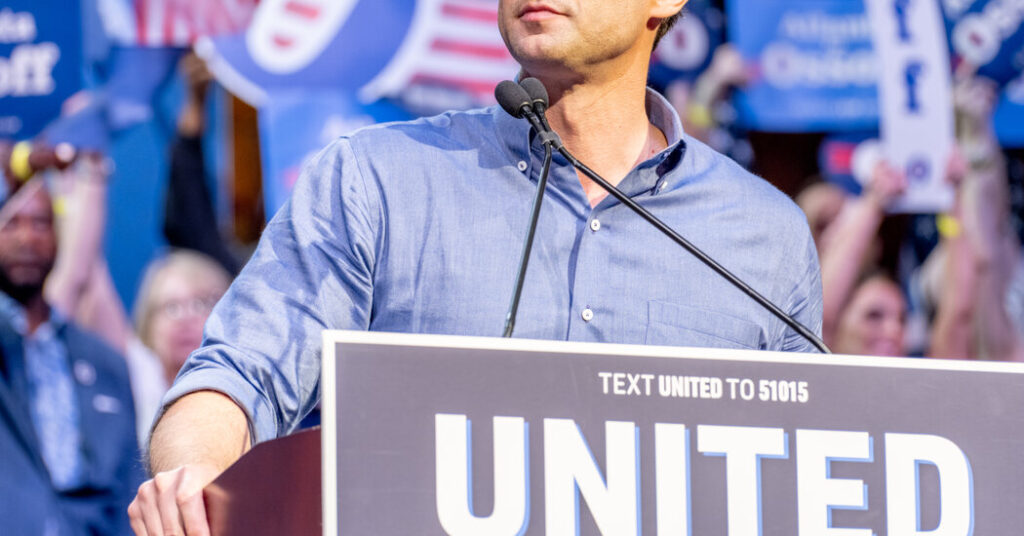
Kicking off his re-election campaign at a rally in Atlanta last week, Senator Jon Ossoff barely mentioned the two Republicans who are in a runoff to oppose him. Instead, speaking to a crowd of more than 1,500 at a downtown concert venue, he blasted the self-dealing of Donald Trump and his “Mar-a-Lago mafia.”
“He’s trying to put his face on the money,” Ossoff said. “Did you see that? He’s building a monument to himself. But see, Atlanta, he’s doing these things now because no one will honor him when he’s gone, because he’s a failed president and a national disgrace.”
The scale and reach of the Trump family’s self-enrichment is so astonishing it can test the limits of human cognition, so when Ossoff talks about it, he usually picks one example to zero in on. In that kickoff speech, he focused on tungsten mining rights in Kazakhstan. Ossoff described how the president of Kazakhstan granted a U.S.-backed company the right to mine the world’s largest known undeveloped deposit of tungsten, an element used in semiconductors, lightbulbs and warheads. Six days after a company backed by Trump’s sons Eric and Don Jr. took a 20 percent stake in an American mining group, that group’s parent company received $1.6 billion in federal financing. “One-point-six billion of your tax dollars to fund and finance their mining project in Kazakhstan, all the while you pay more for gas, for groceries, for health care,” said Ossoff.
As often happens with Ossoff’s speeches, clips from the one last week went viral online, where people from across the Democratic ideological spectrum have been buzzing about a possible Ossoff presidential candidacy. If Ossoff wins re-election, wrote the progressive journalist Mehdi Hasan, “he immediately becomes one of the favorites for the 2028 Democratic presidential nomination.” Sarah Longwell, a former Republican strategist who now publishes the anti-Trump Bulwark, posted a photo of Ossoff with the words, “President-maxxing so hard.”
If you were cooking up an ideal 2028 candidate in a lab, he — and let’s face it, it’s probably a he — would look a lot like Ossoff. He’s young and handsome, with a picture-perfect family: a beautiful wife who works as an obstetrician-gynecologist and two small daughters. He’s a Southerner from a reddish state with a history of wooing Black voters. And he’s a Jewish critic of Israel who, as much as anyone in politics today, has the potential to bridge the Democratic Party’s agonizing divide over Zionism.
But the excitement Ossoff is generating is about more than demographics. It stems from his skill in eviscerating Trump’s gluttonous profiteering, his brazen attempts to turn this country into the most squalid sort of kleptocracy. In his bid for re-election in a state Trump won in 2024, some expected Ossoff to tack to the center; last year JD Vance predicted that he’d start praising Trump’s agenda. Instead, Ossoff is excoriating Trump and his systemic corruption in a way that transcends the Democratic Party’s progressive-moderate divide.
He couples that attack with an achingly earnest sort of patriotism. Ossoff’s recent speeches, which he says he writes himself, have two parts. First, he dissects the rot in America’s governing institutions, a rot that, he always notes, predates Trump and helped give rise to him. Then he lays out a liberal, pluralist version of American identity to challenge the Trump administration’s white nationalism.
“We’re bound together by the same great national spirit that passed civil rights laws, defeated fascism, and landed men on the moon,” Ossoff said in his kickoff speech. A bit later, he added, “This is what small men like Donald Trump and JD Vance and Stephen Miller will never understand. That our national greatness flows not through our blood or our genes, but through our ideas.”
Movements that have defeated authoritarianism, most recently in Hungary, usually use precisely this formula: a sweeping denunciation of corruption with a reclamation of national mythology. “Across decades and continents, corruption has been the fatal weakness of authoritarian regimes,” the Stanford political scientist Adam Bonica wrote in an essay last year. Widespread outrage over corruption helped topple Ferdinand Marcos in the Philippines, Viktor Yanukovych in Ukraine, Otto Pérez Molina in Guatemala and Najib Razak in Malaysia. “As democratic norms erode and elections become increasingly tilted, anti-corruption movements offer what partisan politics cannot: the moral authority to unite society against a rigged system,” wrote Bonica.
Though he’s working within the strictures of partisan politics, Ossoff is trying to build that kind of movement. He helped popularize the phrase “the Epstein class” to describe the network of wealthy people — Democrats and Republicans alike — who enabled the sex-trafficking financier Jeffrey Epstein. When he talks about Trump’s shameless looting, he radiates righteous indignation, like a millennial Atticus Finch. I was in Hungary in April when Peter Magyar dislodged the strongman Viktor Orban with a deeply patriotic campaign centered on the regime’s gargantuan corruption. Ossoff’s indictment of Trump’s “Mar-a-Lago mafia” echoes Magyar’s condemnation of Viktor Orban’s “mafia state.”
More than any other politician in America, Bonica told me, Ossoff is following the playbook that’s worked against autocrats in other countries. Whether or not he runs for president, the party can learn something from his approach.
I first met Ossoff in 2017, when he was running for Congress in a special election in Georgia’s Sixth District, in the Atlanta suburbs, attempting to flip what had been a solidly Republican seat. It was the first major race of Trump’s first term, and Democrats were desperate to rebuke him. The contest became the most expensive special election in history, prefiguring Ossoff’s later Senate race, which also set spending records. Ossoff lost narrowly, but his race helped catalyze the creation of a new Democratic infrastructure in the district, which the Democrat Lucy McBath won the next year.
Back then, Ossoff was one of several young politicians — others included Josh Shapiro, then running for Pennsylvania attorney general, and Senator Cory Booker of New Jersey — whose speaking style mimicked Barack Obama’s distinct preacherly cadence. “It almost seemed like he was doing Obama on a ‘Saturday Night Live’ sketch,” the linguist John McWhorter said of Ossoff’s 2017 concession speech. These days Ossoff sounds less like an Obama imitator, but he still has something of the former president’s vibe, a cerebral cool inflected with the uplift of Southern Black churches.
When Ossoff was 17, he interned for Representative John Lewis, a hero of the civil rights movement whom he considers a mentor. He’s thought a lot about the way that movement grounded itself in American ideals.
“We have to be reconnecting ourselves and the public with the pluralist tradition in American politics and its roots in our founding documents,” he told me after his speech last week. “I have found that the tradition of civil rights politics rooted here in Georgia and the South — the lessons that I learned from Congressman Lewis — have helped me keep true north in sight in a time when the cynicism is so deep that trying to call us back to our better angels is sometimes dismissed as naïve.”
This high-minded sincerity can feel almost countercultural at a moment of such profound national debasement, when Democrats like Gavin Newsom are leaning into Trump-style trolling. “Obviously, he’s trying to win an election, but he also is trying to make a statement about what this country needs to be,” said Tré Easton, vice president of public affairs at Searchlight, a heterodox Democratic think tank. “And you know, I got to be really honest with you: I’m not seeing that from really any other political leader at that caliber right now.”
Ossoff vehemently insists that he’s not going to run for president in 2028. He’s called all the chatter about it a “curse” that distracts from the only contest he cares about: the midterms. “If we do not restore checks and balances in these midterm elections, I don’t know that we have a free and fair presidential election in 2028,” he told MS NOW’s Jen Psaki in April. “So, let’s keep our eyes on the ball, folks.”
Until recently, Ossoff was considered one of the more vulnerable Democrats, but he’s ahead in the polls. After a vicious primary, two Republican candidates remain locked in a runoff, and many of their voters are demoralized. In focus groups, Longwell told me, Georgia Republicans despair of their chances. Still, it would be malpractice for Ossoff to take anything for granted.
It is standard, of course, for politicians running for Congress or governorships to disavow any interest in the presidency. Obama, remember, brushed off the idea of a presidential bid when he was campaigning for Senate in 2004. Still, there are reasons to believe Ossoff means it.
He appears to be a bit of an introvert, and though he’s often been in the national spotlight, he doesn’t seem to relish it. Since his election in 2020, he’s mostly kept his head down, focusing much more on building his office’s constituent services operation than on his national profile. Though he’s usually happy to appear on local TV in Georgia, his staff has to push him to do cable news.
It’s become conventional wisdom among many Democratic operatives that a successful candidate must dominate the information ecosystem, mastering quick, vertical video updates and long, meandering podcasts. Ossoff shows little interest in either. Though he was only 33 when he took office — the youngest senator since Joe Biden was elected in 1972 — he’s not very online. His TikTok feed mostly consists of excerpts from speeches and snippets of him grilling witnesses in the Senate. On the relatively rare occasions that he appears on podcasts, he avoids talking about himself. In April, Tim Miller of The Bulwark tried to draw him out about his workout routine — Ossoff has noticeably bulked up since his first congressional campaign — but didn’t make much headway. At a time when many politicians are trying to be influencers, Ossoff has an old-fashioned reserve.
When he speaks, he’s slow and deliberative, sometimes pausing in the middle of a sentence to gather his thoughts. “Words matter and have power and are treated too cheaply,” he told me.
Obama, of course, was also an introvert. As David Axelrod, his former chief strategist, told me, Obama meant it back in 2004 when he said he wasn’t planning to run for president. After his blockbuster speech at the Democratic National Convention, Obama was the subject of public fascination, and feared his new Senate colleagues wouldn’t take him seriously if they thought he was using the office as a launching pad. “We made a big effort to stay out of the national spotlight,” said Axelrod. “We stayed off the Sunday shows.”
But Democrats, including Harry Reid, then leader of the Senate Democratic caucus, kept urging Obama into the race. “That thing was as close to a draft as I have ever witnessed,” Axelrod said. Obama was in demand because of his biography, but also because, unlike most Democrats, he’d had the courage and foresight to oppose the Iraq war.
Here, too, there’s a parallel with Ossoff. In 2024, Ossoff was one of only 19 senators to sign on to Bernie Sanders’s resolution calling for an embargo on certain arms to Israel, bucking pressure from Biden’s White House. In a sober floor speech, he said, “The American people are rightly horrified by the lack of sufficient concern for innocent Palestinian life that has left so many children unnecessarily dead in Gaza, without limbs or riddled with shrapnel.” A few moments later, he added, “We seem to have forgotten that we have the power to influence our ally’s conduct.”
At the time, Ossoff’s stance seemed politically risky. “His chances of getting re-elected in 2026 just became that much harder,” said the Israeli newspaper Haaretz. But today, much of the Democratic Party’s mainstream is where Ossoff was two years ago, with even the ur-centrist Rahm Emanuel, who once volunteered with the Israel Defense Forces, calling for a cutoff of military aid. The moral position, in retrospect, was also the savvy one. Voters “want to believe that there are leaders out there who are willing to draw lines and who aren’t so obsessed with their own perpetuation in office that they’re willing to sacrifice all principles to get there,” said Axelrod.
Ossoff, who was sworn into office on the Hebrew Bible of Rabbi Jacob Rothschild, an ally of Martin Luther King Jr., is not an anti-Zionist. “I want the Israeli people to be safe and secure,” he told me. “I make no apology for opposing the reckless killing of noncombatants.” This position will not satisfy either AIPAC or the Democratic Socialists of America. But it would be hard for Ossoff’s opponents to tar him as either an antisemite or as someone who was complicit in the atrocities that occurred while Biden was president.
By the time Ossoff arrived in Washington, he’d been thinking about the ugliness of unaccountable power for years. Before he was a politician, Ossoff ran a company called Insight TWI that produced documentaries about international corruption and human rights abuses, several of which aired on the BBC. He oversaw an award-winning program about the mass rape of Yazidi women by ISIS and an investigation into an alleged Kenyan death squad. In one of his most high-profile projects, he worked with Ghanaian journalists exposing corruption in international soccer. A slew of officials, including the former president of the Ghana Football Association, were caught on camera taking bribes.
The exposé ran on the BBC in 2018, a few months after Ossoff’s failed congressional campaign. After its release, Ahmed Hussein-Suale, one of the Ghanaian journalists who worked on it, was threatened by some of the men who were implicated, and in 2019, he was assassinated. The police reportedly believed he was killed in retaliation for his work. Speaking at Hussein-Suale’s memorial service in Accra, Ossoff said it wasn’t enough to just arrest the killers. “Those who hold high positions, who threaten journalists, who call for violence against journalists, should also face accountability,” he said.
It’s easy to see the through line between Ossoff’s message then and now. “My belief that corruption is at the core of oppression predates my public life,” he said. Running investigations of “war crimes and human rights abuses in hostile environments, it was so clear how kleptocracy, corruption and authoritarianism so often go hand in hand.”
Today, Ossoff brings elements of his documentary background into his attempts at political persuasion. The first video released by his new campaign is a nearly four-and-a-half-minute spot that dives into Big Pharma lobbying to explain the corporate capture of American lawmaking and the high price of prescription drugs. Almost a mini documentary, it breaks most of the rules of traditional political advertising, getting into the weeds of a fairly wonky subject. “Drawing on my background in journalism, to make something comprehensible, it cannot be discussed merely in the abstract,” he told me. “You’ve got to break down how it really works.”
As much as he lambastes Trump, Ossoff always emphasizes that he’s more a symptom of a broken system than a cause. “Donald Trump is a demagogue who has exploited the underlying rot of systemic corruption, and the widespread disillusionment and cynicism that flows from the experience of life in a society where politics is so corrupted,” he said. “He has exploited that rot with a promise to unrig the system and then proceeded simply to re-rig the system for himself.”
Ossoff attributes much of what’s gone wrong in American politics to Citizens United, the 2010 Supreme Court decision striking down restrictions on corporate and union spending in American elections. Unlike many liberal Democrats, he’s not calling for expanding the Supreme Court. Instead, he wants to see a national campaign to amend the Constitution to get dark money out of politics, which he thinks could bring people together rather than further polarize them. “We have to be capable of imagining ambitious change,” he said. “Our politics is in such a bad place that I think an effort like that could energize people, inspire people, unify people who otherwise are at odds, and reshuffle the deck.”
He’s right that Americans broadly hate Citizens United, but changing the Constitution is a grueling process with almost endless choke points, and I suspect his position will seem, to many progressives, like a punt. Still, his approach could play well with those parts of the electorate that yearn for an end to American divisions and don’t trust either party to fix things. As Bonica notes, in many polls, Democrats are seen, unfairly, as being as corrupt as Republicans. It might be good politics, then, for Ossoff to champion reforms that aren’t seen as purely partisan.
“In polarized societies, the most effective opposition doesn’t fight on the traditional left-right battlefield where positions are entrenched,” wrote Bonica. “Instead, it creates an entirely new axis of conflict.”
That’s essentially what Ossoff is aiming to do, and it’s why so many are looking to him to lead. If he wins re-election, especially by a comfortable margin, “I’m sure people will come to him and say, you know, dude, we need you,” said Axelrod. Maybe Ossoff will say no. But it can only help him to look like someone who needs to be persuaded.
The Times is committed to publishing a diversity of letters to the editor. We’d like to hear what you think about this or any of our articles. Here are some tips. And here’s our email: [email protected].
Follow the New York Times Opinion section on Facebook, Instagram, TikTok, Bluesky, WhatsApp and Threads.
The post Why Everyone Wants Jon Ossoff to Run for President appeared first on New York Times.