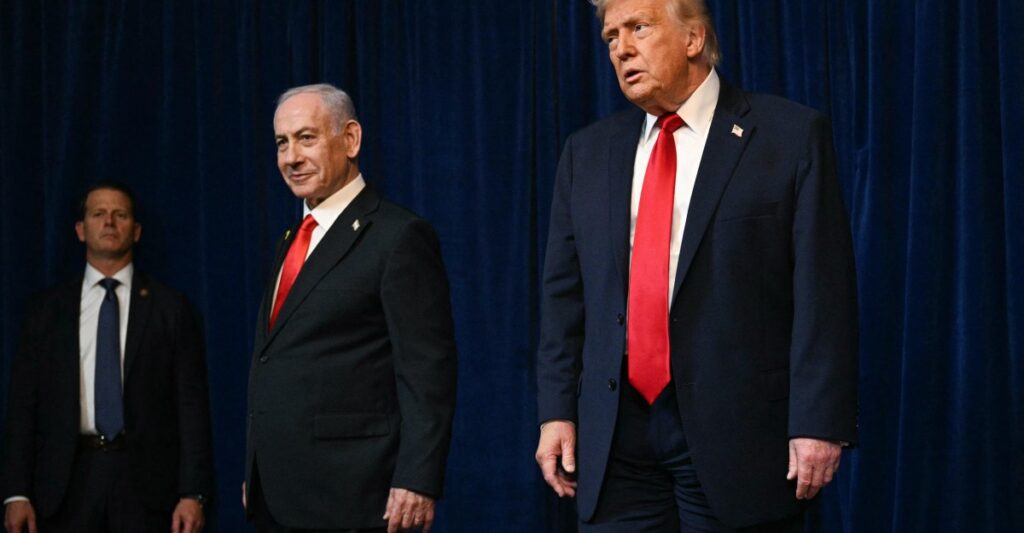
At its outset, the war known as Operation Epic Fury in the United States and Operation Roaring Lion in Israel marked a historic first: the first time the two countries’ militaries went to war fighting side by side. By all accounts, Prime Minister Benjamin Netanyahu was one of the key voices — if not the most important voice — influencing President Donald Trump’s decision to launch the military operation, which has now lasted more than 100 days. And yet, it’s been clear from the start that there were differences in the two countries’ priorities when it came to the war. Those differences have never been more evident than they were this past weekend.
On Sunday night, Iran launched its first direct attack against Israel since the tentative ceasefire in the conflict in early April, firing a barrage of missiles at several targets including an air base; Tehran said it was retaliation for Israel’s prior offensive in southern Lebanon. Trump said on Sunday that he had urged Netanyahu not to retaliate in order to allow ceasefire talks to continue. He also told the Financial Times in an interview on Sunday that Netanyahu “won’t have any choice,” but to accept a US-negotiated ceasefire, adding, “I call the shots,” he said. “I call all the shots. He doesn’t call the shots.”
Nonetheless, Netanyahu appeared to take a shot of his own on Monday, with Israel launching strikes against a petrochemical plant in southern Iran — its first strikes inside the country since the ceasefire. US officials say the US military did not participate in the attacks.
The two sides have now taken steps to deescalate. Iran’s military says it has concluded its operations against Israel for now, while Netanyahu instructed his military to halt preparations for another attack after Trump posted on Truth Social that both countries “immediately stop ‘shooting.’”
Publicly, it looked like Netanyahu had defied Trump, although subsequently, sources told the Wall Street Journal that Netanyahu had made clear to Trump in a conversation on Sunday that he had to retaliate, and Trump had simply urged him to keep it limited. Either way, it’s a signal that when it comes to this war, the two leaders’ incentives are moving in opposite directions. The airstrikes come just a week after a tense phone in which Trump called Netanyahu “fucking crazy” and accused him of ingratitude over what Trump felt was Israel’s disproportionate military actions in Lebanon. On Sunday, according to Trump, he warned Netanyahu that if he escalated the war further, he might soon be left to fight Iran alone.
The divisions here are not new. Israel’s end goal, from the start of the operation, has been regime change in Tehran, whereas the United States was more concerned about maintaining regional stability. As was the case in Gaza, Israeli officials felt the ceasefire with Iran was imposed on them by the United States and that their objectives had not yet been met.
Compounding the issue, both leaders are trailing heading into pivotal elections. Netanyahu faces the very real possibility of losing power in national elections in late October. Trump’s Republicans may lose one or both houses of Congress in midterm elections in November.
While Trump likely still believes he can salvage a victory out of Epic Fury and has shown he won’t cut a deal with Iran at any price, it would clearly be in his best interest, and in the interest of his party, for him to end an unpopular war that has driven up the cost of living for American voters as quickly as possible.
In Israel, meanwhile, the war is extremely popular, and resuming it may redound to the benefit of Netanyahu, reeling in the polls over his ongoing corruption trial as well as criticism over the security failures that led to the October 7, 2023, terrorist attacks. After months in and out of bomb shelters, it would certainly be harder to make the case to Israeli voters that it was all worth it if the war ends with Iran’s regime still in place, rebuilding its missile forces, its proxy networks, and perhaps even its nuclear program. Israel’s military is also pushing ever more aggressively into Lebanon in response to rocket attacks from Iran’s ally Hezbollah, despite US-led efforts to reach a ceasefire there.
“There was no way that Netanyahu — when he’s so close to an election when he’s underwater, and when people are already angry about what’s going on in northern Israel [where Hezbollah is firing missiles] — could simply not respond to direct Iranian ballistic missiles on Israeli territory,” said Michael Koplow, chief policy officer at the US-based Israel Policy Forum.
Both leaders are also at pains to demonstrate that they are not letting the other one “call the shots.” Netanyahu has been under increasing criticism from his electoral opponents for turning Israel into a client state of the United States and being unable to stand up to Trump; the criticism will only get louder if Israel is pressured into agreeing to a US-brokered ceasefire viewed as favorable to Iran. Trump, meanwhile, is taking heat from opponents as well as members of his own coalition for taking marching orders from Israel. Netanyahu has incentive to show he can defy Trump. Trump continues to emphasize that he’s the dominant partner in the relationship.
The biggest point of stress in the partnership in the coming weeks may be Lebanon. Israel views Hezbollah as an imminent threat and wants to separate the issue from the negotiations with Iran, preserving its ability to strike in Lebanon as it sees fit. The Iranians, as they did on Sunday, are eager to link the two battlefields, demanding that any ceasefire also cover Lebanon. That means that the Trump administration — for whom the issue of Hezbollah is far less existential — is increasingly viewing Israel’s actions in Lebanon as an obstacle to ending the wider war. Trump has already pushed Israel to curtail some of its operations and avoid strikes on the Lebanese capital, Beirut.
It will certainly complicate efforts to bring this war to a close if the United States has to negotiate a ceasefire not only with its adversary, Iran, but with its ally, Israel, as well. But ultimately, there’s probably a floor to just how bad relations between Trump and Netanyahu can get. For all that he’s far more willing than other US presidents to publicly say things that seem calibrated to humiliate the Israeli leader, Trump is also far more willing to accede to Israel’s actual policies — in Iran, Lebanon, or the Palestinian territories. For his part, Netanyahu can only go so far when it comes to publicly breaking with Trump.
The real test for whether something has fundamentally changed in the US-Israeli relationship is likely to come when one or both of these leaders are out of office.
The post The growing US-Israel split over Iran appeared first on Vox.