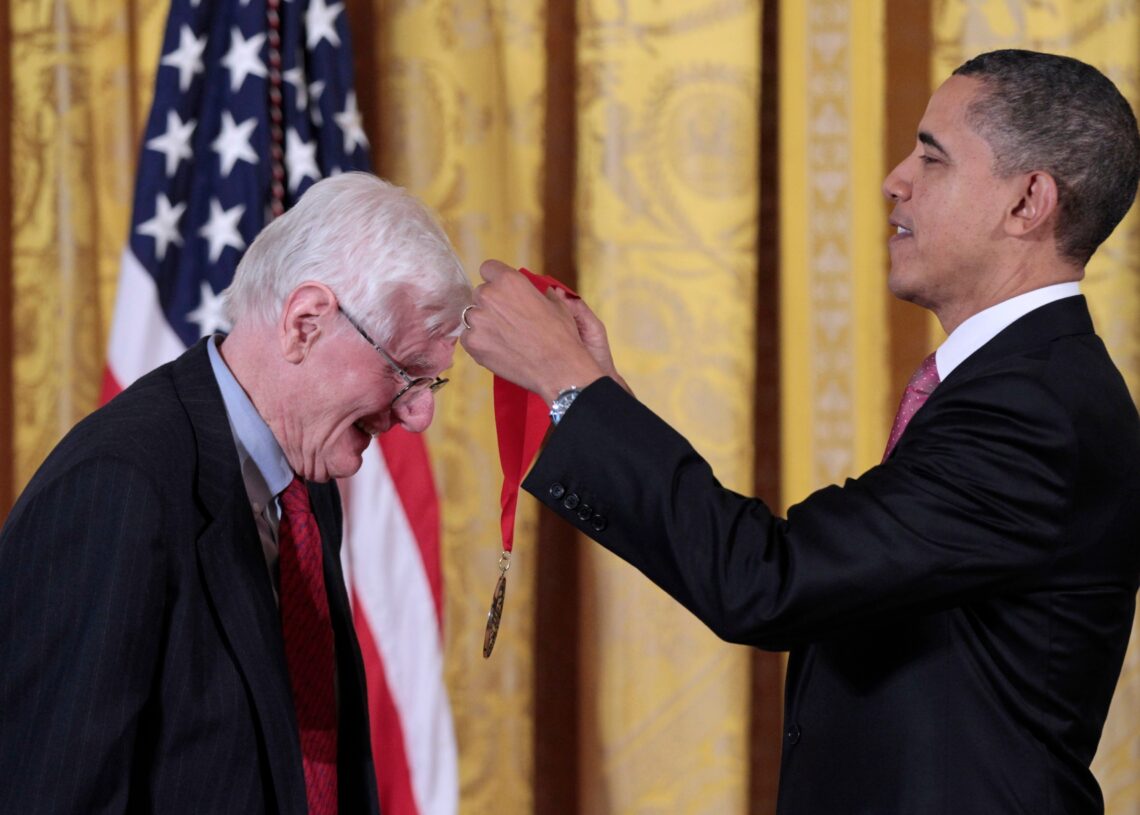
Gordon S. Wood, a Pulitzer Prize-winning author and professor of American history at Brown University whose books illuminated the radical ideas that undergirded the American Revolution and helped a generation define what it means to be an American, died June 7 at a hospital in Providence, Rhode Island. He was 92.
His daughter Amy Louise Wood said he died after being struck by a car while crossing the parking lot of an East Providence supermarket.
In a career spanning nearly a half-century, Dr. Wood addressed the most fundamental questions of American identity: What binds a country of immigrants, rich and poor, believers and nonbelievers, urban and rural, southern and northern, whose ancestors shared little more than uprootedness?
His best-known works, “The Creation of the American Republic, 1776-1787” (1969) and “The Radicalism of the American Revolution” (1992), were considered benchmarks of intellectual and social historiography that helped reshape America’s origin story in the years after World War II.
In a field crowded with more prolific and popular historians such as David McCullough and Ron Chernow, and rife with tensions over emerging historical perspectives on slavery, race, gender and Indigenous people, Dr. Gordon was long considered the academic dean of Revolution-era history.
Challenging the scholarship of prior generations who saw the Revolution through the prism of 19th-century ideas about class conflict and economics, Dr. Wood recast the founders within what he considered the framework of their time.
In his revision, the founders still figured as privileged White men with economic interests. But beneath their powdered wigs, he wrote, their minds were swimming in radical 18th-century Enlightenment ideas about liberty, equality and the threat of tyranny that also made them a new breed of Utopian revolutionary — leaders who wittingly and unwittingly set in motion what Dr. Wood called “the most radical and far-reaching event in American history.”
Their ideas, he argued, would become the “ideological adhesive” that bound people together in the thorny, factionalized landscape of early America.
The same ideas bind Americans still, he asserted.
“It can’t be enough ‘to be an American’ to ‘go to McDonald’s.’ I mean, that can’t be the only adhesive that holds us together,” Dr. Wood said in a C-SPAN interview in 2002. “It has to be something else. And it’s our history, and particularly the Revolution.”
Dr. Wood wrote a dozen books, edited and contributed to many more, and maintained a steady output of reviews and essays. He taught early American history at Brown, in Providence, from 1969 until his retirement in 2008.
In addition to the Pulitzer for history, which he received in 1993 for “Radicalism,” he received just about every major prize offered to historians in the United States, including Columbia University’s Bancroft Prize and the American Historical Association’s John H. Dunning Prize (both in 1970). President Barack Obama presented him with the National Humanities Medal in 2011.
In researching his first two books, “Creation,” and “Radicalism,” Dr. Wood followed the path of his mentor and PhD dissertation supervisor, Harvard historian Bernard Bailyn, a pioneer in the mining of previously unknown or overlooked 18th-century source materials. Dr. Wood immersed himself in British and American political tracts, newspapers, sermons and private letters to trace a skein of ideas circulating in early America.
Those ideas, Dr. Wood concluded, inspired not just one rebellion but a series of them.
The first was the war of independence against the British monarchy. But in rapid succession in the decades thereafter, Americans also underwent profound upheavals in the structure of their social ties and in their expectations about the role of government in society.
The American Revolution, he wrote in “Radicalism,” “destroyed aristocracy,” inaugurated “an entirely new kind of popular politics,” and “made the interests and prosperity of ordinary people — their pursuits of happiness — the goal of society and government.”
The idea that sovereignty and the right to make law resided in the people rather than in government, that three equal branches of government would withstand incursions of tyranny better than one, and that liberty meant protecting individuals from official encroachments were all relatively new ideas at the time. The genius of the founders, he wrote, was to wrestle those ideas into functioning mechanisms that helped define not only a new kind of government, but a new kind of people.
By far the most profound of these new ideas — “that all men are created equal” — Dr. Wood wrote in “Radicalism,” proved “far more potent than any of the revolutionaries realized.”
The founders’ idea of equality, of course, was of its time, Dr. Wood noted. But nonetheless, he wrote, “Equality became so potent for Americans because it came to mean that everyone was really the same as everyone else, not just at birth, not in talent or property or wealth, and not just in some transcendental religious sense of the equality of all souls. Ordinary Americans came to believe that no one in a basic down-to-earth and day-in-and-day-out manner was really better than anyone else. That was equality as no other nation has ever quite had it.”
Praise and controversy
Yale historian Edmund S. Morgan called Dr. Wood’s “Radicalism” “a tour de force of historical revision.” Pauline Maier, a historian at MIT, writing in the New York Times in 1992, called it “the most important study of the Revolution to appear in over 20 years.”
Dr. Wood was criticized, too. A younger generation of academics who pioneered the study of race, gender and class in early American history accused him of omitting too many groups from the American landscape that he presented in his scholarship, especially women and enslaved people.
In 2012, Nancy Isenberg, a history professor at Louisiana State University who later wrote “White Trash: The 400-Year Untold History of Class in America,” accused Dr. Wood in the Journal of the Early Republic of “trumpeting the American dream” with a portrayal of the Revolution that largely neglected everyone but the elite, while exonerating the founders of culpability for slavery and the beginnings of the forced displacement of the Indians.
Dr. Wood rebuffed critics with scholarly thrusts and parries that became increasingly pointed. In 2015, he published an essay in the conservative Weekly Standard magazine condemning “moral hand-wringing” by a cohort of younger historians “obsessed with inequality and white privilege.”
The new generation of historians, he wrote, “has devoted itself to isolating and recovering stories of the dispossessed: the women kept in dependence; the American Indians shorn of their lands; the black slaves brought in chains from Africa. Consequently, much of their history is fragmentary and essentially anachronistic — condemning the past for not being more like the present. It has no real interest in the past-ness of the past.”
Historians, he argued, have an obligation to see the past in the context of its time and place. In the introduction to “Radicalism,” he wrote, “To focus, as we are today apt to do, on what the Revolution did not accomplish — highlighting and lamenting its failure to abolish slavery and change fundamentally the lot of women — is to miss the great significance of what it did accomplish; indeed, the Revolution made possible the anti-slavery and women’s rights movements of the nineteenth century and in fact all our current egalitarian thinking.”
For the most part, the tension between Dr. Wood and fellow historians played out in academic journals, and under the radar of the general public. But the name “Gordon Wood” made a cameo in popular culture in the 1997 movie “Good Will Hunting.”
In a scene set in a bar near Harvard, the title character — a janitor and self-taught genius played by Matt Damon — cuts a grad student down to size in an argument over 18th-century American economic conditions by exposing the student as a verbal plagiarizer who was lifting his argument verbatim from a historical monograph.
The student begins, “Wood drastically underestimates …” before being cut off by Will, who recites the passage in full: “ ‘Wood drastically underestimates the impact of social distinctions predicated upon wealth, especially inherited wealth …’ You got that from Vickers, ‘Work in Essex County,’ page 98, right? Yeah, I read that, too.”
“That’s my two seconds of fame!” Dr. Wood told the Los Angeles Review of Books in 2015. “More kids know about that than any of the books I have written.”
Working-class upbringing
Gordon Stewart Wood was born in Concord, Massachusetts, on Nov. 27, 1933, and spent his adolescence in Waltham, a Boston suburb. His father held various jobs, including as a factory worker, and his mother did office work, while they raised him and a sister.
He entered Tufts University in nearby Medford on the advice of his high school Latin teacher. “My parents were not college graduates, so I was a little uncertain about what I should do,” he told C-SPAN in 2002. “It was a local school. I was a commuter. And that’s the long and short of it.”
Dr. Wood entered the Air Force after graduating in 1955, planning to return to Tufts for an advanced degree in international relations and pursue a career in the Foreign Service. But his experience in the military soured him on working in government, he told interviewers, so instead he enrolled at Harvard University to study history. He received his PhD in 1964.
In 1956, he married Louise Goss. In addition to his wife and his daughter Amy, a historian at Illinois State University, survivors include his daughter Elizabeth Wood Gagnon and his son Christopher Wood, an art historian at New York University; five grandsons; and a great-granddaughter.
Dr. Wood published his latest book, “Power and Liberty: Constitutionalism in the American Revolution,” in 2021. The life of a scholar was difficult, he said, and the morals taught by history were nebulous, sometimes even bitter.
“I don’t think history teaches a lot of little lessons, frankly,” he told C-SPAN. “I think it teaches one big lesson, which is that nothing really ever works out the way the perpetrators intend. I can’t think of any major event in the history of the world that ever turned out the way the participants who launched it expected.”
The post Gordon S. Wood, eminent scholar of U.S. history, struck by car and killed at 92 appeared first on Washington Post.