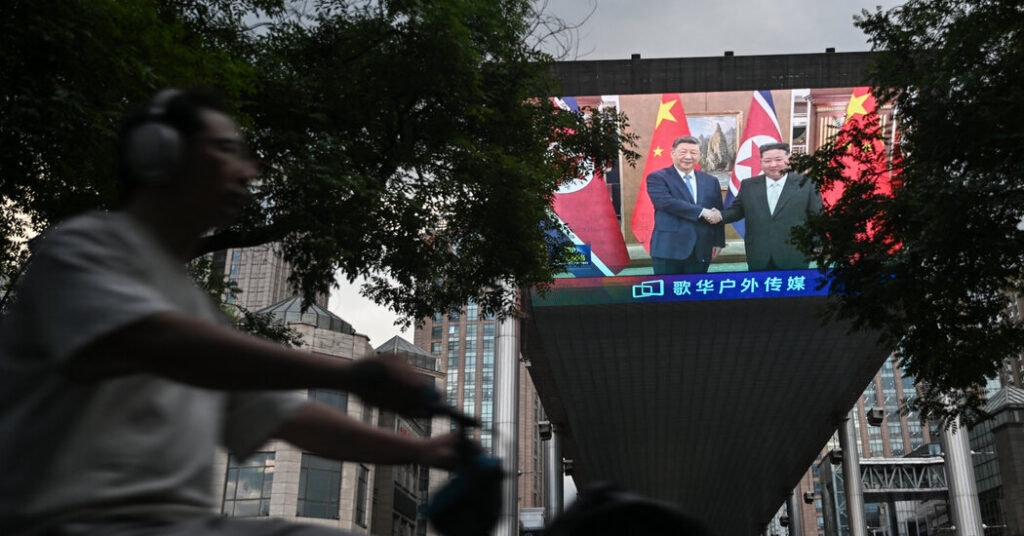
China’s top leader, Xi Jinping, arrived in North Korea on Monday and delivered what analysts said was a subtle reminder to the country’s newly emboldened dictator, Kim Jong-un, that China is his most important benefactor, economic partner and bulwark against the United States.
According to an official summary of the leaders’ talks released by Chinese state media, Mr. Xi called for “close strategic communication” with Mr. Kim and for strengthening exchanges “at all levels and in all fields.” He said he was willing to deepen relations with Mr. Kim in “the new era,” a phrase Mr. Xi has used to project China’s growing strength on the world stage.
In many ways, Mr. Xi’s two-day trip to Pyongyang, North Korea’s capital, is an effort to balance influence from Russia, which signed a mutual defense pact with North Korea two years ago. That deal has helped revive North Korea’s economy, by allowing Mr. Kim to trade weapons and troops with Russia for badly needed oil, food and weapons technology, and given him a stronger hand in talks with Mr. Xi.
Mr. Xi was received by Mr. Kim and his wife, Ri Sol-ju, when he landed in Pyongyang, his first trip there in seven years. His motorcade was greeted by a military honor guard and throngs of citizens waving both national flags, with children dancing and clutching bright balloons. North Korea gave Mr. Xi a similar welcome the last time he visited Pyongyang.
At a meeting at the Kumsusan Guest House, Mr. Xi pledged to cooperate with Mr. Kim in trade, agriculture, science, tourism and health care.
North Korea had not released a statement about the meeting by late Monday. Mr. Kim was expected to press Mr. Xi for more economic support and possibly a greater acceptance of North Korea’s nuclear weapons program.
China’s summary made no mention of the nuclear program, instead stressing that the two countries should “jointly safeguard regional peace and development.”
China’s long held position is that it opposes a nuclear North Korean state, largely over concerns about driving U.S. allies like South Korea to seek nuclear weapons. Statements about working toward ending the program used to be standard for the two sides during diplomatic engagements, but they have been omitted since last September, when Mr. Kim visited Beijing to attend a military parade.
“China’s approach to North Korea has shifted markedly over the past seven years, from the role of a mediator for North Korea–U.S. denuclearization talks to that of a strong strategic partner in countering the United States,” said Hong Min, an expert on North Korea at the Korea Institute for National Unification, a research institute based in Seoul.
The change may reflect China’s desire to placate North Korea. But it could also suggest that the Chinese government believes that a nuclear-armed North Korea would provide leverage over the United States and South Korea, analysts said.
Mr. Xi evoked the two countries’ history fighting the United States together in the Korean War, reminding Mr. Kim that their “traditional friendship” had been “forged in blood.”
“The overall message that Beijing wants to project through this summit is the unity and the unbreakable bonds between the two countries,” said William Yang, a senior analyst for the International Crisis Group.
In a letter published Monday in North Korea’s main state-run newspaper, Rodong Sinmun, Mr. Xi declared that relations between China and North Korea were at a “new historical starting point.”
He called on the two countries to “oppose hegemonism and power politics,” an oblique reference to the United States. In a veiled swipe at Japan, with which China has been in a monthslong feud, Mr. Xi wrote that they should also oppose “any scheme or action aimed at reviving militarism and undermining regional security and stability.”
As with Russia and Iran, Mr. Xi has cast North Korea as a close partner in a new world order free of what China sees as U.S. dominance and meddling.
Mr. Kim has said North Korea should boost trade with China to further stimulate its economy and generate hard currency. Yet all its top exports — coal, iron ore, fish and textiles — remain prohibited under United Nations sanctions, creating a huge trade deficit with China that has threatened to drain its foreign currency reserves.
Mr. Xi’s offers on trade and tourism could change that, but it is not clear whether it is possible to do so without violating U.N. sanctions.
Both China and Russia have grown increasingly reluctant to enforce those sanctions in recent years, as tensions with the United States have worsened. In a joint statement issued last month, Mr. Xi and President Vladimir V. Putin of Russia declared their opposition to “the use of diplomatic isolation, economic sanctions, force and pressure” against North Korea.
Such backing has emboldened Mr. Kim to hold on to his nuclear arsenal and insist on being treated as a nuclear-armed state. In the days preceding Mr. Xi’s arrival, he visited a missile factory and a newly operational weapons-grade uranium enrichment facility, vowing to “beef up our state’s nuclear forces at an exponential rate.”
The post China Reasserts Itself, to Contain North Korea’s Tilt Toward Russia appeared first on New York Times.