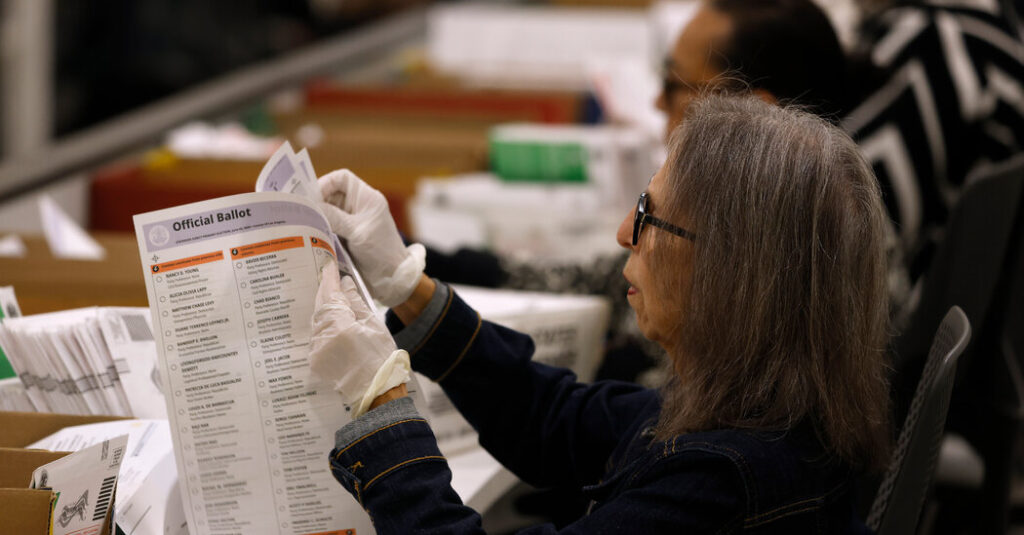
California’s election process is notoriously time-consuming, in part because of the state’s reliance on mail-in voting, and a requirement that officials do extensive work to check signatures, open envelopes and inspect ballots.
This year, a large surge of Democratic voters — weighing a choice among candidates they felt were unexciting — waited longer to turn in their ballots, further slowing down the count.
Gov. Gavin Newsom, a Democrat, has acknowledged that the long counting process doesn’t look good, and opens the state up to criticism and conspiracy theories, including from President Trump.
The governor sent a letter to election officials in May urging them to speed things up, saying that “the longer the voting count takes, the more mis- and disinformation spreads.” But his plea does not appear to have moved the needle.
Here’s what to know:
Other states with mail-in voting report quickly. Why doesn’t California?
Colorado, Arizona and Washington all process large numbers of mail-in ballots, but report results much more quickly. California hasn’t kept up with the personnel and resources necessary to match them, voting experts and advocates said.
Each county determines its own election spending, staffing and schedules, creating major differences in how fast they can return results.
Office space is also an issue.
Some counties lack room to accommodate workers and observers, and to securely store ballots received in the mail.
In Yolo County, outside Sacramento, election officials knocked out a wall in their building a few years ago to make space to process the growing number of mail-in ballots, said Jesse Salinas, the county’s registrar of voters.
“We are at capacity,” he said. “I don’t have any empty space.”
Could the count be sped up?
Some large counties, such as Los Angeles and Orange, have invested in equipment to accelerate counting — but they can still take a week to process up to 90 percent of the ballots because of limited hours. Smaller, less wealthy counties can take three or four weeks.
Mail-in ballots postmarked by Election Day are eligible to be counted in California if they arrive up to seven days later, meaning many votes aren’t even received until days after the election. Some eligible votes from the current primary might still be in the mail.
Stephen Richer, the former top elections official in Maricopa County, Ariz., one of the nation’s largest voting jurisdictions, suggested that the biggest factor is a lack of will among state leaders to sacrifice accessibility for speed. California gives voters extensive time to cure ballots that might have technical issues, and allows same-day registration.
Though Arizona delivers results more quickly, Mr. Richer empathized with election officials who fear they could face allegations of cutting corners if they counted too fast.
Top election officials don’t see the problem.
California’s top elections official, Secretary of State Shirley Weber, has made it clear that she wants counties to take the time to get it right, no matter the national reaction.
“Accuracy comes before speed,” Ms. Weber said in a statement last week. “California is the nation’s largest voting state, with millions of ballots to process and count. Taking the time to do this work correctly protects voters’ rights and ensures the integrity of our elections.”
Where does the vote stand?
Spencer Pratt, a Republican reality TV star, appeared to be running in second place in the Los Angeles mayor’s race until Sunday, when City Councilwoman Nithya Raman pulled ahead of him by just over 3,000 votes.
As of Sunday night, Ms. Raman, 44, had 27.1 percent of the vote and Mr. Pratt, 42, had 26.7 percent. The race has not yet been called for either candidate. Mayor Karen Bass, 72, secured her spot in a runoff the day after the election, and remains in the lead with 34.7 percent of the vote.
In the governor’s race, Xavier Becerra, a former Biden administration official, advanced on Friday, according to The Associated Press. Steve Hilton, a Republican, and Tom Steyer, a Democrat, were vying for second place and a spot on the ballot in November.
Laurel Rosenhall, Jill Cowan and Livia Albeck-Ripka contributed reporting.
The post What’s Taking So Long to Count California Ballots? appeared first on New York Times.