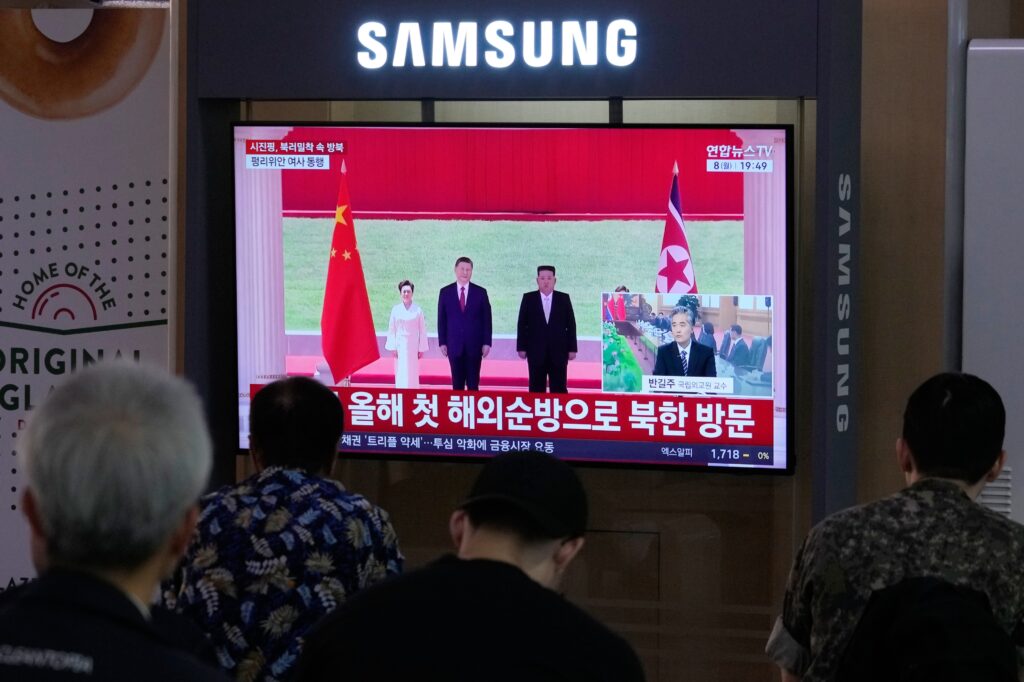
SEOUL — Chinese President Xi Jinping and North Korean leader Kim Jong Un celebrated what they called the “unbreakable” bond between their two countries on Monday, with Xi in Pyongyang, as they sought to project unity in the face of a Western-led global order.
Xi arrived on Monday to pomp and fanfare — his first trip in seven years to the North Korean capital.
The rare excursion, a two-day visit, is Xi’s first trip out of China this year, while more than a dozen world leaders have come to see him in Beijing. It comes at a moment of rising relevance for Pyongyang on the global stage since becoming a key partner of Russia in its war in Ukraine.
North Korea has supplied Russia with munitions compatible with Soviet-era weapons and more than 12,000 troops — giving Kim, the leader of one of the world’s poorest and most isolated countries, new leverage with major powers such as China and Russia.
North Korea and China have long maintained a complicated partnership. The two nations often herald a friendship “forged in blood,” referring to the Korean War, in which the Chinese fought alongside the North.
China is North Korea’s main economic lifeline, but Pyongyang has sought to maintain some independence from Beijing. Meanwhile, China is keen to keep close tabs on its nuclear-armed and unpredictable neighbor.
The relationship became strained after North Korea shut its border to China during the coronavirus pandemic. But North Korea is warming up to China again and Beijing wants to shore up its relationship with Pyongyang, the only power with which it has formalized a mutual defense treaty.
“Beijing never really wants North Korea to stray too far out of its orbit. Meanwhile, North Korea never wants to get sucked into the vacuum of Chinese power,” said John Delury, a northeast Asia historian and senior fellow at the Asia Society, a New York-based think tank. “That’s their historical dynamic, and that’s their dynamic now.”
This week’s visit kicked off with a highly choreographed welcome: A crowd of North Koreans waving Chinese and North Korean flags to welcome Xi’s motorcade. Xi’s trip is officially billed as a commemoration of the 65th anniversary of the two countries’ 1961 friendship treaty.
Giant portraits of the two leaders were on display at the Kim Il Sung Square in Pyongyang, where Kim and his wife, Ri Sol Ju, greeted Xi and his wife, Peng Liyuan, according to footage released by Xinhua, the Chinese state-controlled news agency.
The North Koreans welcomed Xi with a 21-gun salute and members of the North Korean military yelled, “We wish Comrade Xi Jinping good health.”
The two leaders observed a military parade, according to Xinhua, after which balloons carrying welcome messages in Chinese and Korean were released.
Xi and Kim held a meeting at the Kumsusan State Guesthouse, where Xi and Peng are staying. Cai Qi, a senior Chinese official, and Wang Yi, China’s foreign minister, are part of Xi’s delegation, Xinhua reported.
The leaders discussed in their meeting the expansions of economic and trade cooperation, working together in agriculture and construction, and increasing people-to-people exchanges across their shared border, according to the Xinhua readout.
Since the pandemic shutdowns ended, North Korea has gradually resumed crossings at its border with China. Trade has also rebounded to pre-pandemic levels, according to Chinese customs data from 2025.
The relationship between the two countries is at a “new historical starting point, facing new development opportunities and shouldering new missions of the times,” Xi wrote in an article published Monday in Rodong Sinmun, a North Korean state newspaper.
“China stands ready to work with the DPRK to steer bilateral relations from a strategic perspective, keep China-DPRK relations abreast of the times, and achieve greater development of the relationship,” Xi wrote, using the formal acronym for North Korea.
There is much for the two leaders to discuss, analysts said Monday.
Beijing wants to better understand North Korea’s policies and strategic calculations, as it declares itself a nuclear state and rejects denuclearization talks with the United States, said Zhu Feng, dean of the School of International Studies at Nanjing University in China.
Kim’s powerful sister announced on Sunday that North Korea’s nuclear weapons program is “the line of no retreat,” and she denounced the U.S., saying it spread “baseless disinformation” that Washington and Beijing share the goal of convincing North Korea to give up its nuclear weapons.
China has not shown much interest in reining in North Korea’s nuclear program in recent years.
As a permanent member of the United Nations Security Council, China has often sided with Russia to veto or abstain from placing new sanctions on North Korea — and U.S., Japanese and South Korean officials have raised concerns that China has decided to recognize North Korea as a nuclear state.
North Korea could have enough material to have assembled some 60 warheads, and enough to eventually assemble some 90, the Stockholm International Peace Research Institute said in its annual report released Sunday.
Beijing is also watching with concern the increased military cooperation between Russia and North Korea.
Pyongyang and Moscow have forged a mutually beneficial relationship, Zhu said: Russia needs North Korean troops and military equipment for the war in Ukraine, while North Korea is receiving energy and other support from Russia.
But Beijing’s deeper worry is over the prospect of a revived Cold War-style bloc, Zhu said.
“The problem is that Russia and North Korea hope Asia can return to the 1950s and form a so-called China-Russia-North Korea trilateral military alliance,” Zhu said. “This is a Cold War structure that China absolutely cannot accept.”
North Korea also may turn to China for insight into the Iran war and Xi’s meeting with President Donald Trump last month, said Delury, of the Asia Society. North Korea has long maintained friendly relations with Iran, but Pyongyang has kept Tehran at arm’s length since the U.S.-Israeli war, condemning the U.S. and Israel rather than explicitly supporting Iran.
And with North Korea abandoning its long-standing goal to reunify with the South, having declared South Korea a “hostile state” in 2024, China may also be interested in discussing the issue with the North, Delury said.
China is interested in keeping a good relationship with both Koreas, and it views a stable Korean Peninsula as key to stability in East Asia, analysts say.
“China’s relations are pretty good right now with the North and South, and that is a key objective for China ever since the end of the Cold War,” Delury said. “It’s very hard to sustain that when there’s a crisis, or when tensions spike between the two.”
Lu reported from Taipei, Taiwan.
The post Chinese leader Xi Jinping makes rare trip to North Korea in show of unity appeared first on Washington Post.