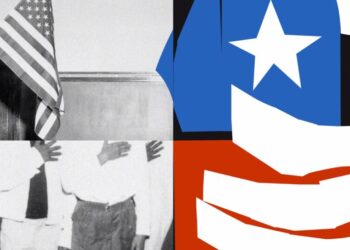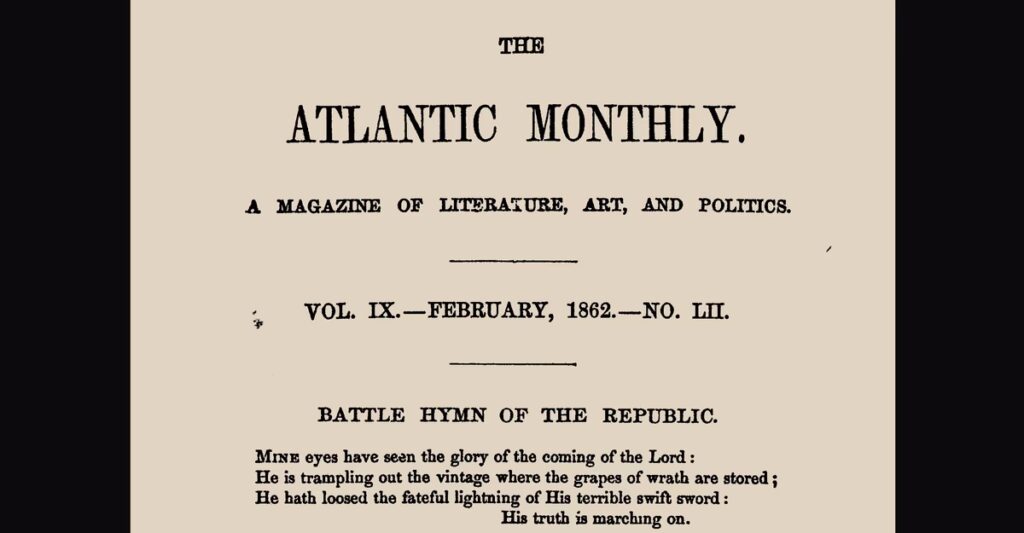
It is quite interesting, and somewhat chastening, to realize that the most important piece of journalism published across the 169-year history of this magazine was not journalism at all, but a poem, and that it was published so early in the life of The Atlantic. And it is particularly humbling to know that we will almost certainly never again publish something that so powerfully transcends space and time. The poem, “Battle Hymn of the Republic,” is one that, to borrow from its final stanza, “transfigures you and me.” We are featuring it on our cover this month in celebration of the 250th anniversary of the founding of the republic.
Julia Ward Howe, the author of the “Battle Hymn”—she wrote it in one fevered night at the Willard Hotel, in Washington, D.C.—received either $4 or $5 for her submission. It was published in our February 1862 issue without her byline, as was then the custom. One of the many reasons we wanted the “Battle Hymn” to represent The Atlantic on the semiquincentennial anniversary of American independence is that it would allow us to print the poem with Howe’s byline on our cover for the first time. It’s the least we could do, given all that she did for this magazine, and for her country as an abolitionist and a suffragist. And also because writing seemed, at times, so difficult for her.
In a note to the editor of this magazine, James T. Fields, that she attached to her submission, Howe wrote: “Fields! Do you want this, and do you like it, and have you any room for it in January number?” She went on, “I am sad and spleeny, and begin to have fears that I may not be, after all, the greatest woman alive. Isn’t this a melancholy view of things? But it is a vale, you know. When will the world come to end?”
Fields, to his credit, accepted the poem (we do not know if he also tried to soothe Howe’s anxiety). He also gave it its grand, martial, and commanding title.
The question arises: What does the “Battle Hymn,” written to prepare the Union and its soldiers for the terrible fight ahead, say about America itself? Our in-house historian, Jake Lundberg, writes in this issue that the poem is both an explication of the promise of America and an exhortation to persevere on behalf of the country. The “Battle Hymn,” Lundberg argues, is our unofficial national anthem, one more relevant through the ages than the actual anthem, the difficult-to-sing by-product of a minor war. “By the time of the Great Depression,” he writes, “the ‘Battle Hymn’ had achieved a truly national character. The song’s stature is such that it can be used to make a statement in a way that the official anthem never can.”
[Video: Jon Batiste reinterprets “Battle Hymn of the Republic”]
You will see in this issue (and, I hope, in everything we do) that our journalists are engaged in worthwhile struggles with the meaning, promise, achievements, and shortcomings of our singular nation. In an article that explores the betrayal of Black military officers, Clint Smith calls out the forces of reaction for misunderstanding the nature of patriotism. And in an essay that examines the tortured debate—inside and outside the academy—over how to tell the American story, Yoni Appelbaum writes about the special challenge inherent in unifying a polarized nation around a common understanding of our history. “For more than two centuries, our creedal nationalism has been a source of strength, binding together Americans of diverse faiths and backgrounds,” he writes. “But lately, we have discovered that it is also a vulnerability.”
The ambition of The Atlantic’s founders was that this magazine would be the preeminent home for arguments about the American idea, and that we would endeavor to tell the truth about the grandness of America as well as its imperfections. That ambition animates this issue—and all of our journalism.
This editor’s note appears in the July 2026 print edition.
The post America’s Promise appeared first on The Atlantic.