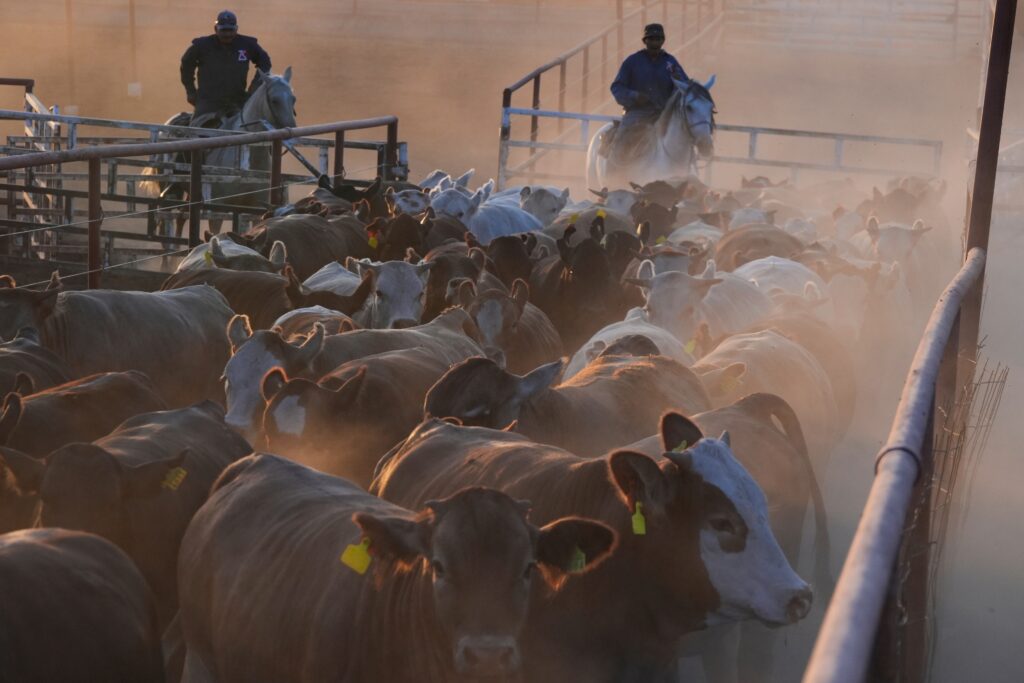
Juan Manuel Fleischer’s ancestors ranched on the borderlands before the United States existed, and the Arizona resident’s business importing Mexican cattle across the modern-day frontier has survived decades of immigration politics and the construction of a towering steel wall.
But that work has collapsed over the past year as an insidious threat shakes U.S.-Mexico relations and the American beef industry: The New World screwworm, a flesh-eating parasite that has resurged south of the border 60 years after it was mostly eradicated in U.S. livestock.
Around 1.2 million young Mexican cattle cross each year through a half-dozen entry ports to bulk up in American pastures or feedyards. But the gates have been shut to livestock for most of the past year, since a cow in southern Mexico tested positive last November for New World screwworm — maggots that burrow into warm-blooded animals, creating foul-smelling wounds and sometimes fatal weight loss. Mexican cattle imports have plunged to about 230,000 in 2025 as additional cases have emerged farther north, including one in September only 70 miles south of the border.
“We’re hurting,” Fleischer said. “We’re basically going broke.”
The unprecedented closure, when a shrinking American cattle herd is contributing to near-record high beef prices, represents both a rare agreement on science and trade between the Biden and Trump administrations and the intense alarm shared by federal officials and the broader U.S. livestock industry. Agriculture Secretary Brooke Rollins has called keeping the parasite out of the country “a national security priority.”
The blockade, however, has upended cross-border relationships forged over generations and financially strained Texas cattle feeders, New Mexico importers and Arizona ranchers.
“We’re trying to almost beg the USDA to keep our Nogales border open,” said Jorge Maldonado, the mayor of Nogales, Arizona, where the livestock pens are empty at a port of entry that remains busy with produce imports.
Maldonado has a small cattle operation across the border in the Mexican state of Sonora, and recently he sold about a dozen animals for $10,000 less than he would have fetched in the United States.
But Maldonado said his larger worry is for his city of 20,000. He estimates that it has collected as much as 15 percent less in bed taxes this year because of the absence of Americans and Mexicans who typically stay overnight and “wine and dine” while negotiating over cattle that must be quarantined for three days on the Mexican side. And it has been “a catastrophe,” he said, for local businesses that revolve around the industry.
One belongs to Fleischer, who in a good year brought in 80,000 cattle from small ranches in Mexico. He walked steers and heifers through the dust and through the metal border barrier, where he was known as an expert at sorting the animals by size with just a glance. When he heard about the closure, Fleischer recalled, “I said, ‘Oh, my god, it’s going to kill us. This will break us.’ ”
Now he is surviving on savings, and his wife and son have taken on substitute teaching jobs.
New World screwworm was a scourge in the first decades of the 20th century, costing U.S. ranchers tens of millions of dollars a year and killing thousands of deer. The federal government spent millions of dollars more to eradicate it in the 1960s through the breeding and unleashing of sterile flies, which eventually doomed the species domestically. Occasional outbreaks have since occurred among livestock in the Southwest, and, in 2016, among endangered Key deer in the Florida Keys. And in September, a rare human casewas reported in a Maryland resident who had traveled to El Salvador.
The concern today is not that New World screwworm would wipe out American cattle, but that the cost of monitoring and controlling it would be enormous, experts and industry officials said. USDA estimates an outbreak could cost the Texas economy alone $1.8 billion.
“This would be a very hands-on issue if it were to emerge,” said Hunter Ihrman, a spokesman for the National Cattlemen’s Beef Association. “It makes people very nervous.”
He said the association is supportive of the border closure and other federal efforts to hold back the pest, though it wants speedier action on plans for an $8.5 million sterile fly production facility projected to open in Texas early next year. The only such facility in North America is in Panama.
At a meeting with Rollins last month in Mexico City, Mexican President Claudia Sheinbaum again pushed for the reopening of the border, calling it a “top priority.” But the USDA, which did not respond to questions for this article, has made clear it does not trust Mexico to control the threat.
Maldonado, the Nogales mayor, said USDA officials who met with him and other Arizona officials and producers on Monday indicated it would stay shut at least until the end of the year.
He and others involved in the trade say they feel confident that the New World screwworm could not slip past import protocols, which involve quarantining in Mexico, anti-parasite treatments and inspection by U.S. and Mexican government veterinarians. They also argue that the closure is contributing to high American beef prices, which the Trump administration has pledged to address by investigating meatpacking companies and importing Argentine beef.
Industry watchers are skeptical the blockade has driven up prices. The loss of Mexican cattle, which in typical times represent about 3 to 4 percent of the American calf herd, has likely had only a “marginal impact” on prices, said Derrell Peel, an Oklahoma State University agricultural economist.
What is clear, he said, is the hardship on those who depend on the trade. “Regionally, the impacts are very severe,” Peel said.
Among those affected is Mark Rogers. He started his Dimmitt, Texas feedyards 30 years ago with a few Mexican cattle. When the border first shut a year ago, 90 percent of his 50,000 animals were Mexican. Rogers found Mexican cattle hardier than domestic, a quality he attributed to the travel and the import process they underwent. After years of almost daily phone calls, he calls the Mexican producers he works with “some of my best friends.”
These days, Rogers is down to about 27,000 head of cattle, he has cut a third of his workforce, and he says he is breaking even. His neighbors also have vacant pens, he said. “I’ve laid in bed at night thinking, ‘What the heck?’” he said. “But I’ve just got to know that one of these days that border’s got to open back up.”
Fifteen percent of the feeder cattle in Texas come from Mexico, the state’s agriculture commissioner, Sid Miller, said in an interview. He said he has sent proposals to White House officials, urging them to allow a “test opening” of imported Corriente cattle for rodeos and to deploy a specific fly bait. They have not responded to the first idea, he said; the USDA sternly rejected the latter.
Discontent is hardly uniform in the industry. Those who breed calves are getting top dollar for their animals. And some who import Mexican cattle say they understand the caution.
The shift “has been painful on one side of the ledger,” said Kevin Buse, chief executive of Champion Feeders in Hereford, Texas, who runs feedyards and ranches in Texas, Oklahoma and Nebraska. He has faith in the health surveillance of cattle on both sides of the border but said he also trusts the USDA’s approach. “We need to open slowly, we need to make sure that what we’re doing is good, and make sure we’re not stepping into a bear trap.”
But the change to Buse’s business is felt by Alvaro Bustillos, president of Vaquero Trading, an El Paso company that before the screw worm blockade generated $400 million in annual revenue importing 250,000 Mexican cattle a year, including for Champion Feeders. Now it is shut down.
Like many in the trade, Bustillos, who is also chairman of the board of the cattle producers’ union in Chihuahua, Mexico, said he worries all the American politics around beef prices have made reopening even thornier. In a September letter, Bustillos urged Rollins to reconsider. “This relationship goes beyond numbers: We share traditions, genetics, culture and families that have worked together for generations on both sides of the border.”
Just over the New Mexico state line, the pens at the Santa Teresa port of entry, the nation’s busiest for livestock, are eerily silent. In a typical year, 500,000 cattle and horses valued at $1 billion cross at the port, according to Daniel Manzanares, who directs the livestock crossing.
Manzanares has laid off half of the 40 employees. Truckers who transported the cattle are also out of work, he said. “There are people selling homes, people selling semis,” he said. “It’s created such a disaster for so many people.”
But for now, he sees little reason to hope. “We are a really tiny chip in the poker game between the U.S. and Mexico,” he said.
The post Flesh-eating worm in Mexico is squeezing U.S. beef supply appeared first on Washington Post.