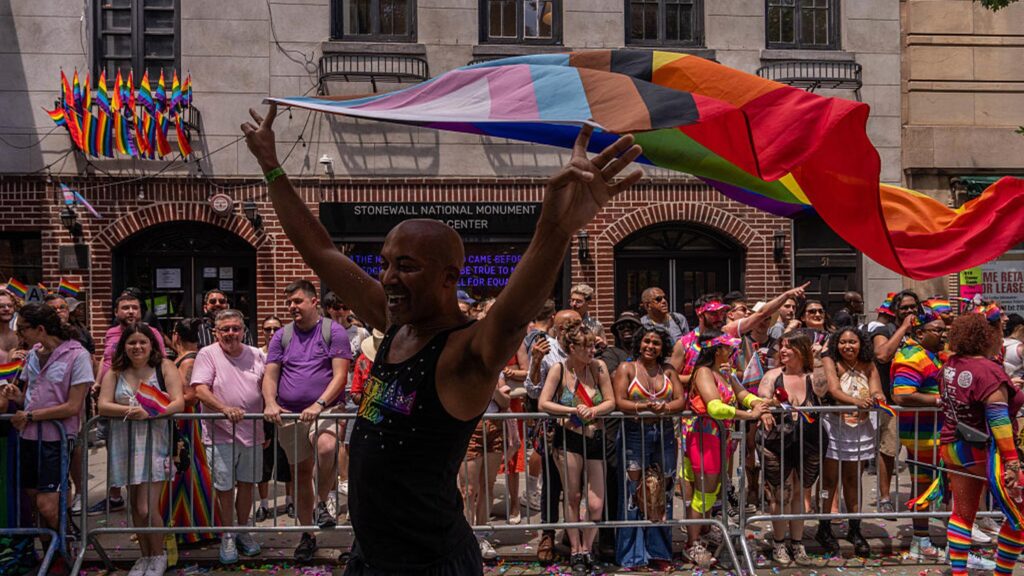
Each year since 1988, the National Trust for Historic Preservation has issued its list of America’s most endangered historic places, spotlighting sites at risk from neglect, climate change, and development. This year, Stonewall National Monument in New York City is among them.
The National Trust’s endangered list is often associated with crumbling facades or vulnerable landscapes. Stonewall, by contrast, reminds us that history can also be endangered by something less visible but equally devastating: erasure of stories, denial of truth, and political attempts to silence communities. Stonewall’s inclusion on this list signals that LGBTQ+ history itself is under threat, and that protecting Stonewall is connected to protecting the rights and dignity of the people whose lives are bound to it.
As the first and only LGBTQ+ visitor center within the National Park Service, our endangered designation underscores what we already know: our histories, including sites like Stonewall, are not guaranteed to endure. In an era marked by federal efforts to strip away transgender protections and a broader political movement seeking to sanitize or ignore queer contributions to the American story, a permanent physical presence is a radical act. We are anchoring a history that many would prefer to see erased.
Stonewall occupies a singular place in American history because, much like we are seeing today, it helped unite and transform a community long relegated to the margins into a visible force demanding recognition, dignity, and equal rights. In the early hours of June 28, 1969, police raided the Stonewall Inn, a gay bar in New York City’s Greenwich Village. But instead of quietly dispersing, patrons and neighborhood residents resisted, sparking several nights of demonstrations that crystallized growing frustration with discrimination and police harassment. The uprising became a turning point in the struggle for LGBTQ+ rights, energizing a new generation of activists and helping propel a movement that would reverberate far beyond New York.
One year later, in 1970, thousands gathered for the Christopher Street Liberation Day March, a protest now widely recognized as the first Pride parade. What began as a commemoration of the uprisings at the Stonewall Inn soon evolved into an annual tradition that spread across the United States and around the world. Over the decades, Stonewall became a global symbol of resistance and liberation, representing the enduring power of collective action to expand the boundaries of freedom and belonging in American life.
To create the Stonewall National Monument Visitor Center, we made a pivotal, deliberate decision from the outset. It would be a non-profit organization, privately and independently run, and entirely supported by donations. This choice was born of a desire for narrative sovereignty, ensuring that our story would never be subject to the shifting whims of political administrations.
Too often, the contributions of women, and specifically women of color, are marginalized or left unrecognized in the very movements they lead. Yet, this visitor center was conceived, built, and fought for by us: two queer women of color. Our identities added a deep layer of complexity to an already improbable undertaking.
Throughout this journey, we have primarily remained in the background, performing the quiet, unglamorous, and painstaking work required to build something new and necessary. But these times demand a different kind of stewardship. When symbols like flags are contested, when history is selectively remembered, and when even a national monument to LGBTQ+ resistance can appear on an endangered list, we cannot afford to remain invisible. We are stepping forward, alongside so many others, to safeguard this legacy, a task that requires visible leadership.
Now, we are asking our allies and advocates to do the same: to further their efforts to move from silent support to active, public commitment to protecting LGBTQ+ history and rights. The National Trust’s designation is not just a stark warning sign; it is a call to action for policymakers, donors, and communities across the country to recognize that places like Stonewall are irreplaceable.
In recent years, we have witnessed a coordinated effort to pressure corporations to withdraw their support for diversity and inclusion programs. Organizations like ours, which sit at the intersection of history and advocacy, find themselves in the crosshairs of a culture war that casts support for LGBTQ+ rights as a liability rather than a core value. Navigating the fundraising frontline in this climate is a sobering reminder of how undervalued LGBTQ+ history is. We live in a world that frequently celebrates the Pride aesthetic in June but turns away from the enduring, uncomfortable truths of our history when political pressure increases.
How can a nation embrace rainbow branding while failing to robustly protect the very sites where LGBTQ+ liberation took root? How can we claim progress if the physical and narrative foundations of that progress remain precarious?
In the 23 months since we first cut the ribbon to open our doors, the Stonewall National Monument Visitor Center has welcomed over 115,000 visitors from all 50 states, the District of Columbia, Puerto Rico, and 93 countries. Every day, we see the weight of this global reach in the faces of those who enter: the elders who were there in 1969, seeing long-overdue validation, and the youth who, for the first time, see a reflection of their own courage. That history, our history, is worth protecting.
The post Stonewall’s Legacy Can’t Be Taken for Granted appeared first on TIME.