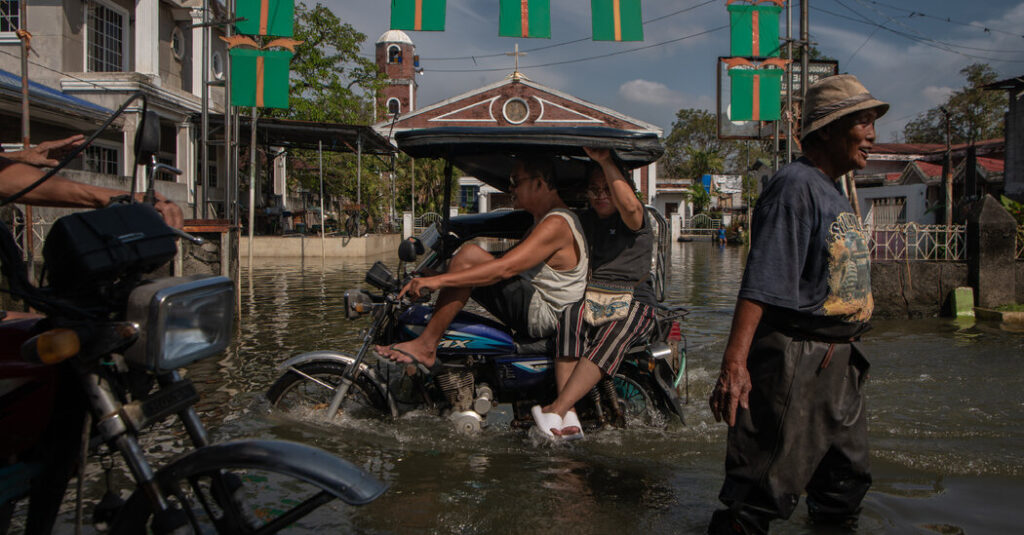
Cynthia Colindres remembers her low-lying village flooding every two or three years when she was growing up, a fact of life in the typhoon-plagued Philippines.
Nowadays, she said, it happens two or three times a year.
So she was stunned when the Philippine government said recently it had spent tens of millions of dollars on flood-control projects in her native province, Bulacan, in recent years.
“So many are listed, but we don’t see any of them,” Ms. Colindres, 49, said of those projects. On Friday, she had to wade through knee-high water to take her 7-year-old son to school.
The perennial flooding in Bulacan and elsewhere has now become the symbol of a scandal engulfing the Philippines. Many of the billions of dollars’ worth of flood-control projects like river walls and dikes approved by the authorities in recent years, it turns out, were never built, while others were not finished or proved to be severely defective.
Last month, nearly 100 people died in the central province of Cebu after heavy rains from Typhoon Kalmaegi inundated drainage systems there. As the region’s governor pointed out, officials in Manila said the equivalent of hundreds of millions of dollars had been spent on flood-control projects in Cebu.
President Ferdinand R. Marcos Jr. acknowledged in August that a multiyear, 545 billion peso (roughly $9.8 billion) program for alleviating flooding was riddled with corruption. He has created an independent commission to investigate wrongdoing, pledged to punish offenders and, last week, announced the arrests of eight people accused of embezzling from the program.
But the scandal has become a ballooning crisis for Mr. Marcos.
On Sunday, thousands of demonstrators took to the streets in Manila to protest the graft. It was the third such large rally since September, and for many it evoked the peaceful movements that ousted two Philippine leaders, including Mr. Marcos’s father, the dictator Ferdinand E. Marcos.
One of the most dramatic aspects of the unfolding scandal involves Zaldy Co, a contractor and former member of the House of Representatives. Last month, the Office of the Ombudsman, an independent agency, filed charges of embezzlement against him, and a special court issued a warrant for his arrest.
But Mr. Co remains at large. From hiding, he has released a series of video messages accusing Mr. Marcos, his executive secretary, one of his sons and a cousin of benefiting from the corruption. All of them denied Mr. Co’s claims.
“The president would not dare be the one to order an investigation if he knew he had done something wrong,” said Claire Castro, Mr. Marcos’s spokeswoman.
Last week, Mr. Marcos announced that in addition to Mr. Co, seven lawmakers would be referred to the ombudsman’s office for prosecution..
“The money of the people will be given back to the people,” Mr. Marcos said.
In August, Mr. Marcos visited Calumpit, the hometown of Ms. Colindres, about 30 miles north of Manila. There, he inspected a defective dike that had been built on the Calumpit River.
Until that visit, Ms. Colindres said, she had blamed climate change alone for her family’s hardship.
She and her husband have renovated their two-story house to adapt to the persistent flooding, Ms. Colindres said. The ground floor is now mostly empty, with all the important appliances and furniture upstairs.
Evacuations, high laundry bills and jump boots, for wading through water, have become the new normal for the couple and their son. They often move their car, a Suzuki Ertiga, to higher ground at the first sign of heavy rain.
“Our hope, first of all, is that someone gets jailed — that someone takes responsibility,” Ms. Colindres said.
Weena Gera, an associate professor of political science at the University of the Philippines, has written that the corruption scheme had two main mechanisms: inflating budgets through congressional amendments and padded appropriations, and then rigging the bidding process.
Networks tied to high-ranking officials pressured contractors for illicit payments, Ms. Gera said. Some lawmakers received up to 30 percent of a project’s cost as kickbacks, she said, with additional payoffs going to district engineers, senior public works officials, bankers and auditors.
Mr. Marcos has said that just 15 contractors secured 100 billion pesos, or about $1.7 billion, worth of projects. Trying to show progress, last month the authorities seized a fleet of luxury cars, including a Rolls-Royce and a Bentley, from a couple who had secured some of the largest flood-control contracts and now face tax-fraud charges linked to the program. The vehicles are being auctioned off.
The scandal has deepened a rift between Mr. Marcos and Senator Imee Marcos, his older sister. She criticized his budget last year, saying the outlay for public works was “bloated.”
The senator is close to Vice President Sara Duterte, a former ally of the president who is now a fierce critic. Ms. Duterte has tried to capitalize on the scandal, saying she had left Mr. Marcos’s cabinet last year because of widespread corruption. But Ms. Duterte has also faced questions about how she spent government-allocated funds.
Aries A. Arugay, who teaches political science at the University of the Philippines, said he believed Mr. Marcos was sincere in wanting accountability. But given the persistence of corruption in Philippine history, Mr. Arugay doubts that the investigation ordered by the president will yield systemic changes.
In Calumpit, Ms. Colindres is still waiting for the government to do its job.
“We hope there’s a real plan of action, some concrete way forward,” she said, “hopefully as soon as possible — that something is really done, because so many people are suffering, especially now with climate change.”
The post The Philippines Spent Big on Flood Control, but the Water Keeps Rising appeared first on New York Times.