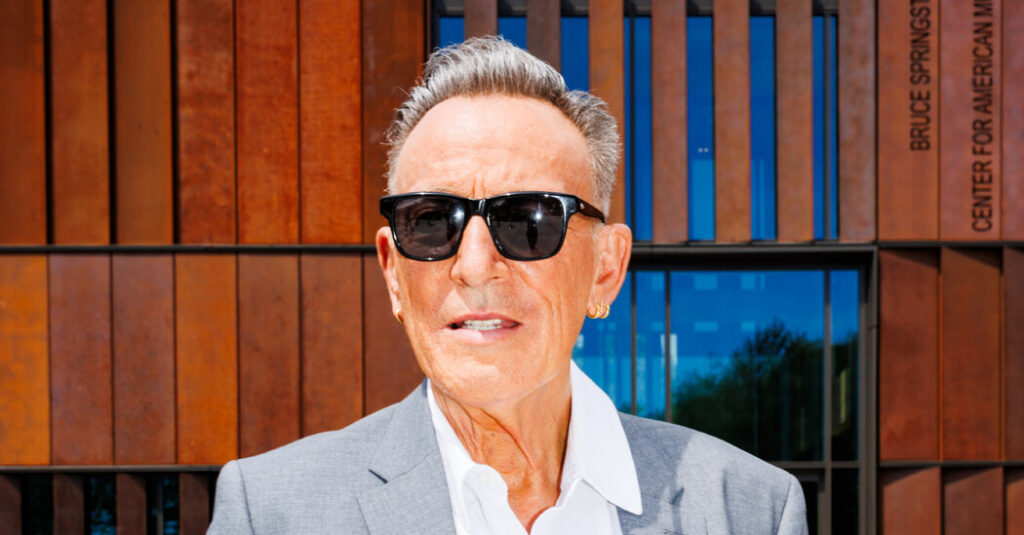
When Bruce Springsteen started playing rock ’n’ roll in bars along the Jersey Shore, he could not have imagined that there would one day be a building with his name out front. But in the last few days he found himself leading the opening festivities for the Bruce Springsteen Center for American Music, a 30,000-square-foot cultural hub on the campus of Monmouth University in Long Branch, N.J.
Scheduled to open on June 13, the center houses Springsteen’s vast archive, along with exhibits dedicated to the history of American musical genres. It is overseen by Robert Santelli, the center’s founding executive director; Eileen Chapman, the director; and Jon Landau, Springsteen’s longtime manager.
As part of the celebration, Springsteen and a host of music luminaries, including Jon Bon Jovi, Public Enemy and members of the E Street Band, put on two nights of shows in an arena on the Monmouth campus. Before hitting the stage, Springsteen, 76, discussed his love of American music and the way he came to embrace the role of cultural preservationist.
The interview has been edited and condensed.
You were initially reluctant to opening a Springsteen archive. Why?
I don’t know, it seemed too auspicious. It’s like, Hey, you really want your name on a building? Who knows what you might do?
Initially, it was just kind of unusual, talking about it. I think when we focused on the fact that it was going to be a place that I would get to share with all these other musicians — that it would be a center for American music itself — I said, “Well, that’s kind of how I see myself.”
I’m a small link in a big chain. I’m the guy that came along and kind of picked up the flag. That’s the way it works. You run with it for a while, and you pass it on to the next guy. I think the center reflects that. I got more comfortable with it when we thought of moving it in that direction.
Was there a thought about what kind of themes or movements you wanted in the exhibits?
I’ll be honest with you: I didn’t have a whole lot to do with that. We talked about the general parameters of what I would be comfortable with and what I felt it should encompass, and I have to say that Eileen [Chapman] and Bob [Santelli] and Jon [Landau] — they all ran with the ball and put it together. I was as shocked as anybody coming through it the other day and seeing what it turned into. I had no idea it was going to be as extensive and as incredibly well presented and put together as it is.
What stood out to you?
Frank Sinatra’s tuxedo was pretty cool, you know? All the interactive stuff. For young kids that are going to come through, there’s going to be a lot to engage them. I look for a place like this as being filled with people who may only be barely familiar with what I do myself. I’ll be satisfied when there’s a line of school buses out in the parking lot. I think that’s what we’re shooting for. All the interactive things are going to be really fascinating for younger people and children.
Thinking about this as a place of permanence, where would you like to see the center in 20 years?
Well, I would imagine 20 years from now, I would like to see, and probably will see, as my own relevancy fades — I’ll be happy with the little glass cabinet with the main business of whatever I did, surrounded by a bunch of other incredible musicians. I would like to see it continue as an American music center, a place that attracts young people who are looking for a sense of historical continuity, a sense of inspiration, a sense of how American music shapes culture and how culture shapes politics. A place that will expand, inspire and educate your mind, your soul and your heart.
You mentioned politics. One of the exhibits that stood out to me was the one on the protest song. Where do you see protest music right now?
It’s certainly not front and center these days. I’ve written a lot of music that has political implications, and what I would call critically patriotic, which is really my definition of a patriot. And I’ve written a lot of music like that. And I suppose I’ve written things that you could call protest songs — “American Skin,” “Born in the U.S.A.,” really, obviously, and, of course, “Streets of Minneapolis.” But where’s it going? There’s young folks out there. Jesse Welles. There’s my buddies in Dropkick Murphys. It’s there, it’s alive, it’s present, it’s living and it’s having its impact. There’s always going to be something to protest in the U.S.A.
In the past, some protest songs like “Ohio” by Neil Young became hits, breaking through popular culture. Is that still possible?
Well, “Streets of Minneapolis,” strangely enough, for where I’m at in my work life now — it was a hit. Millions of people saw the video on YouTube and downloaded the song. I was shocked by the amount of people. It was far beyond what my music usually generates in social media.
I think anytime there are events that people are desperate to contextualize and to understand, protest music will always have its place. I believe that when the times call for it, and if there’s an artist there who is willing to meet those times, fire with fire, it’ll be relevant.
Why put the Center of American Music in New Jersey?
Well, it’s in New Jersey, because I’m from here, I live here. It’s like, why not?
There’s an expansive lineup for the Music America shows celebrating the opening. And the concert President Trump planned for the America 250 celebration on the Washington Mall has fallen apart. Was this a way of doing a version of that, or celebrating the 250th?
I have to give the credit to the folks who put it together. Last night, there was an entire night of Indigenous musicians over at the Pollak Theater. That was fascinating. And the way that Bob set up these two nights, which is taking you through the history of American music, with all these artists who have generously donated their time, is really what should have been happening nationally, and should have been happening on the Mall. So it’s nice that it’s happening, period. And I’m flattered and excited that it’s happening here.
You have a long history of playing at Monmouth University. Was that a thought behind putting the center here?
I like the fact that it’s on a university campus, having never really attended college myself, which is something I regret. But everything played out the way it played out. I’ve played as a musician here since I was about 19 years old, a lot of shows on this campus, and Bob was an alumnus. So I like the fact that it’s here and a place that I feel really at home in.
Monmouth County has long been a red county, and your recent tours have challenged the current Republican Party. Was there a purposefulness to having the center here, especially with a protest exhibit?
No, not at all. It’s a bit of a reflection of my own personality and character — who I am — that we did want the place to reflect. I think whatever your political leanings are, you’re going to come here and you’re going to be enlightened and entertained. You may not agree with everything you see, but that’s the lay of the land. So I think it’s a place for everybody.
It reminded me of one of your closing remarks about neighbors in the most recent tour.
Yeah, it’s a bridge.
Was any of your initial hesitance about the center also thinking about legacy?
I used to think about that when I was younger, believe it or not. But as I got older, I had a friend, John Sayles, the great film director. He said: ‘I make my movies for people to see them right now. That’s really their fundamental purpose. Where they go after that, I don’t have any control over, and it’ll be what it’ll be.’
I’m playing for right now. And, like I said, eventually, in this building, I’ll have a small space in it. At some point, I won’t have my big floor up there, and that’s the way it should develop. And I’ll be satisfied and happy.
I find it hard to believe your archive could be contained in a small space. What gives you that feeling?
There’s so much in American music. It’s just the way that I view my own career.
If you could have anyone included in the center, or something that you really think should be there, or perform with, who would that be?
Oh, God, there’s everyone. Bob Dylan and James Brown. Sam and Dave. All my heroes, my mentors and teachers, all the artists who inspired me and taught me my craft. Eventually, hopefully, we will encompass a lot of those folks. But there’s so many influences right now.
Is there an artist who has gone unheralded that you’d like to spotlight on in the center?
Well, my buddy Steve Earle’s in, so that’s nice.
We’re close to Asbury Park. How much do you see a local music scene able to thrive now?
Well, Asbury, I never thought I would live to see it revitalize itself as it has. That alone is something I’m very happy about. The town still has a lot of work to do. Once again, there’s the West side that needs a lot more attention. But, yeah, there’s a lot of young, good young musicians in Asbury that I stumble across once in a while.
But I’m not down there. I’m in bed at freaking 9 o’clock. I’m in bed before the set starts. So it’s their town now.
Nick Corasaniti is a Times reporter covering national politics, with a focus on voting and elections.
The post Bruce Springsteen Talks About His Place in American Music appeared first on New York Times.