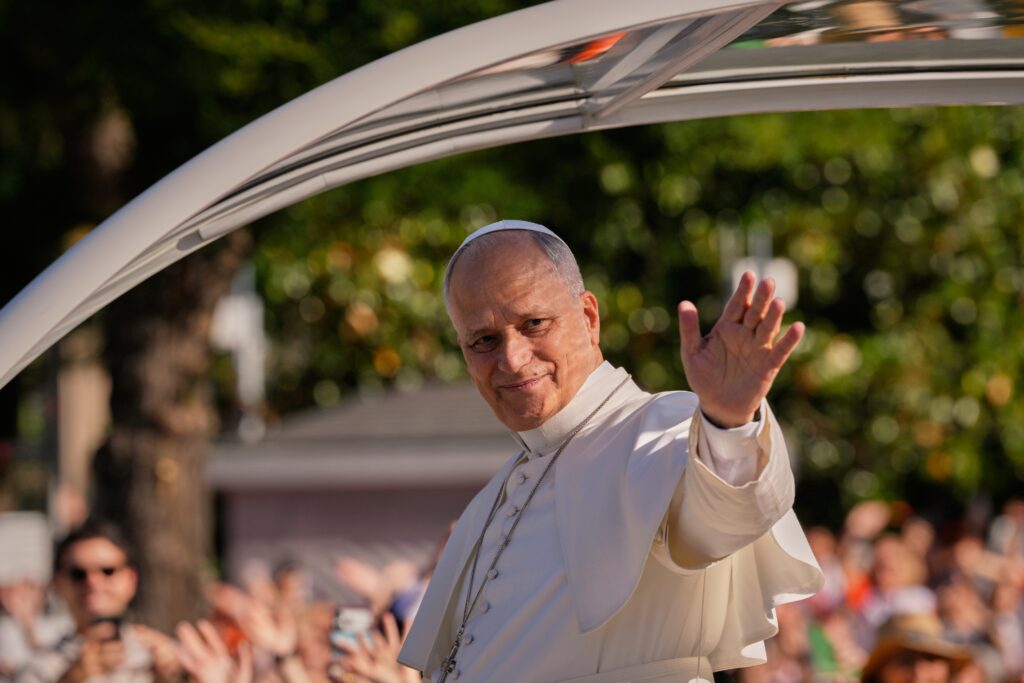
MADRID — This weekend, icons of faith and pop culture have circled each other in the Spanish capital like celestial bodies drawn close by gravity. One, the first U.S.-born pope, leader of 1.4 billion Catholics. The other, Bad Bunny — the Puerto Rican singer whose gospel of reggaeton has racked up more than 123 billion streams on Spotify.
Madrid, all of Spain and the celebrity-obsessed press have pondered the possibility of a supernova encounter, with Bad Bunny having requested to meet the Holy Father, according to a person familiar with his interest.
Either way, something special is taking shape on Pope Leo XIV’s first official trip to a major Catholic country in the West. The stoic Chicagoan who began his papacy with the body language of an introvert is displaying the makings of his own star turn.
In Spain, which has grown widely secular in recent decades and is one of the world’s most socially progressive nations, Leo drew an estimated 500,000 people Saturday night for a youth concert and prayer vigil and 1.1 million for a sprawling open-air Mass on Sunday that brought parts of Madrid to a standstill.
These are some of the biggest crowds of his 13-month papacy, and two days into a seven-day trip, his totals far exceed the 500,000 fans paying upward of $80 a pop for Bad Bunny’s 10-night run of concerts in Madrid.
At the start of his papacy, and on his first foreign trip — to Turkey and Lebanon last year — Leo was sometimes stiff and stilted. But the man emerging from the popemobile in Spain, moving through crowds in pristine white with emotive assurance, holding babies, hugging disabled people, blessing foreheads, seems transformed.
Onstage, Leo, speaking fluent Spanish, seems more affecting, more natural, sometimes stirring the faithful to tears.
“He’s found his stride,” said Elise Ann Allen, a Vatican journalist and author of a biography of Leo, nodding and smiling as she watched him onstage Saturday evening. “He’s found his voice.”
Leo, 70, has grown increasingly vocal in his opposition to the war in Iran, and his role as a foil to President Donald Trump has elevated his global stature. But observers also see a pope who is more inspirational at ground level, with his speeches moving throngs in Africa in April, even as he chastised the powerful by decrying corruption, violence and tyrants.
Last month, Leo’s first encyclical — centered on the morality of artificial intelligence — stirred global reflection, with disparate politicians including Vice President JD Vance and Spain’s liberal prime minister, Pedro Sánchez, quoting his work.
Popular acclaim does not come easily to all popes.
During his 26 years as pontiff, much of it spanning the late 20th century, John Paul II was seen by scholars to connect with the masses in an especially powerful and transformative way, and he is often credited with aiding the fall of communism.
Before Benedict XVI’s shock retirement in 2013, the German-born pope was adored by traditionalists and drew large crowds, though he himself conceded he lacked a certain charisma with the faithful.
By contrast, Francis, the first New World pope, was endowed with — or suffered from, depending on the point of view — an excess of personality, presiding over a controversial papacy that enjoyed secular popularity even as some conservatives accused him of grandstanding, fuzzy rulemaking and lacking doctrinal discipline.
Leo is beginning to show “Francis’s [level] of social engagement combined with the balanced and thoughtful attitude of Paul VI,” said Marco Politi, a Rome-based author of several books on the Vatican. “We’ll see surprises in this papacy. As one Vatican monsignor said, using the last name the pope was born with, ‘Prevost has more in his storage room than he shows in the shopwindow.’”
In the current attention economy, in which digital distractions compete with a rising desire for genuineness, comparisons of a pope and a pop star are hardly far-fetched. The worlds of celebrity and faith each involve a claim to mystique, to cult following, to image crafting. The rapture of fandom and devotion can mirror each other.
The artistic power of Bad Bunny, a global megastar and ambassador of Hispanic youth culture, is to mesmerize; to feel linked. The same can be said of a pope charged with inspiring the faithful, sometimes to religious ecstasy.
Leo, aboard the papal flight, noted that he would be competing for attention with Bad Bunny in Madrid. Leo said he hoped young people “are looking for something more … [a] spiritual dimension in their lives. They realize there’s an emptiness, and a lack of a sense of meaning.”
“If they are confronted with the question, do they want to see Bad Bunny or do they want to see the pope, I think many will see Bad Bunny,” Leo said. “But I think there will also be a few here to see the pope. And that says something.”
Those few turned out to be throngs.
A person familiar with the discussions between the Archdiocese of Madrid and Bad Bunny’s representatives, who spoke on the condition of anonymity to frame confidential conversations, said the artist had expressed interest in a meeting upon learning that he and Leo would be in Madrid at the same time.
The lingering question, the person said, centered on working around two tight schedules.
An encounter between Leo and Bad Bunny — a former altar boy raised in the home of devout Puerto Rican Catholics who is not known to be currently religious — would join two outwardly disparate symbols of Trump’s wrath.
Leo, leader of the largest Christian faith, has condemned the war in Iran and called the Trump administration’s migrant crackdown “inhuman.”
Bad Bunny, the reigning king of Latin trap and reggaeton, is a superstar whose Super Bowl halftime show in February was both hailed as a celebration of tolerance and the Spanish-speaking world, and derided by the MAGA movement and Trump, who called it an “affront to the Greatness of America.”
They may have radically different personas, but when it comes to pluralist visions, Leo and Bad Bunny are brothers in arms. Leo became a naturalized dual citizen of Peru while serving there as a missionary and bishop, and he has gone out of his way to sidestep overt references to American patriotism. If he celebrated Thanksgiving last year, he did so in private. Next month, he will visit the migrant hub of Lampedusa, Italy, on the Fourth of July.
Any decision to engage with one of the world’s most streamed artists, whose spicy songs could make a pontiff blush, could also show a pope willing to take risks by meeting youth culture where it exists and thrives, opening himself up to criticism from those who have taken aim at Bad Bunny for his lyrics, gender-fluid style and defense of undocumented migrants.
In Spain, Leo has been greeted like a rock star.
In Madrid on Saturday, amid chants, flags and the hum of anticipation during Leo’s vigil for young people, Elena García, 19, wore a broad smile as she awaited his arrival.
“For a Christian, meeting the pope is like the biggest football fan meeting Cristiano Ronaldo,” García said. Should Bad Bunny make a gesture to the pope, she said she’d be thrilled: “We welcome with open arms anyone who wants to live the faith and do good.”
On Sunday evening, Leo held an event focused on connecting the church to culture, art and sport.
In an emotional speech before the pope, Spanish actor Antonio Banderas noted the church’s historic role as a patron of the arts.
“The church has been the biggest promoter of art in humanity,” Banderas said, looking directly at the pope as he spoke. “Art must be the alternative to violence, all forms of violence, as Christ did,” he added. Leo smiled in reply.
The Spain trip is in its early days, but it has seen Leo at his most effusive, and at ease. He showed a playful side aboard the flight from Rome to Madrid, quipping to journalists when asked whether he preferred the Real Madrid soccer team or its rival Barcelona: “That’s easy. … The pope is for all teams, but Prevost is Real Madrid.”
During a visit to a Madrid social center for the poor on Saturday, he joked that he’d failed to memorize his speech, saying it was okay because “we’re all family here,” before reading off a written script. (Francis, undoubtedly, would have winged it.)
During that same event, as well as the youth event later that night, Leo appeared more animated, hugging the faithful, including a young disabled Russian immigrant who seemed to melt in Leo’s arms.
Not everyone was won over by Leo’s style — which Leire Martínez Barcena, who jointed a group of pilgrims from Castellón at the papal Mass on Sunday, compared unfavorably to Francis.
“I was very much a Francis person. He felt more down to earth, less about gold, more about the people,” she said. “Yesterday I noticed he was wearing a very large gold brooch to fasten the cape. With Pope Francis, you almost never saw gold.”
Yet in Plaza de Cibeles, crowds stretched for blocks Sunday morning as Catholic chants echoed off surrounding buildings, people held hands, embraced and joined in song; some in tears, some smiling.
Elías Domínguez Teva, 37, a priest from Seville, looked around him, surprised by the crowd. “What has struck me most is the affection people are showing him,” he said. Leo, he added, was begging to “come into his own.”
Dalila Olmo López contributed to this report.
The post With Leo and Bad Bunny touring Madrid, the bigger star might be the pope appeared first on Washington Post.