It’s hard to imagine a more fraught combination for what was supposed to be a fun Friday night: Seattle’s Pride celebration will feature a World Cup match on June 26 between Iran, where homosexuality is punishable by death, and Egypt, where homosexual activity is punishable by up to three years in prison.
When FIFA’s schedulers announced the Pride Match pairing after December’s draw, it felt a little like a sick joke. The Egyptian Football Association has said it will reject “in absolute terms” any signs or symbols of gay pride. Mehdi Taj, the head of the Iranian football federation, told news agencies that the game assignment was an “irrational move,” and just about everyone was, for once, on Iran’s side.
Iran’s role in the entire tournament has since become a much thornier dilemma: Whether the country will participate at all will remain in doubt until 11 men take the field for their opening game against New Zealand, scheduled for June 15 in Los Angeles. In March, after the United States and Israel killed Ayatollah Ali Khamenei, Iran’s sports minister said that the country “was not in a position to participate in a World Cup.” Iran then petitioned FIFA to move its group-stage games to Mexico, but that plea was rejected. Late last month, Iran moved its base camp from Tucson to Tijuana. FIFA brokered the deal after the U.S. balked at hosting the Iranians for extended periods.
“Football unites the world,” Gianni Infantino, FIFA’s president, likes to say, ignoring the fact that the U.S. keeps bombing Iran, and that fans from Iran, Iraq, Haiti, Senegal, and the Ivory Coast are still subject to President Trump’s full or partial travel bans. An Ebola outbreak has also threatened the Democratic Republic of the Congo’s participation. Less than a week out from the biggest men’s World Cup in history, Infantino’s easy rhetoric is proving no match for the world’s more complicated realities.
At FIFA’s annual congress, held in April in Vancouver, delegates from 210 countries were registered as present during the impossibly long roll call. (“Faroe Islands?” “Present.”) The single absence was Iran’s, after Taj had his Canadian visa revoked mid-flight for having once been a member of the Islamic Revolutionary Guard Corps, listed by Canada as a terrorist entity. He arrived in Toronto, was refused entry, and was sent back to Tehran.
Trump had promised that Iran’s players would be allowed to enter the U.S. “It would be hard to believe they have a good team, but we must let them play at the World Cup,” he said recently. The Iranians left their farewell celebrations in Tehran and headed to Ankara, Turkey, to get fingerprinted for their visas, not knowing if they’d receive them. The players finally did, on June 5; Iransaid that more than a dozen staff and officials, including Taj, were denied visas but will reportedly travel to Mexico in the hopes of winning belated approval. Nobody seemed to know how the drama would end—except, that is, for Gianni Infantino.
“Of course, Iran will be participating at the FIFA World Cup 2026,” he said during his address at April’s congress. “Of course, Iran will play in the United States of America. The reason for that is very simple, dear friends. It is because we have to unite. We have to bring people together.”
He ignored the fact that during an earlier test of the electronic voting system, delegates from the 210 members in attendance were asked to agree to the fact that they were gathered in Vancouver.
In a secret ballot, five voted no.
This World Cup cycle, the first to include 48 teams and share hosting duties among three countries, is expected to bring in a record $13 billion, and each of the participating countries will pocket a base reward of $12.5 million. It was supposed to be $10 million, but Infantino began hearing complaints from even rich countries feeling the squeeze: travel, hotel, and ticket costs threatened to leave teams in the red. His last-minute decision to increase payouts, announced two days before the congress, quelled a larger revolt.
Managing Trump has proved trickier. In December, Infantino awarded him the first FIFA Peace Prize, an obvious play at soothing Trump’s anguish for his not having received the Nobel. Even by Infantino’s usual standards for lightly concealed skid-greasing, it was a shameless display.
Infantino declined requests for an interview, but several delegates to the FIFA Congress who wished to remain anonymous told me that the 56-year-old Italian Swiss Lebanese lawyer is more of an operator than a manager, better equipped to maintain his power, $6 million salary, and the lifestyle they afford him than to do much good with them. (Vancouver police reportedly denied a request for Infantino to receive a level-four motorcade while he was in the city, the same level afforded to the pope and the U.S. president; FIFA denied asking for any specific level of security.)
Infantino became FIFA’s leader in 2016 after Sepp Blatter, another Swiss, was unseated amidst a major corruption scandal. More than a dozen FIFA executives and their associates were indicted by the U.S. government in a bribery and vote-buying scheme. Delegates, mostly from small or developing countries, received kickbacks in exchange for their votes, especially on World Cup hosting duties, and the U.S. lost the 2022 men’s World Cup to Qatar in what was widely seen as a corrupt result. Although Blatter himself was not charged in the investigation, his regime collapsed under the weight of hundreds of millions of dollars in bribes for TV rights and other spoils, and he was soon banned from international football for ethical breaches.
When the U.S., Canada, and Mexico were awarded the honor of hosting 2026’s edition—the first such vote under Infantino’s new regime—Infantino, who cast himself as a reformer, won credit for righting a wrong.
But while avoiding Blatter’s style of brazen corruption, he became, almost instantly, chummy with strongmen, and perhaps a bit too enthusiastic about his place among them. Infantino’s first World Cup was hosted by Russia, after which he received the Russian Order of Friendship from President Vladimir Putin. (Infantino has since started campaigning to lift Russia’s ban from play that followed its invasion of Ukraine.) His second was in Qatar, where he moved and accepted the use of a private jet, becoming one of the emirate’s most impassioned defenders in the process.
In a February interview with Politico, Blatter accused his successor of ruling “like a Sun King.” “Who is FIFA today?” Blatter asked. “It consists only of its president, Infantino. FIFA is a dictatorship!” Blatter also suggested that Infantino, like a lot of dictators, has started acting withdrawn. At FIFA headquarters, he said, Infantino doesn’t wish to be greeted and won’t share an elevator. “He isolates himself completely,” Blatter said.
It’s no accident that FIFA is based in Zurich. The association has always professed a convenient and lucrative neutrality, faithful only to the beautiful game and the money it generates. The second World Cup, in 1934, was held in Benito Mussolini’s Italy and served his blustery model of fascism; 1978’s edition took place in Argentina, in the middle of its military junta and the disappearance of tens of thousands of dissidents.
From his home in Doha, Infantino helped Qatar establish a new precedent for a host’s imposition of its norms on visitors. Two days before the competition began, Qatar banned alcohol sales in and around stadiums. Budweiser, one of the tournament’s major sponsors, couldn’t do anything about it.
There was also an uproar over rainbow-colored captain’s armbands that read OneLove, promoting inclusion. Seven European captains threatened to defy an order against wearing them, until, hours before England’s opening kickoff, FIFA announced that each would receive a yellow card. The seven captains caved.
Infantino has claimed he understands the plight of the oppressed: He grew up as a redhead in Italy. Still, he defended the move by saying that Europeans needed to apologize for 3,000 years of their own sins before “starting to give moral lessons to people.” Qatar’s culture was worthy of respect, he said, and Infantino’s FIFA would help ensure that it was respected.
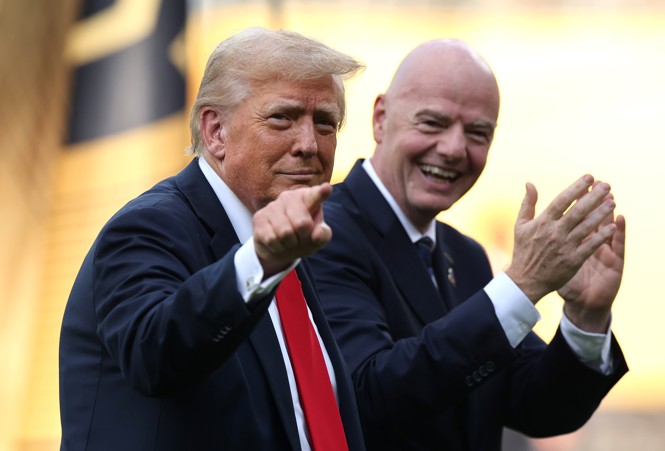
Infantino engineered his next coup when Saudi Arabia was named host of the 2034 World Cup after its sovereign wealth fund invested heavily in FIFA. Because the 2030 edition was scattered across Europe, Africa, and South America (with Argentina, Paraguay, and Uruguay receiving one token game each), 2034 was open to bids from only Asia and Oceania. FIFA then sped up the bidding process, giving potential hosts only 25 days to submit their applications. Saudi Arabia did so immediately, and alone.
There was an outcry, as there often is about Infantino’s undemocratic tactics, but it didn’t matter: Saudi Arabia’s grand sportswashing campaign had won its greatest trophy. (There have been suggestions that Infantino expanded the World Cup to 48 teams in part to make it easier for China to qualify; it still fell short, and TV rights there reportedly sold for about a fifth of what FIFA had hoped.) He has continued his pattern of tribute paying with Trump, attending a MAGA rally, Trump’s inauguration, and the premiere of Melania. According to New York magazine, Infantino also named Miami as a host city after a dinner there with Jared Kushner, Trump’s son-in-law and a proud new Miami resident.
During Trump’s first term, Infantino had been more critical of the president and his policies, especially his travel ban on Muslim-majority nations. “When it comes to FIFA competitions, any team, including the supporters and officials of that team, who qualify for a World Cup, need to have access to the country—otherwise there is no World Cup,” he said in 2017. “That is obvious.”
He has since chosen a different tack, trying to moderate his wild-card host with gifts and obsequious attention, one very strong man to another.
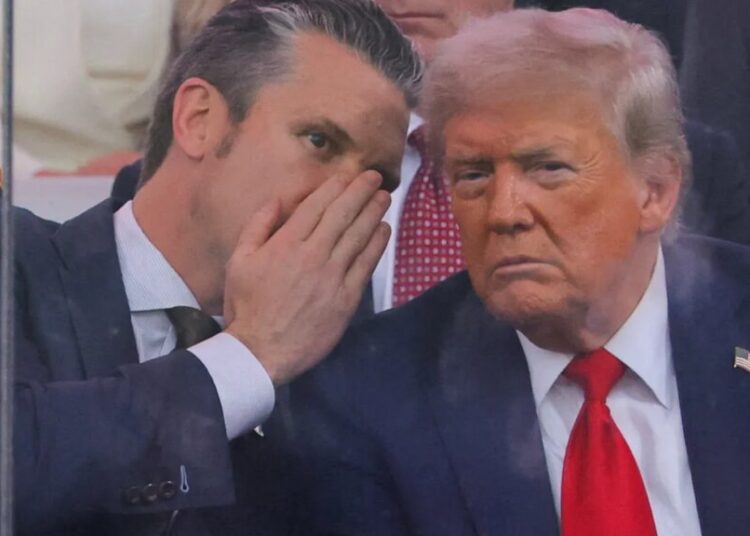
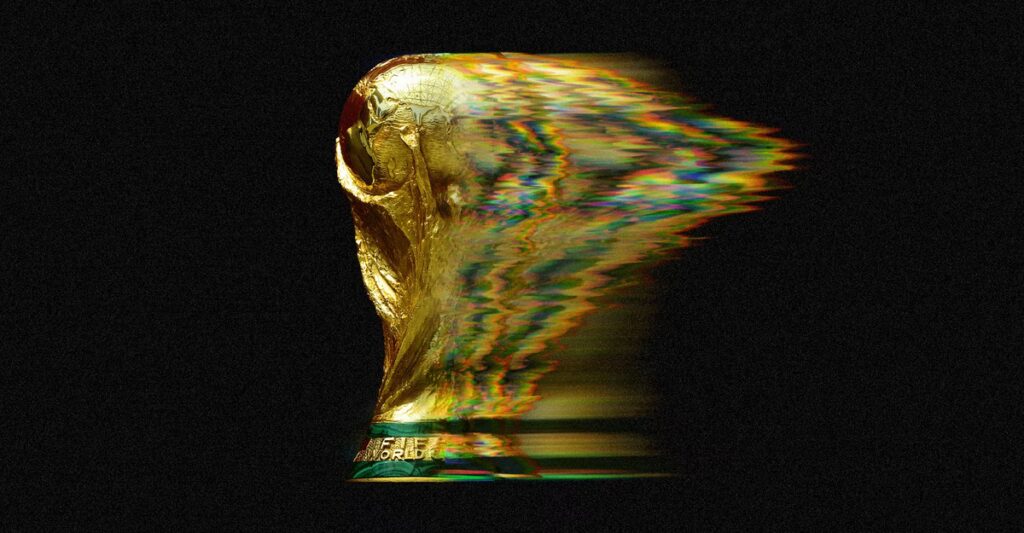
In August, Infantino brought the World Cup itself to the Oval Office. “Since you are a winner, of course, you can as well touch it,” he said, handing the trophy to Trump, who was wearing a red TRUMP WAS RIGHT ABOUT EVERYTHING! cap indoors.
“Can I keep it?” Trump said, before answering his own question. “We’re not giving it back.” Infantino did eventually wrest the trophy from Trump’s hands—“That’s a beautiful piece of gold, I will say,” Trump said, his eyes following it the way a cat tracks a laser pointer—before giving him the even gaudier FIFA Peace Prize in December.
Of course, Infantino couldn’t have foreseen Trump’s military incursions in Venezuela and Iran or his threats to invade Greenland, which made the peace prize look even more ridiculous than it already did. (In a January interview with The Guardian, an anonymous FIFA source said it was a “deep embarrassment,” and in April, the president of Norway’s federation called for the peace prize to be abolished and its awarding to be investigated.)
Venezuela narrowly missed qualifying for the World Cup, which, in its way, solved a problem, and Greenland’s application for membership in the Confederation of North, Central America and Caribbean Association Football, or CONCACAF, was unanimously rejected last June.
Iran’s team, however, not only qualified but, no doubt to Trump’s surprise, is ranked 21st in the world, only five spots behind the United States. If the Iranians do take the field, Seattle’s Pride Match might decide who wins Group G. The first-place finisher will advance to the Round of 32 game scheduled for July 1, also in Seattle. There are a lot of games to be played, but one scenario is a match in which Iran plays Iraq.
There is another: If Iran finishes second, it will play on July 3 in Dallas. If the U.S. finishes second in its group, too, Iran’s opponent will be the United States of America.
Infantino endured another lesson in the limits of his facile brand of diplomacy in Vancouver, when he was outmaneuvered by Jibril Rajoub, the 73-year-old president of the Palestinian Football Association, who had asked to address the congress. Rajoub called for sanctions against Israel for the war in Gaza, the way Russia had been punished for the war in Ukraine. Basim Sheikh Suliman, the vice president of the Israel Football Association, parroted Infantino with a vague response about football’s ability to unite the world. “In football, there is no place for politics,” he said.
After Suliman finished, Infantino asked him to stay onstage, and he invited Rajoub to come back up: What better way to demonstrate the power of football, and for Infantino to reassert his sense of self, than to have these two men shake hands for the cameras?
Rajoub climbed back onstage but refused to shake Suliman’s hand, shouting about the injustices of the war in Gaza. “Please, please, please,” he cried, loud enough to be heard at the back of the giant room. “We are suffering.” Suliman stood still, uncertain of what he should do. Infantino, smiling through it, eventually got both men offstage.
A FIFA source who wished to remain anonymous told me later that both men had agreed in advance to a handshake. If that’s true, Rajoub had set a trap.
Rajoub once served as Palestinian President Yasser Arafat’s national security adviser and spent 17 years in various Israeli prisons. In 1970, he was convicted of throwing a grenade at a bus of Israeli soldiers. He’s also the head of the Palestine Olympic Committee, and in 2015, he named a table-tennis tournament after Muhannad Halabi, who had stabbed two Israelis to death, including a young father, two months earlier. The idea that he would get onstage and smile for the cameras while shaking hands with a representative of Israel is almost laughable. But somehow, he convinced Infantino that he would.
Or Infantino convinced himself. He concluded the congress by announcing that he would seek reelection at next year’s edition in Rabat, tweaking the rules so that he could serve 15 years instead of 12, the term limit. A clutch of FIFA staff, dressed in identical blue suits and FIFA-branded Adidas sneakers, stood and applauded. Not many of the delegates did. Infantino ran his most recent two elections unopposed, and it’s widely expected that he will again.
But he might face a challenge from Victor Montagliani, the Canadian head of CONCACAF. Montagliani also spoke in Vancouver, and his speech sounded like the start of a rival campaign. “Leadership is not about power,” he said. “Leadership is about service. It’s about making decisions for the many, not the few.” Infantino looked on, his smile not quite reaching his eyes.
Any genuinely global event will have its friction points—and having three countries host 48 others, rather than one country host 32, was always going to make things knottier. But this World Cup should have been different. It was, in soccer parlance, a sitter. There are none of the usual final-week jitters about stadium preparedness or creaky infrastructure, and the U.S. is still, like FIFA, technically a democracy.
But there is a Trump-shaped shadow over the 2026 World Cup, beyond the on-and-off war with Iran. Foreign fans, like other tourists, have heard horror stories about ICE and are electing to stay home. Hoteliers in most U.S. host cities are forecasting lower occupancy rates than they had hoped, and inflation and price gouging have made tickets and public transit prohibitively expensive for Americans. (On match days, NJ Transit is charging $98 for a return trip to MetLife Stadium, a ticket that normally costs $13.) One of our great unifiers—1.5 billion people watched the last final—looks like it could be another source of division instead, and what should have been Infantino’s simplest navigation suddenly seems his most perilous.
The FIFA Congress is an annual event, no matter whether there’s any real need for it. It’s another chance for Infantino to exert his influence with first-class airfares, suites at luxury hotels, and fleets of polished black SUVs. According to one soccer executive, Sarah McLachlan received $500,000 to play four songs at a splashy private party for delegates. Infantino defends the excess as a demonstration of his commitment to equality: Everyone gets paid. So long as each of FIFA’s 211 members pretends to try to qualify for the World Cup, they get at least $5 million every cycle. That’s a lot of money for Timor-Leste, Eritrea, and Guam.
“The most important point for me is that whatever we do in FIFA is guided by one principle, one very simple principle,” Infantino told the congress. “FIFA has 211 members, and all 211 are equal.”
There was supposed to be some real business done in Vancouver: the votes for who will host the women’s World Cups in 2031 and 2035, the first two to field 48 teams. The ballot was a formality because Infantino had ensured there was only one bid for each year. In 2031, the U.S. is once again poised to host, along with Mexico, Jamaica, and Costa Rica. In 2035, it’s supposed to be the United Kingdom.
But here, again, Infantino’s plans have been complicated by Trump. Shortly before the Vancouver congress, The Athletic reported that Trump’s administration has withheld the usual guarantees about visas and security for 2031—not that they’ve meant much in 2026—until FIFA rewrites its transgender-athlete policy, banning athletes born male.
FIFA, accustomed to being the one that makes the demands, has so far resisted the change. Trump’s leverage is the absence of a competing bid. Infantino removed the votes for both women’s World Cups from Vancouver’s agenda, pushing them to a virtual Extraordinary Congress on November 23, three weeks after the U.S. midterm elections.
But first comes Infantino’s own strategic test, the same one faced by every emperor whose dominion threatens to collapse because of overexpansion. FIFA could have easily avoided the Pride Match controversy, at least. Seattle’s celebration could have featured Belgium and New Zealand, which are competing in the same group and playing each other on the same day. Instead, that game went to Vancouver.
Ignorance is one explanation for the otherwise inexplicable, but the fact that FIFA has said nothing about its scheduling decision and the anxiety it has caused suggests intent.
Only four years after Qatar, it’s possible that Infantino, recognizing that he yielded to one host’s demands, decided against placating countries that might take offense to a different host’s more liberal standards. The rules have to stay the rules: These are the conditions, and they are not for you or for us to change. We’ll make sure the grass is cut. Your only choice is to play or not play.
Or, given the circles in which he has come to operate, he might be employing a more sinister calculus.
How might Infantino continue to curry favor with Trump, who, in addition to his anti-DEI policies, has threatened Democratic-led host cities with the removal of games? How might one man help the other unsettle “radical left” cities such as Seattle beyond even the usual World Cup chaos? How might Infantino continue to profess neutrality while still clearly taking a side, pretending to listen to every voice while remaining obedient to only one?
The way you’d ruin any party: You’d invite the worst possible guests.
The post The Absurd World Cup appeared first on The Atlantic.