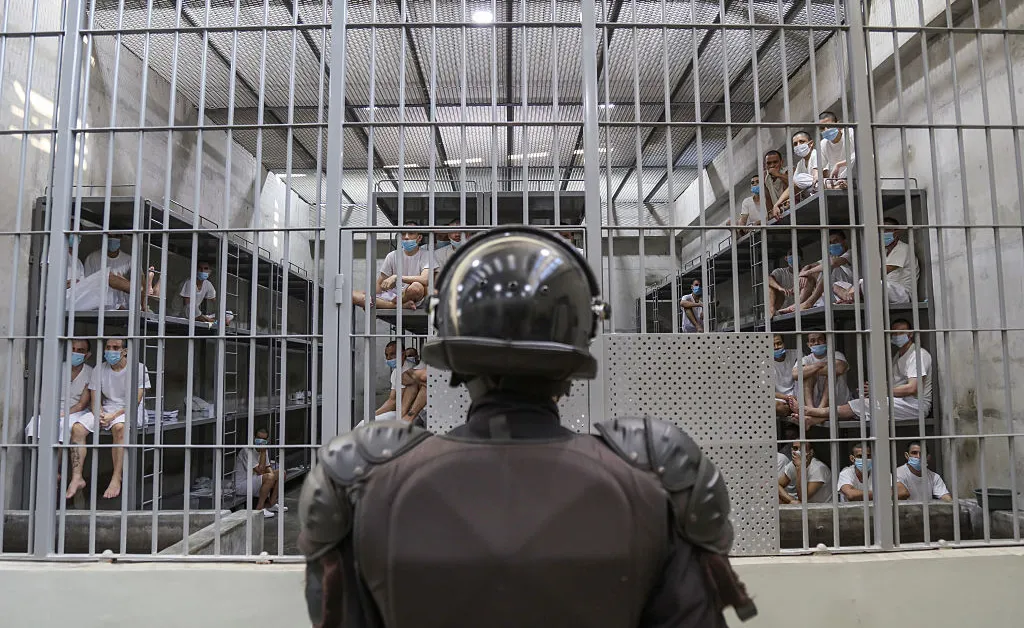
A now-closed immigration detention center in the Florida Everglades known as “Alligator Alcatraz.” New, foreign-funded “model” prisons rising across the Caribbean. And El Salvador’s CECOT mega-prison, where more than 250 people deported from the U.S.—including Kilmar Abrego Garcia—were sent earlier this year. Together, they reveal how a global vision of mass incarceration is spreading, one cellblock at a time.
[time-brightcove not-tgx=”true”]
These facilities illustrate a growing obsession with prison construction as the only perceived solution to crime. Much of this expansion is at least partly financed—even after the Trump administration’s major cuts to the U.S. foreign aid budget—by the U.S. and the European Union. Each of these facilities divert resources away from more effective and humane approaches to creating safe communities.
On the Dutch Caribbean island of Sint Maarten, for instance, the Point Blanche Prison and House of Detention Facilities is being rebuilt through a United Nations Office for Project Services project, at a cost of roughly USD $52 million, mostly financed by the Netherlands. In French Guiana, the French government is spending around 400 million euros (approximately USD $450 million) on a new prison in Saint-Laurent-du-Maroni, complete with a maximum-security wing. And in the Bahamas, construction began in July on a $50 million high- and medium-security facility.
The list continues. In Trinidad, the Minister of Homeland Security recently announced that the 268-year-old Port of Spain Prison will be decommissioned in four phases to make way for a new facility. The government there also plans to open a new prison on the neighboring island of Tobago. In Jamaica, Prime Minister Andrew Holness has said that plans for a new high-security prison are nearly complete and that land for the project has already been identified. Similar projects are underway in Ecuador, Costa Rica, and Honduras, where a new “megaprison” designed to hold 20,000 people is being modeled after high-security facilities in the United States and El Salvador.
To be clear, these Caribbean prisons are screaming to be shuttered. Conditions there are, generally speaking, an abomination: vastly overcrowded, rife with disease, and mostly devoid of space for quality programming such as education or job training. Trinidad’s Port of Spain Prison, for instance, has been condemned by courts for being unfit, overcrowded, unsanitary, and in violation of constitutional rights. Like Jamaica’s Tower Street Adult Correctional Centre, it has no toilets in the cells, leaving human beings to defecate in newspaper sheets.
Yet focusing so much government time, money, and foreign aid on prison building is both myopic and ineffective—a shiny way to make a tough-on-crime statement without actually building safer communities. Even new “model” prisons have been criticized for inhumane conditions, lack of meaningful programs to support education, skill-building, or reintegration into society, and limited oversight. Nevertheless, across the Caribbean and Latin America, governments are still pouring hundreds of millions of dollars into prison construction.
Generally speaking, Global South governments can only make these kinds of investments with significant international donations or loans. The U.S. has been the major player in this sector for the last twenty years, providing at least $5.2 billion of international criminal justice assistance funding from 2013-2022. In the first decade or so of the 2000s, as part of “Plan Colombia,” U.S. agencies such as USAID and the Federal Bureau of Prisons built at least 16 new prisons there. Canada, meanwhile, funded the Croix-des-Bouquets prison in Haiti, which opened in 2012 with capacity for 872 people and by 2021, when hundreds escaped from the facility, held more than 1,500 people.
Read more: How the U.S. Exports Punishment
The Dominican Republic provides an instructive example of well-intentioned international reform interventions gone wrong. Since the early 2000s, the Dominican government, with European funding, built more than a dozen modern, well-managed “new model” prisons. These dramatically improved conditions, fairness, and recidivism rates. But since the government did not tackle endemic corruption and the excessive use of pretrial detention, the prison population swelled, almost doubling in number between 2003 and 2020; the pretrial detention rate remains brutally high, around 60%. In the name of tackling dire conditions, the government is planning to build even more prisons, without a clear path to reducing pretrial detention.
What happens when prison building takes center stage? Big-picture rethinking—of legal systems; of misdemeanors and petty offenses on the books; and of root causes of crime, like inequality and social exclusion—falls by the wayside.
Staggering pretrial detention rates across the Global South illustrate how justice can be undermined when the focus of reform is on building prisons. In many countries, more than half of the people in prison have not been convicted of anything; in several Caribbean countries, detainees languish for on average up to four years in prison before sentencing, sometimes spending longer in prison awaiting trial than their imposed sentence. Courts routinely ignore laws prohibiting pretrial detention of more than a few months and treat such stays as “justice”; punishing the accused, despite not convicting them. Courts in Trinidad and Tobago refuse to recognize a speedy trial right altogether. Overwhelmingly, individuals in pretrial detention are marginalized people who cannot afford bail or access adequate legal aid. Public defenders are chronically underfunded, meaning that the poorest individuals experience both the longest delays and weakest advocacy, a mechanism for criminalizing poverty.
The pathway to justice has already taken shape, and we need only to follow it. Evidence demonstrates that diversion programs, restorative justice practices, bail reform, and reintegration services reduce incarceration without jeopardising public safety.
Jamaica’s National Restorative Justice Programme, launched in 2012, offers a compelling alternative to incarceration by resolving conflicts through dialogue among survivors of crime, individuals who caused harm, and communities. Operating through several community-based centers, it has contributed to reducing court backlogs and recidivism. Jamaica’s experience shows how restorative justice can strengthen safety, trust, and social cohesion, demonstrating that safety grows from inclusion, not exclusion.
We are often asked by policymakers around the world to point to a “model prison,” and we tell them the same thing: there are no “model prisons”; there are humane, holistic, decolonized systems. Effective reform shifts public resources from building cells to rethinking legal systems and expanding social services that allow people to meet their needs, thereby preventing crimes from occurring in the first place, and making us all safer.
The post How the Global South Got Caught in the West’s Prison Pipeline appeared first on TIME.