The 10th in an occasional series of profiles on Southern California athletes who have flourished in their post-playing careers.
The play started innocently enough with Tab Ramos bouncing a one-hop pass to Paul Caligiuri, who played the ball off his chest 40 yards from goal. But everything changed when a Trinidadian player stepped lazily out to meet him.
Caligiuri faked right then cut left, the beaten defender sticking his right leg out wildly in protest. Suddenly surrounded by nothing but space, Caligiuri let the ball take one small hop before striking a left-footed volley from about 28 yards that arced softly between the right post and the outstretched arms of diving goalkeeper Michael Maurice.
Goal!!!!!!!!!!!!!!!!!!!
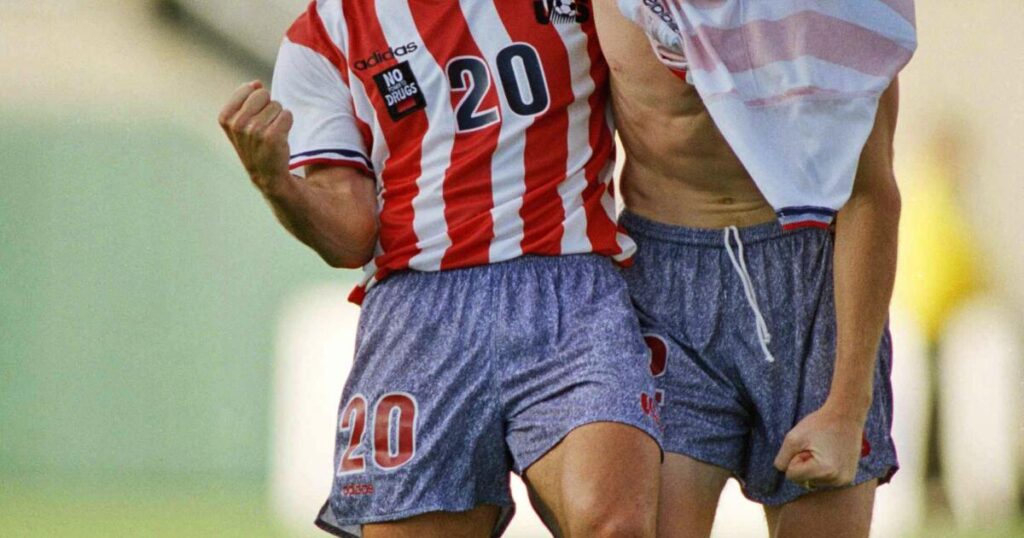
That score, in the 30th minute of the final game of World Cup qualifying in the fall of 1989, was as unlikely and unadorned as it proved to be earth-shattering. Because when the U.S. made that goal stand up for a 1-0 win over Trinidad and Tobago, the Americans qualified for the World Cup for the first time in 40 years.
The U.S. has missed the tournament just once since then, and will play host to the World Cup for a second time this summer. Yet none of that starts without Caligiuri’s goal, which has become known as “the shot heard ‘round the world.”
“Someone asked me what moment in sports has ever impacted a complete sport as much as that goal,” Caligiuri said.
The list is a short one.
Jackie Robinson breaking baseball’s color barrier. Dick Fosbury flopping over the bar in the high jump. Tiger Woods winning the Masters. Like those moments, Caligiuri’s goal was so transformational it became the line separating the present from the past, the ancient from the modern.
“We established the game,” Caligiuri said. “Now we’re talking a whole different level. The expectations are way higher.”
Before Caligiuri’s goal, the U.S. had no first-tier soccer leagues. Now it has both men’s and women’s leagues, with five teams valued by Forbes at more than $1 billion. When Caligiuri scored his goal, the women’s national team was just four years old. Since then it has gone on to win four World Cups and five Olympic gold medals while the men’s team has ranked as high as fourth in the world, according to FIFA.
“We sort of expanded our wings because of what happened in 1989,” Ramos said. “You can make a case a lot of things that happened after that wouldn’t happened had it not been for that 1989 team.”
When Caligiuri scored his goal, soccer wasn’t even a blip on the sporting landscape in the U.S. Today it has passed baseball and hockey to become the third-most popular sport in the U.S., according to a recent survey by the Economist.
“I think about it all the time,” said Soccer America editor Paul Kennedy. “Would MLS have happened? Would soccer continue to grow if there hadn’t been Caligiuri’s goal?”
The goal changed Caligiuri’s life as well. Cut from the Olympic team five years earlier, he went on to play 110 games for the national team, retiring as the second-most-capped player in history. (He’s still 11th on the all-time list.) He started seven World Cup games and his goal in the team’s group-play opener in Italy in 1990 was the first by an American in the tournament in 40 years.
He was also one of the first Americans to play in Europe and was a charter member of MLS, starting for the Columbus Crew in the team’s first game. His final game came with the Galaxy, in the 2001 U.S. Open Cup final. Four years later, he was inducted into the National Soccer Hall of Fame.
Few men in U.S. Soccer history have had a hand in tearing down so many barriers and leading so much progress. But it’s a history that must be retold to be understood and appreciated. The return of the World Cup offers an opportunity to do just that.
“The information about players like him are getting lost,” said Nick Webster, executive vice president of the Orange County-based United Premier Soccer League (UPSL), the largest pro-developmental soccer organization in the U.S. and an organization Caligiuri serves as an ambassador.
“He played a long time ago. But the World Cup, that’s a definite connection. What changed the landscape of the sport in this country was the World Cup.”
More children are registered to play soccer than any other sport in the country, according to US Youth Soccer. That’s another thing that’s changed since “the shot heard ‘round the world.” Because when Caligiuri was growing up in Diamond Bar, the only playmate he could find was the door of his garage.
“Oh, I bugged everybody from my siblings and neighbors. And I’d kick it with anybody that wanted to give me some attention,” he said.
Usually, they didn’t. So Caligiuri, the youngest of five children, played against the garage, developing his own drills.
“The only way you could figure out how far you could kick it was to hit the garage on a fly,” he said. “Next thing you know, I’m in the middle of the street, I’m in my neighbor’s driveway. Right foot, left foot. I’d bounce it two or three times and try to kick it.”
Before long, he was strong enough to break the springs that raised the door and crack the stucco framing it.
“My dad,” Caligiuri said, “had to replaster it.”
His dad eventually asked him to find a new place to practice. So Caligiuri got a job washing dishes at a pizza place to earn gas money and when he got his driver’s license, he began making regular trips to Palos Verdes to watch teams in the semipro Greater L.A. Soccer League practice.
His passion and ambition were obvious and soon he was invited to train with a team, a 16-year-old playing with adults.
“Six months later I get to put on a jersey,” he said. “Eventually, I’m starting on that team.”
What inspired that passion and drive was an incident that had taken place four years earlier, when Caligiuri’s youth team went to see the L.A. Aztecs play at the Rose Bowl. Outside the stadium a small net had been set up and any kid who could put the ball in the goal would be entered in a raffle to be a ball boy on the field.
Caligiuri refused to leave, shooting, then returning to the back of the line to try again until finally he wore down the man running the raffle and was escorted to the sidelines to be a ball boy.
“I wanted to be close to the players,” he said. “And I’m like, ‘whoa, this [game] is really fast.’”
But that wasn’t the biggest takeaway. The Aztecs had just two Americans on their roster, so what Caligiuri heard on the sideline was a mix of Spanish, Serbian and heavily accented — and barely intelligible — English from players born in England, Scotland, Wales and Ireland.
“I had no idea what they were saying. I walked away going, where’s the American player?” he said as he sat at a conference table in the Santa Ana offices of the UPSL. “From that point on I drove my family crazy, like I’m going to turn pro. Because I wanted to show the rest of the world Americans could play soccer. That’s what was driving me.”
So he raised money selling light bulbs and uncooked popcorn door to door to fund a trip to Germany, where he spent part of his freshman year in high school training with a youth club in Berlin. After high school, he played at UCLA, making two All-America teams and captaining the Bruins to an NCAA championship. Left off the 1984 Olympic team — still a painful slight for Caligiuri more than four decades later — he made the cut in 1988 and started three games in Seoul before returning to Germany to play in the second-tier Bundesliga 2 with SV Meppen at a time when Americans didn’t play in Europe.
But all that was just a prelude to the eight-match CONCACAF Championship in 1989, the qualifying tournament for the next World Cup in Italy. The U.S. hadn’t played in a World Cup since 1950 — and hadn’t even qualified for three of the last four qualifying events. The Americans’ odds were better, though, since Mexico, long the region’s top power, wasn’t participating, having been banned by FIFA from knowingly using underage players in a youth tournament.
After losing its first game to Costa Rica, the U.S. couldn’t afford to lose again — and it didn’t. But scoreless draws with Guatemala and El Salvador had the Americans third in the five-team table heading into the final game in Port of Spain. They needed a win to jump over Trinidad and Tobago and advance to the World Cup; Trinidad needed just a tie to move on.
“We didn’t know what we were doing,” Ramos said. “We were just going one game at a time, playing as hard as we could. Not that we didn’t think we could do it. But, you know, if you think about it, the U.S. hadn’t qualified in four decades. What made us so special?”
But if that team lacked talent and awareness, it had grit and moxie, which were just as important.
“Beyond talent and fitness is personality. And that team had personality,” Ramos recalled recently. “No one counted on any of those players. We were mostly amateurs but we pulled so much more than our weight. It didn’t matter the nerves. It didn’t matter where it was, it didn’t matter who were playing. We just went for it.
“Maybe we didn’t know what we didn’t know.”
Caligiuri fit that mold perfectly.
“Paul was the typical laid-back California guy. Nothing fazed him,” Ramos said. “It was that calming part of the team that we didn’t have with the East Coast guys.”
Still, Caligiuri seemed an unlikely hero. The game against Trinidad was his first start in the qualifying tournament and he was playing up in the midfield, not in his usual position on the back line. Yet a third of the way into a scoreless game with everything on the line, Ramos trusted him with the ball most.
What happened next changed U.S. soccer forever and validated the hours and hours a young Caligiuri spent kicking a ball against his garage door.
“The garage is actually smaller than a goal, the stucco right above it. So I need to hit a line drive, but arch so it hit the garage,” Caligiuri said, describing a shot he practiced thousands of times, eventually learning to make it with either foot. “When the player kind of sold himself and stepped up to me, I just blew by him.
“I knew my distance. Touch, bounce and shoot. If you’re going to give me the layup, I’m going to take the layup.”
On a chilly spring night, Caligiuri, wearing a hooded Adidas jacket and black sweatpants, stands in the center of a small soccer field on a bluff in Mission Viejo. Gathered around him are a handful of coaches and more than a dozen teenage soccer players, eager to learn from a master.
Caligiuri is 62 and he doesn’t move with the same pace and grace he once did. His unruly brown hair is beginning to gray and the stocky build he had as a player has filled out a bit. Caligiuri now prefers devouring barbeque to polishing off opposing forwards.
But some things haven’t changed.
When Caligiuri walks into a room or onto a soccer field, it becomes a stage and he is the lone actor. He picks the topic of conversation and dominates the discussion. Opposing points of view don’t stand a chance.
Only now the passion and determination that turned Caligiuri into one of the most consequential players in U.S. Soccer history is fueling a new mission to change how players are managed, taught and developed at the grassroots level.
He’s not the only one from the 1989 team taking up the challenge. Ramos founded a soccer club, was a head coach in the U.S. youth national team system, an assistant with the senior national team and a head coach in both MLS and the USL Championship. Steve Trittschuh and Brian Bliss, who also started in the game against Trinidad and Tobago, have both coached in college and MLS. John Harkes coached in MLS and in the USL League One.
“It was just a generation of players that knew how to value every step of the way in soccer,” Ramos said. “We feel like we’re always selling the game. We’re used to that and we’re comfortable with it and maybe that’s why we stuck with it.
“It’s sort of a lifetime application to keep doing that.”
That’s certainly what led Caligiuri to become an ambassador and tireless advocate for the UPSL. It’s why he once oversaw the men’s and women’s programs at Cal Poly Pomona, served as an athlete representative on U.S. Soccer’s board and ran for president of the organization in 2018. He has coached multiple youth teams in south Orange County and will give advice to anyone who walks up to him with a ball and a question.
And Caligiuri is as bold and forceful with an opinion as he once was with a soccer ball.
“The biggest issues we have with soccer in this country is fields and we have issues with costs,” he says with the fervor of a Baptist preacher. “That’s plaguing soccer in this country.”
For the sport to thrive, Caligiuri believes, the pay-to-play system has to be completely overhauled and the game needs to be made available to everyone. Travel for youth teams must be reduced so kids can use that time to train and play. And while elite teams and the MLS academy system is fine, the top of the U.S. Soccer pyramid will only be as strong as the grassroots base supporting it.
And that base, Caligiuri said, is being ignored.
“If I’m 16 years old — which is key age, right? — where am I going to practice every day?” he asked. “How do you make it affordable? How do you make it safe? How do you tackle the travel problem? And what do you do in terms of giving an opportunity to players? The rest of the world’s practicing every day.
“We have to do the groundwork and roll up our sleeves and get it done.”
Which is exactly why Caligiuri is instructing youth players on a field so small cars zoom past without even knowing it’s there.
“With Paul, what separates him from other coaches is he always wants to train,” said Roman Van den Bosch, an 18-year-old high school student who has been working with Caligiuri for a couple of years. “We have three practices a week, and then we have a game. He never misses a practice. He’s here every day, whether we have five players, 12 players. He’s going to be there for us.”
Joe Martinez, whose son, Kahlel, has been on the same team for about a year, said Caligiuri rarely dwells on his accomplishments.
“He does a great job not really getting into who he was as a player,” Martinez said. “He might make a reference to it, just for the purpose of a coaching point. But beyond that, no. He tries to keep that low-key.”
The biggest change Martinez has noticed in his son since he began to work with Caligiuri is his confidence.
“It’s another level,” he said. “So it’s been a great platform for Kahlel.”
Who, after all, knows more about building confidence than Caligiuri? He honed his skills banging a ball off his garage thousands of times until he built enough belief to take the most consequential shot in U.S. Soccer history. And with the World Cup returning to the U.S., the “shot heard ‘round the world” will echo once again.
But he isn’t done tilting at windmills. After defying tremendous odds to get the U.S. into the World Cup 36 years ago, he’s now battling an entrenched bureaucracy in an effort to build the support system the sport needs to thrive. And in his mind, nothing less than the future of American soccer is at stake.
“I’m older now,” he said. “What is my contribution to the game going to be? I want to make a contribution.”
The post Paul Caligiuri made ‘shot heard ’round the world.’ Now he wants to save grassroots soccer appeared first on Los Angeles Times.