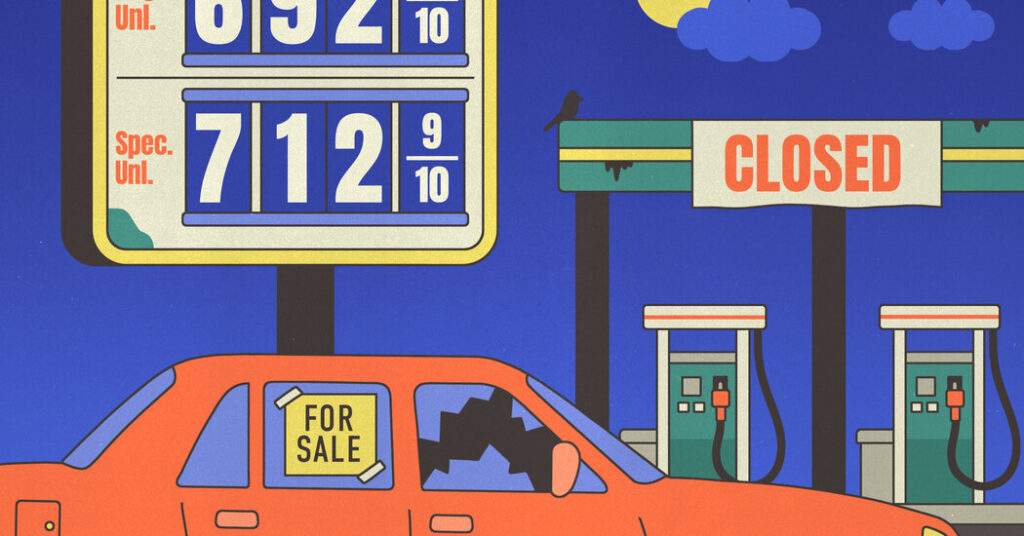
As the war in Iran has stymied traffic through the Strait of Hormuz, demand for oil has fallen, and industry watchers and oil executives have started to fret about “demand destruction.” The decades-old term refers to the sustained loss of demand for a commodity caused by high prices.
In March, Goldman Sachs analysts said that oil prices hitting $100 a barrel or more (which has happened periodically since Israel and the United States attacked Iran on Feb. 28) was “associated with more significant oil demand destruction.” In April, the International Energy Agency, which said it expected oil demand to shrink by 1.5 million barrels per day this quarter, noted that it anticipated that “demand destruction will spread as scarcity and higher prices persist.”
Demand destruction is “not a technical economics term,” said Catherine Wolfram, a professor of energy economics at the Massachusetts Institute of Technology’s Sloan School of Management. She has seen it used among oil market traders and those on the financial side of the industry.
How it’s pronounced
/di-mand di-strək-shən/
In the short term, she said, “people just can’t afford these higher prices, and so are being forced to find alternatives,” such as calling into meetings on Zoom to avoid driving, or taking vacations closer to home to skip plane travel.
In some countries, governments are intervening to reduce energy usage. South Korea, for one, has advised people to ride bicycles and take shorter showers, and has told government agencies to take their vehicles off the road one workday per week.
In the longer term, changes that people — and governments — make now, including turning to renewable energy sources, may permanently dampen demand for oil. “Anyone who bought an electric vehicle is definitely happy to have done so,” Dr. Wolfram noted. E. V.s make up only a small portion of cars in the United States (they’re more popular in Europe, where gas costs much more), but many Americans say they are open to buying them.
But Dr. Wolfram added that, to her, “the most worrying thing is the demand that’s not destroyed: the purchases of gasoline or jet fuel or diesel that people still have to make at these much higher prices.”
The last example of sustained demand destruction, said Ryan Kellogg, a professor focused on energy policy at the University of Chicago, came during the 1970s energy crisis. It reduced petroleum demand for a long period and led to the adoption of fuel-economy standards in the United States. Oil prices since then have been volatile at times — they soared in 2007 and 2008 as global demand surged, and crashed at the start of the Covid-19 pandemic. Russia’s invasion of Ukraine in 2022 set off a new spike. Now prices are volatile again — and, if they continue rising, behaviors may continue to shift.
Consumers tend to be quite “attentive to first digits,” Dr. Wolfram noted; they may react more strongly to a gasoline price of $5.01 than $4.99. Already, some lower-income consumers have cut back slightly on gas, according to research from the Federal Reserve Bank of New York.
Even if the Strait of Hormuz reopens soon, prices may not simply return to normal, partly because oil prices are also tied to other factors. “The Iranians have bombed refineries that produce gasoline and jet fuel, so there’s been some physical destruction that will take a lot longer to repair,” Dr. Wolfram said.
“People just can’t afford these higher prices, and so are being forced to find alternatives,” she reflected. “Hopefully, those alternatives are palatable.”
The post As Oil Prices Spike, Talk of ‘Demand Destruction’ Sets In appeared first on New York Times.