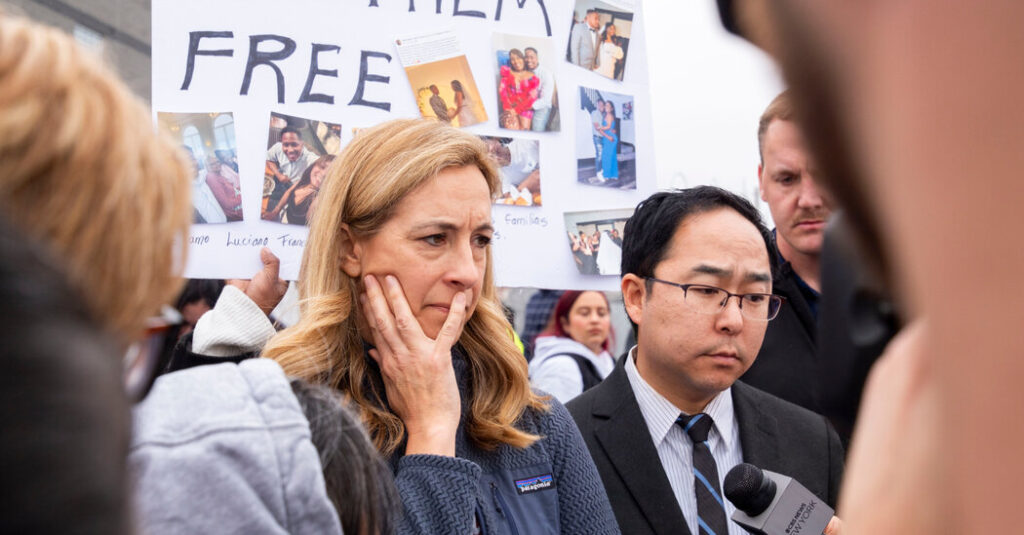
Mikie Sherrill was just five months into her job as governor of New Jersey when long-simmering unease over a federal immigration lockup in Newark cascaded toward chaos.
Ugly images of federal agents wielding batons as they clashed with demonstrators in gas masks were ricocheting in encrypted group chats and on social media platforms. A U.S. senator had been pepper-sprayed outside the Delaney Hall detention center. President Trump’s homeland security secretary was threatening to halt international flights at Newark Liberty International Airport two weeks before the state was set to host the FIFA World Cup soccer games. And Mr. Trump’s border czar had warned state officials and Newark’s mayor, Ras J. Baraka, that he was prepared to flood the streets of the state’s largest city with armed agents.
Ms. Sherrill had no good choices.
“It really became our focus, my focus, to make sure no one died,” she said in an interview.
The crisis remains a volatile, early test of Ms. Sherrill and her administration, with the potential for political fallout that could reverberate far beyond Newark. Ms. Sherrill, a moderate Democrat, has already faced criticism from the left, which has pointed to her decision to send in New Jersey State Police troopers to quell disturbances outside Delaney Hall as evidence of cooperation with the Trump administration’s divisive immigration crackdown. Republicans have said that the images of unrest underscore their belief that Democrats are weak on crime.
“It wasn’t about politics,” Ms. Sherrill said of using troopers to temporarily take charge, fearing a rapid escalation by federal agents. “We knew it was going to be a tough decision.”
The standoff between demonstrators and law enforcement officers has since made its way onto the national television news and into a performance by Bruce Springsteen, who on Thursday invoked “Minneapolis and Delaney Hall” before singing Woody Guthrie’s “Deportee” during a concert in New Jersey celebrating 250 years of American music.
Peter McDonough Jr., a political strategist who was a close aide to Christine Todd Whitman when she was the state’s Republican governor, said that for now, the typical centrist voter in New Jersey was likely to view Ms. Sherrill’s decision favorably.
“The nonpartisan, average New Jerseyan sees her as a take-charge governor — a woman who rolls up her sleeves and steps in,” he said.
But the crisis is far from over. A melee erupted Friday evening between dozens of protesters and detention center employees. After dark, demonstrators repeatedly blocked vehicles trying to leave Delaney Hall and spilled pylons filled with sand into the street.
Federal agents charged four people with felony crimes, according to Markwayne Mullin, the Department of Homeland Security secretary.
“This is a real high-stakes game,” Mr. McDonough said. “You’ve got the eyes of the world on you.”
Detainees who had begun what they described as a hunger and labor strike over conditions within the 1,000-bed, privately run detention center had requested to meet with the governor. She showed up at the front gates of Delaney Hall three days later, on Memorial Day.
She was not allowed to enter.
But Senator Andy Kim, who as a member of Congress has oversight authority over Immigration and Customs Enforcement facilities, was. Twice that day, he toured the detention center, hoping to calm the fears of detainees’ relatives who were waiting outside.
He exited to chaos, he said.
“There was this very real palpable feeling that emerged in my mind that someone could die,” he said.
Arms outstretched, he stood between demonstrators and a truck loaded with federal agents, concerned that a protester might try to make contact with one of the men clinging to the exterior of the armored vehicle.
“Renee Good and Alex Pretti died for less,” he said of the two people killed by federal immigration agents in Minneapolis.
Mr. Kim, a Democrat, wound up in a mist of pepper spray and exploding pepper balls.
In the days that followed, the communication between the Sherrill administration and the state’s Democratic congressional delegation and their top staff members intensified. They began sharing information and coordinating oversight visits in text messages and during videoconference calls, some of which were arranged with less than five minutes’ notice, according to two congressional aides based in Washington. One of the staff members, who has more than 20 years of experience on Capitol Hill, said that not since the coronavirus pandemic and Hurricane Sandy had there been this level of coordination.
Four days after Memorial Day, Mr. Trump’s border czar, Tom Homan, traveled to City Hall in Newark to meet with Mr. Baraka. “He wanted to work this out peacefully,” Mr. Baraka said in an email about the 10 a.m. sit-down.
The mayor said Mr. Homan told him that federal officials were prepared to deploy 31 tactical police units on the streets near Delaney Hall. State officials said they had been similarly warned of a potential influx of federal agents.
“They were preparing for the surge that evening,” Ms. Sherrill said. “And so we felt like we had a decision to make at that point.”
Ms. Sherrill held a news conference at 3 p.m. that day, May 29, at a state police command center in Ewing, N.J. The state police, she announced, were creating spaces for people to peacefully protest but also establishing vehicle checkpoints and assuming command-and-control near Delaney Hall.
After warnings to protesters, troopers moved in on horseback and on foot soon after 9:30 p.m., according to the state police. Those who did not move were arrested.
“Horses? And flash bangs? And tear gas on unarmed protesters?” said Nedia Morsy, of Make the Road New Jersey, an immigrant rights organization whose members have demonstrated near Delaney for more than a year. “If state police are going to use the same tactics that ICE agents use, they aren’t any different.”
Protesters like Alexandra Smith, 23, from Passaic County, N.J., have expressed deep frustration with Ms. Sherrill’s response and efforts by the governor and Mr. Baraka to characterize the protesters as out-of-state provocateurs.
“She says that we are violent and that out-of-state protesters are agitating the people,” Ms. Smith said on Wednesday. “But time and time again, it’s been police officers and ICE agents that have escalated the situation.”
On Saturday, Mr. Mullin said in an email that demonstrators would “not slow us down and ICE operations remain undeterred.”
“Assaulting and obstructing ICE law enforcement is a crime and felony,” he said. “Anyone who assaults law enforcement will be prosecuted to the fullest extent of the law.”
Last Sunday, after a fire was set on a roadway outside Delaney Hall, Mr. Baraka implemented a 9 p.m. curfew on nearby streets.
Earlier that day, the Roman Catholic Archdiocese of Newark led a prayer service near Delaney Hall led by Cardinal Joseph W. Tobin.
Cardinal Tobin said the governor had contacted him several times to discuss the situation at Delaney Hall.
“The governor has taken a very principled stance,” he said. “It was not simply to maintain safety, but it also was not to give ICE an excuse to intensify their presence and become even more violent, as they have been in other parts of the country.”
The goal of the prayer service, he said, was de-escalation of the crisis.
“I quoted Nietzsche in some of my remarks, who said, ‘If you want to do battle with monsters, ensure that you don’t become one,’” Cardinal Tobin said.
Sixty-one people were arrested that Sunday night.
The next day, the state police transferred control of the scene to the Newark Police Department, as planned. The mayor has since lifted the curfew and said that Newark police officers would scale back their presence near the detention center.
“It is not the responsibility of the Newark Police Division to secure a private facility,” Mr. Baraka said Thursday in a statement.
Immigrant rights activists point to glimmers of progress over the past two weeks. Immigration authorities have released roughly 30 people from Delaney Hall during that time, including an 18-year-old high school student, two pregnant women and people in wheelchairs, according to Amy Torres, executive director of the New Jersey Alliance for Immigrant Justice.
Family visitations that were suspended restarted last week.
Ms. Sherrill sued the private company that runs the facility, GEO Group, after state health officials were denied full access to the building. She also announced that lawmakers had agreed to add $12 million to a legal assistance fund for migrants who are fighting deportation or detention, more than doubling the state’s financial commitment to the program.
On Tuesday night, she met privately with relatives of detainees in Jersey City for more than two hours.
“She sat down person to person,” said the Rev. Alex Gaitan, a Claretian missionary, who for 10 months has visited Delaney each weekend, celebrating Mass, leading prayer meetings and offering blessings. He translated the conversations from Spanish as needed for the governor. “She was taking notes of every single thing.”
Mark Bonamo contributed reporting.
Tracey Tully is a reporter for The Times who covers New Jersey, where she has lived for more than 20 years.
The post A New Governor Faces Her First Crisis Amid Tear Gas and Tough Decisions appeared first on New York Times.