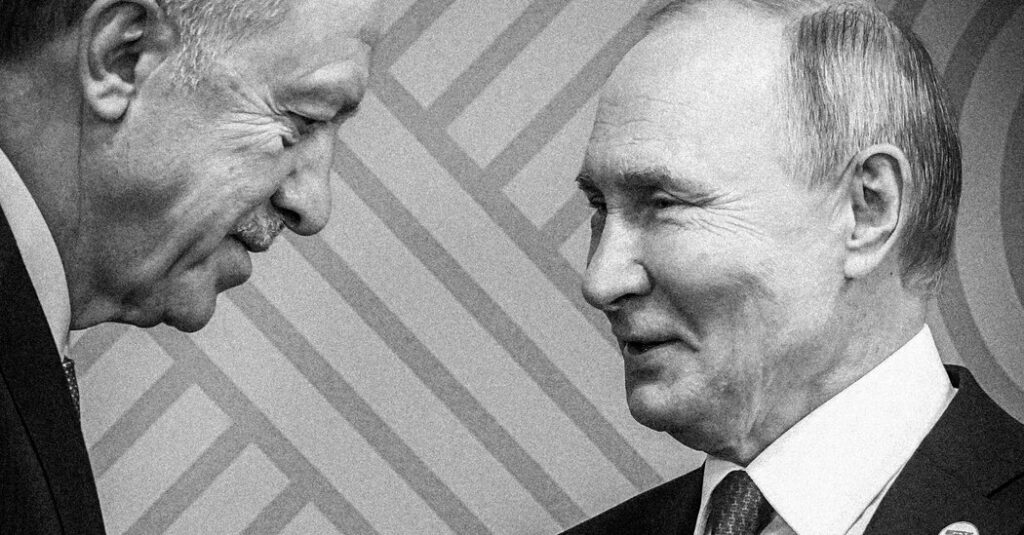
About a decade ago, the war in Syria helped to forge an unlikely partnership in the Middle East between Turkey and Russia. It is now unraveling. In its place, Turkey is helping Ukraine to establish a foothold in a part of the world where President Vladimir Putin of Russia previously enjoyed considerable influence.
The partnership between Mr. Putin and President Recep Tayyip Erdogan of Turkey has always been equivocal, and for a time, it seemed that the war in Syria might draw them into a direct confrontation. Ankara was supporting the rebels trying to topple Bashar al-Assad, Syria’s brutal dictator, while Moscow was intervening to prop him up. Ultimately, however, both powers accommodated each other.
When Turkey launched an incursion into northern Syria in 2016, for example, it was able to do so only because Russia, which controlled Syrian airspace at the time, allowed it. Turkey, in turn, imposed limits on its help to the rebels. Arrangements like this reflected a broader understanding between the two: Each tolerated and reinforced the other’s presence in the country, to the benefit of both.
For Mr. Putin, the benefit was Turkey’s acquiescence to Russia asserting its power in Syria and elsewhere in the Middle East and the cracks that their cooperation created in Western alliances. Mr. Erdogan benefited from a regional ally at a time when his relations with NATO were strained.
In the early years, Mr. Erdogan was the junior partner of the two, but the war in Ukraine has shifted the balance. Isolated by the West, Mr. Putin increasingly relied on the Turkish president, who refused to join Western sanctions. Turkey became a hub for Russian trade, investment and energy flows, and Ankara found itself with greater leverage.
The real turning point in the partnership came when Mr. al-Assad was ousted in late 2024 and Russia, bogged down in Ukraine, did not come to his rescue. Instead, Moscow moved quickly to try to build ties with Syria’s interim leader, Ahmed al-Sharaa, and continues to supply the country with oil. Russia was left in the position of negotiating with a government staffed with people it had bombed relentlessly for years. And Turkey, which had supported the rebels, emerged newly dominant.
For Turkey, this is a big moment — an opportunity to reposition itself as a pivotal ally of NATO, rebalance its relationship with Russia and help Ukraine to cultivate new relationships in the Middle East.
In April, President Volodymyr Zelensky of Ukraine, traveling on a Turkish state aircraft, made his first visit to Syria for talks with Mr. al-Sharaa and the Turkish foreign minister, where they discussed military and energy cooperation. Turkey is involved in rebuilding the Syrian Army into a modern force that can move beyond decades of Soviet-style influence. For Ukraine, this is an opportunity to contribute its expertise in military production and drone warfare, shaped by years of war with Russia, while cultivating a relationship with a country that was once in Moscow’s orbit.
Ukraine has already been capitalizing on the Iran war by cultivating closer military ties with Gulf states. When Iran attacked neighboring countries with Shahed-136 kamikazes, the same drones that Russia has used in Ukraine, Mr. Zelensky quickly sought to leverage Ukraine’s experience, dispatching air defense teams to Qatar, Saudi Arabia and the United Arab Emirates.
Turkey, which has strong military ties with the Gulf, sees Ukraine’s growing role as a complement to Ankara’s relationships that will allow it to expand what it’s offering. For Russia, which has spent years developing closer economic and security ties with Gulf monarchies, the shift is yet another setback.
Ukraine badly needs allies and revenue streams, and its entry into the Middle East will establish its role as a security provider. That Mr. Erdogan is helping to open the doors for Ukraine starkly underscores Mr. Putin’s waning ability to project global power and how much has changed in the relationship.
It’s clear that Ankara is no longer balancing between Moscow and NATO and is tilting the field against Mr. Putin. Russia’s decline has given Turkey, after a decade of deference to Moscow, the freedom to pursue its interests. Ukraine is the beneficiary.
Gonul Tol is a senior fellow at the Middle East Institute and the author of “Erdogan’s War: A Strongman’s Struggle at Home and in Syria.”
The Times is committed to publishing a diversity of letters to the editor. We’d like to hear what you think about this or any of our articles. Here are some tips. And here’s our email: [email protected].
Follow the New York Times Opinion section on Facebook, Instagram, TikTok, Bluesky, WhatsApp and Threads.
The post After Years of Deference to Putin, Erdogan Is Trying Something New appeared first on New York Times.