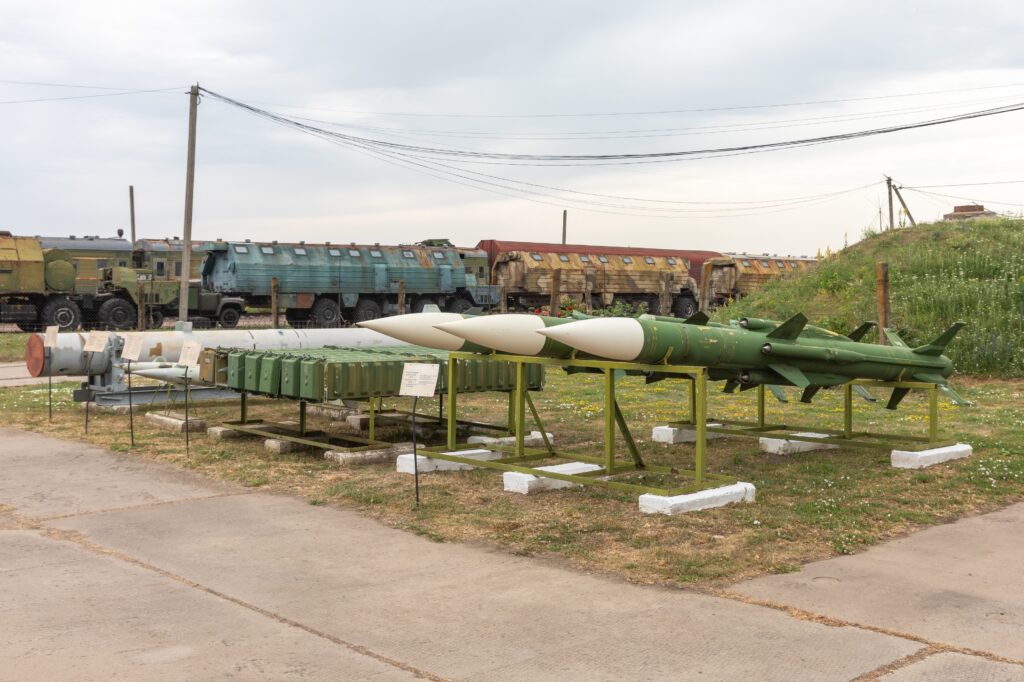
After the Soviet Union was dissolved in 1991, Ukraine gained independence, its own constitution and international recognition. It also inherited a massive Soviet nuclear stockpile — some 1,900 strategic nuclear warheads and thousands of “tactical” nuclear weapons, along with 167 intercontinental ballistic missiles, according to the Washington-based Nuclear Threat Initiative.
Overnight, it became home to the world’s third-largest nuclear arsenal, behind only Russia and the United States.
The question for the fledgling country became: What should it do with its inheritance?
In 1994, Ukraine decided to relinquish its nukes in a transfer to Russia. In return, Ukraine received security assurances. Codified in the Budapest Memorandum, signed by Britain, Russia, Ukraine and the United States, the agreement included explicit commitments not to use force against Ukraine. That did little to protect it from Russia in the years to come.
The upcoming meeting between Russian President Vladimir Putin and President Donald Trump’s special envoy, Steve Witkoff, has prompted renewed discussion in Europe about the necessity for postwar security guarantees for Ukraine. The country’s history following the fall of the Soviet Union may demonstrate why Ukraine and its backers in Europe are wary of assurances that lack heft.
Inheriting nuclear arms
In 1990, as constituent republics of the Soviet Union asserted the primacy of their laws, the parliament of Soviet Ukraine adopted a Declaration of Sovereignty, spelling out principles of self-determination, economic independence and the right to its own army. The document also committed Ukraine to “three nuclear-free principles: to accept, to produce and to purchase no nuclear weapons.”
Ukraine’s position on nuclear weapons “sort of just slipped into the declaration,” said Mariana Budjeryn, a historian of post-Soviet nuclear history and researcher at the Harvard Kennedy School’s Belfer Center. “Surprisingly, it wasn’t contentious at all.”
Two key factors drove the choice: the national trauma of the Chernobyl nuclear accident and the anti-nuclear advocacy of prodemocratic, pro-independence movements. “Everything nuclear was associated with the Soviet Union, with Moscow, with this oppressive regime,” said Budjeryn.
After the Soviet Union’s dissolution, Washington’s “primary issue of engagement with these newly independent states,” she said, was, “Who controls nuclear weapons?” Ukraine, for its part, was focused on reforming its economy and building a state.
Though it didn’t have operational control over the nuclear warheads, Ukraine could have made a drive for the bomb, analysts said. With its industrial capacity, Ukraine was well-positioned to transition its post-Soviet arsenal into a full-fledged nuclear program, said Stephen Herzog, professor of the practice at the James Martin Center for Nonproliferation Studies.
Some Ukrainians advocated for keeping nuclear weapons, arguing that giving up deterrence was naive — but that was “a very tiny minority,” said Budjeryn.
Mostly, the debate was between those who wanted to get rid of them as soon as possible, and those who argued that Ukraine “should get a deal at the very least,” she said.
The Budapest Memorandum
Ukraine argued that if it was voluntarily renouncing its right to possess nuclear weapons, then it wanted, in return, security guarantees and financial compensation for the fissile materials in the warheads.
But in negotiations with the United States, Ukrainians quickly understood that Washington would not be taking on new security obligations. It could only pledge reassurance — essentially restating international commitments already recorded in U.N. charters or the negative and positive security assurances of the Non-Proliferation Treaty.
The Budapest Memorandum, signed by Ukraine, Russia, the United States and Britain in 1994, stated that the signatories “reaffirm their obligation to refrain from the threat or use of force against the territorial integrity or political independence of Ukraine.”
In acceding to the NPT as a nonnuclear state later that year, Ukraine committed to giving up its weapons and never seeking nuclear arms. Belarus and Kazakhstan, which also inherited Soviet nukes as successor states, did the same.
There was a “a bit of a trick in translation” in the final Budapest Memorandum texts, said Budjeryn. In the official English text, it was a memorandum on security “assurances” — but in the Ukrainian and Russian translation, that word was transcribed as “security guarantees,” which means something a little more binding in American political parlance.
In January 1994, Steven Pifer, a U.S. State Department official, flew to Moscow to make sure that the Russian- and Ukrainian-language versions of the memorandum were the same as the English text.
“I had to sit down with the heads of the Russian and Ukrainian delegation with a tape,” he said, recalling that he told them, “We now need, for the record, to record that when you see ‘garantiya’ [guarantee] in Russian in this text and ‘harantiya’ in Ukrainian in the Ukrainian texts, those words are understood in the sense of the English word ‘assurance’, not ‘guarantee.’”
In the end, “Ukraine got less than it had asked for, and Ukrainians knew that very well,” said Budjeryn.
Ukrainian regrets
Though heralded as a major success for diplomacy and nonproliferation at the time, some in Ukraine remember the memorandum with a measure of frustration and regret.
Russia blatantly violated the promises of the agreement when it occupied and annexed Crimea in 2014. It did so even more brazenly with the full-scale invasion of Ukraine that began in 2022.
“Which one of these major nuclear countries suffered? All of them? No. Just Ukraine,” Ukrainian President Volodymyr Zelensky told the European Council in October 2024. “Who gave away nuclear weapons? All of them? No. Just Ukraine. Who is fighting today? Just Ukraine.”
On the 30th anniversary of the agreement’s signing in December 2024, Ukraine’s foreign ministry called the Budapest Memorandum “a monument to shortsightedness in strategic security decision-making.” It released a statement decrying the agreement’s lack of “real, effective security guarantees” as a “strategic mistake that Moscow exploited.” Zelensky and the ministry have invoked the agreement in calls for NATO membership — a nonstarter for Russia.
Out of the Budapest Memorandum, Ukraine did secure development aid, increased U.S.-Ukrainian partnerships and U.S. support for a NATO-Ukraine relationship.
Enforcement after Russia’s invasion of Crimea in 2014 fell to Western partners, who “decided to take a very minimalistic interpretation of their obligations under the memorandum,” Budjeryn said. But before then, Ukraine also made “very little of this document,” she argued, in terms of fleshing it out into a more robust security arrangement. “They signed it, they put it on the shelf. … And they sort of forgot about it,” Budjeryn said.
Security guarantees and Trump’s peace proposal
A recent draft of a peace proposal for Ukraine — incorporating ideas from the U.S. and Russia, and drafted without Ukrainian input — stunned European leaders and prompted meetings across Europe and in the U.S. between diplomats and heads of state with a stake in the conflict.
Zelensky said on social media Monday that ongoing talks were focused on “negotiations to end the war and on security guarantees.”
An American delegation including Witkoff and Secretary of State Marco Rubio met in Florida with Ukrainian top security official Rustem Umerov over the weekend. Both sides said progress had been made to bring the plan into greater alignment with Ukraine’s interests, but that work remained. The original draft, which was leaked to Axios, included some conditions seen as uncrossable “red lines” in Kyiv, including surrendering territory in the country’s east and agreeing to never join NATO.
There was little detail on how Ukraine might deter a potential future invasion — a question that might have appeared settled in 1994.
“By international standards, here you have a country that really did everything right,” Burdjeryn said. Ukraine had the option to have nuclear weapons, and decided instead to be “a good international citizen.”
“Fast forward 20 years,” she said, “and they’re basically getting punished for doing what’s right.”
The post Why Ukraine’s history sows fear of weak security guarantees appeared first on Washington Post.