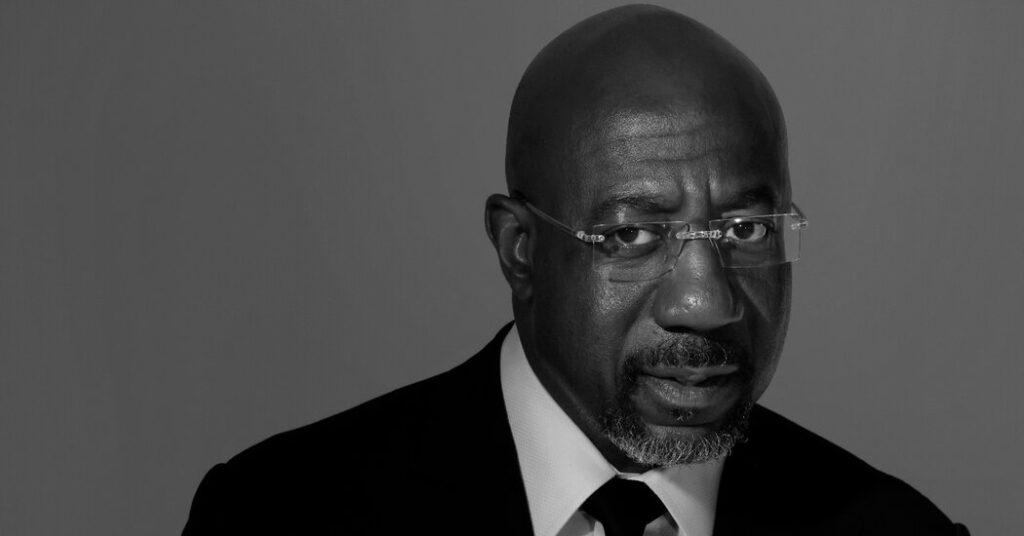
Give Raphael Warnock credit for timing. In his new book, “The Crooked Places Made Straight: Reflections on the Moral Meaning of America,” the Democratic senator from Georgia singles out voting rights as one of the country’s most pressing political and moral issues. It’s a matter that, following the Supreme Court’s recent blow to the Voting Rights Act and the resulting rush to redraw districts in the name of partisan gerrymandering, has turned for many into a full-blown crisis.
Warnock’s emphasis on the moral underpinnings of politics comes naturally. In addition to being a senator, he’s also the senior pastor at Atlanta’s famed Ebenezer Baptist Church, where the Rev. Dr. Martin Luther King Jr. was once among his predecessors in the pulpit. Given Senator Warnock’s high standing with both the church and the state, he’s well suited to talk about another hot-button topic, which is the influence of Christianity on politics and the public sphere. He and I spoke about that, as well as about what’s behind the attack on voting rights, what certain Republicans get wrong about religion, and his own family’s story.
Subscribe: Apple Podcasts | Spotify | YouTube | Amazon | iHeart
You have called the Supreme Court’s recent ruling on voting rights “Jim Crow in new clothes.” But I want to know about your personal relationship with voting rights, because your parents and grandparents grew up in the Jim Crow South. Can you tell me what voting rights means to you from a family perspective? My mother grew up in Waycross, Ga., literally picking somebody else’s cotton in the 1950s, and because of the arc of progress in this country over the last 60 years, I often say the hands that used to pick somebody else’s cotton got to pick her son to be a United States senator. So this story of fighting for voting rights doesn’t feel distant to me. We’ve only been a democracy in a real sense since 1965. What we are witnessing in real time is an assault on those basic voting rights. I think that the Supreme Court has committed violence against the ways in which ordinary people can have a voice in our system. And as someone whose parents lived through that ugly history, I take deep offense.
According to the logic underpinning some of the Supreme Court’s decisions lately, your being elected as senator is evidence that the Voting Rights Act, as conceived, is no longer as necessary. What’s your response to that? Well, the folks who say that don’t know how I got here. Even in my last runoff, state officials in Georgia looked at the anatomy of my victory in the runoff, which is itself a vestige of the Jim Crow South. They cut the runoff in half in terms of the number of weeks. Then as we were going into the runoff that weekend, state officials said, “Sorry, you can’t vote that first weekend of the runoff.” They were referencing an old law in Georgia that said you can’t vote the first weekend if it’s a few days after a holiday. The holiday was Thanksgiving. They said their hands were tied. So I decided to untie their hands and sue them. It took a court decision and two appeals so that students who were home that weekend — young people, working class, poor people who were disproportionately Black and brown — could turn out and vote. About 70,000 people voted [on Saturday]; I won by 100,000 votes. This is how voter suppression works. It’s the ways in which you begin to chip away at people’s access, which again, disproportionately impacts Black people, brown people, poor people. That’s how you swing an election. Chief Justice John Roberts put forward this theory that we no longer need the protections of the Voting Rights Act. That’s what he said in 2013. But what has happened in the years since that awful decision in 2013, Shelby County v. Holder? Yes, I’m sitting here, but the racial turnout gap has actually grown wider since 2013. Roberts has long felt that we didn’t need the Voting Rights Act. He despises the Voting Rights Act.
Why do you think that’s the case? You’d have to ask him, but he has felt this way since he was a young lawyer in the Reagan Justice Department. The Congress in the 1980s overwhelmingly said, Look, the impact matters. A young Roberts said, No, it shouldn’t be impact; you should have to show intent. He was saying that as a young lawyer, just 15 years or so after the voting rights law was passed. He’s never believed in it, in my view.
A lot of the discussion in the wake of the Louisiana v. Callais decision is conflating race and partisanship, collapsing two things into one. What does focusing on the intertwining of race and partisanship get right in terms of understanding the Callais decision, and what does it get wrong? The idea that you can just completely separate these things is on its head false. The decision said you can engage in partisan gerrymandering as long as it’s not racial. It’s dishonest; the decision is dishonest. When L.B.J. passed the voting rights bill into law, he said, I think I just gave the South to the Republicans for a long time. Those words were prophetic. The old Dixiecrats left the Democratic Party. Where’d they go? They went to the Republican Party. So the irony of this moment is that the same partisans who were attacking voting rights in the 1960s are attacking it again.
You could call the Democrats losing the South an unintended negative consequence of the Voting Rights Act. Can you foresee any unintended negative consequences for the Republican Party in the wake of Callais? I think that they have unleashed something, potentially, that they did not anticipate: the deep offense that people will feel; not just Black voters but people of moral courage, people who have a sense that everybody’s voice needs to be heard. I think that we may witness turnout that could completely change the math of gerrymandering.
This gerrymandering battle is a race to the bottom as far as fair representation. Do Democrats have any choice other than to participate? If I had my druthers, we’d get rid of gerrymandering. I’ve got bills to do so. Republicans can join me anytime. But it was Donald Trump who called into the state of Texas and literally said, Give me more seats. And the Supreme Court poured fuel on that fire. It would be irresponsible for Democrats to unilaterally disarm. We cannot. In fact, I think blue-state governors have a moral obligation to look and see where we can increase our opportunities to win.
I want to switch gears. Your colleague John Kennedy, a Republican senator from Louisiana, wrote a book, “How to Test Negative for Stupid,” that has been a big best seller. I was reading it, and toward the end he does a rapid-fire assessment of hot-button issues in America. When he writes about race, he says that America is not a racist country, and the country’s history is proof that it’s not a racist country. I think it’s pretty easy to imagine someone else saying that, actually, the country’s history is proof that racism is deeply embedded. But I don’t think Senator Kennedy’s view is wildly out of line with how a lot of conservatives see race in the country. Where do you find common ground when there’s such a fundamental disagreement about the country’s history when it comes to race? He is oversimplifying a complicated issue. America has a complicated story. And I embody the complexity of the American story in my own story. I had an older father, a World War II-era veteran. I remember him telling me about how when he came home, he had to give up his bus seat to a teenager while wearing his soldier’s uniform. That wasn’t that long before I was born. But now his son sits in a Senate seat. I love this country, flaws and all. But part of how you love somebody is you tell them the truth. I’d be irresponsible to sit in this seat while ignoring the fact that the “land of the free” is the mass-incarceration capital of the world. I’ve got a brother who went through that system. He made a terrible mistake. What he did cannot be justified. But he was a first-time offender — nonviolent, drug-related offense — went to prison, was sentenced to life without parole. Nobody died, no one was hurt physically. Nobody even got high. Long story. … And yet I sit here. That’s the complexity that perhaps I know in a way that’s different from my colleague and friend John Kennedy.
In your new book, you write about how Christians in the United States have in the past stood on the wrong side of justice — slavery being the prime example. You also write about how Speaker Mike Johnson spent a lot of time praying in the Capitol’s chapel in advance of passing the One Big Beautiful Bill, a bill that you describe as “Robin Hood in reverse” — robbing the poor to give to the wealthy. I read those things in the larger context of people of sincere faith taking political actions that you see as ungodly or immoral. But it was interesting to me that you didn’t really directly grapple in the book with how you understand when fellow believers take positions that you can’t morally abide. So from a theological perspective, how do you understand that? For me, the acid test of one’s faith is the depth of your commitment to the people who are on the margins. I’m a Matthew 25 Christian.
“What you did unto the least of us, you did unto me.” I don’t understand how you read that, say a long prayer, hold hands with your fellow legislators and then cut a trillion dollars out of Medicaid. I have to ask whether the religion is more performative than substantive. I don’t like to use fancy words, but I’m a trained systematic theologian, and there is something called the hermeneutics of suspicion. That’s when you look at a text or you look at the world with a critical view, and you ask the hard questions. I apply that same hermeneutics of suspicion to my own faith. I examine myself and ask: “What’s really driving this? Why are you taking that view? Why did you vote this way?” Usually if you ask politicians enough questions about why they’re voting, it’s connected to their politics. I think the speaker has a certain agenda and a certain view. Part of the obligation of a person of faith is to ask yourself: “What are you actually worshiping? What are you actually committed to?” Are you committed to the poor? Are you committed to the despised and the rejected? Would Jesus agree with the actions of ICE in this moment, in which we’re seeing organized cruelty on our streets, masked men jumping out of unmarked cars, separating families, terrorizing whole communities of people, whether they’re documented or not, whether they are citizens or not? What is it in the Gospel, I would ask my colleagues, that says that this is right? Do unto others as you would have them do unto you. There’s some variation of that in all of the great faith traditions, and that’s the question people aren’t asking themselves deeply enough. Because if you do, you might actually have to make some decisions that make you uncomfortable.
You know Mark 12:17, right? You tell me. [Laughs] I love this. Tell the Christian preacher the Scripture. Believe it or not, I haven’t memorized the whole Bible.
It’s “render to Caesar the things that are Caesar’s, and to God the things that are God’s.” How do you understand that? Pay your taxes, show up as a good citizen, but don’t bow down to Caesar. That’s what it means to me.
I didn’t mean to test you on that one. But that piece of Scripture is about church and state. And I want to understand how you delineate between when you’re driven by faith and when you’re driven by the public good. There can’t be a perfect overlap. And this isn’t a leading question; it comes out of sincere curiosity. I’m driven by the values in my faith. But those values are resonant in all of the great faith traditions, and in people who claim no faith tradition at all but are people of moral courage. Love, truth-telling, justice-making, compassion, empathy, looking into the eyes of your neighbor and seeing a glimpse of your own humanity — that’s what drives my work, and not the creeds of the faith. You didn’t ask me, but I’ll venture out into the waters and say that this is what drives my view on reproductive choice. I get a lot of attacks from folks on the right who try to challenge my pastoral identity, my Christian identity. I’m unbothered by that. I have a deep reverence for life and I have profound respect for choice. The question there is, Whose decision is it?
I have to believe that many of the people attacking you are authentic in their belief that your positions are ungodly. I apologize if this is a Theology 101 question, but how do you know you’re right? How do you have confidence that your position is the moral one? Look, there are things that I believe deeply, but faith isn’t about knowing. Faith is just that — it’s an act of faith. I don’t even respond to people who question my Christian authenticity. I don’t even have time for that. It’s so basic to who I am. I’m part of the Kingian tradition, and that movement changed America. At its height, Martin Luther King Jr. and Rabbi Abraham Joshua Heschel marched together. Rabbi Heschel said, When I marched alongside Dr. King, I felt like my legs were praying. So where is there room for him, and the Hindu, and the Sikh, and people who are agnostic, folks who are atheists?
Or searching. Or searching, maybe because the expression of the God they are hearing about is a racist, classist, misogynistic, homophobic God. They don’t believe in that God, so they call themselves atheists. Well, this Christian pastor’s got a message for them: I don’t believe in that God, either.
There’s a lot of discussion on the right about Christianity being under attack. Vice President Vance talks about a war being waged on Christians in the United States. Do you understand where that perception comes from? Who’s waging the war?
Vice President Vance also said that the left has “labored to push Christianity out of national life.” I think that a war on Christianity, in my view of the faith, is cutting a trillion dollars out of Medicaid. Jesus spent much of his ministry healing the sick, even those with pre-existing conditions. That’s what leprosy was. He never billed them for his services. They’re taking health care away. That’s what a war on Christianity looks like to me. I often say that I’m not a senator who used to be a pastor; I’m a pastor in the Senate. But this pastor who serves in the Senate does not want to live in anybody’s theocracy. Christian, Jewish, Muslim — I don’t want to live in anybody’s theocracy. And what they are asserting is a kind of dangerous Christian nationalism. I’m struck by JD Vance saying he’s defending the faith, but he seems more than willing to attack the pope when the pope doesn’t agree with his politics, or when the pope is just calling on us to think about peace. I mean, did you hear him? He said the pope needs to be careful when he’s talking about theology. JD Vance, the newly converted Catholic, is already instructing the pope on how to be a good pope. I think you see the callousness, the hubris, the willingness to attack the church and the pope himself if it gets in the way of his political agenda. I’m not impressed.
Let me go back to voting rights. You’re against gerrymandering, but earlier you said that you feel Democrats have a moral obligation to compete with Republicans on redistricting. So what is the way out of this doom spiral of competitive gerrymandering? Democracy would be better off if we had more competitive congressional districts in our country. Each side would lose a little something. We’d have to give a little, get a little. But I think at the end of the day, the country would be better off. We could ban partisan gerrymandering right away if the Congress decided to do so. I’ve got my bill. So far I’ve gotten no Republican takers. But I’m a preacher. The doors of the church are open.
When we were talking about Justice Roberts, you said that you believe he “despises” the Voting Rights Act. I don’t know what’s in his heart, but his opposition to it has to do with jurisprudence, not race, right? So my question to you is whether or not jurisprudence can be disentangled from race in the context of the Voting Rights Act? Is opposition to the Voting Rights Act de facto racist? I think that what the Supreme Court did was deeply intellectually dishonest. You cannot disaggregate the ghosts of Jim Crow and the reality of race in our country from the struggle around voting rights. I wasn’t making a comment about what’s in the Chief Justice’s heart. But the legacy of the Roberts court is that, through the Shelby case, through the Callais case, and through the Citizens United case, they’ve done a lot of damage to our democracy and our electoral system.
Another way of asking the question is whether what you describe as intellectual dishonesty is tantamount to racism? Let me put it this way: What I’m concerned about is impact, which is the very thing the court decided that they won’t even consider. They won’t deal with the impact of the decisions that they’re making. And we’re seeing in real time the consequences of that, as you’ve got Southern states that are in the middle of an election deciding to pause the election and throw out votes that have already been cast so that they can draw lines to get a partisan advantage — and then claim that it’s not about race. Well, in many cases, it’s not. It’s about power. But people who are greedy for power will use anything to hold on to the power, including race.
I want to read something to you that Justice Clarence Thomas said about progressivism in a speech not that long ago at the University of Texas, Austin. He said: “Progressivism seeks to replace the basic premises of the Declaration of Independence and hence our form of government. It holds that our rights and our dignities come not from God but from government.” He’s basically suggesting progressivism is immoral, anti-God and anti-American. As a progressive politician and a pastor who just wrote a book about American morality, what do you think Justice Thomas doesn’t understand about progressivism? I don’t know what to make of what Justice Thomas is saying. I know that he seems seriously compromised, to me, by the gifts that he’s received over the years. It’s interesting to me that Republicans are so obsessed right now with playing with the lines. Justice Thomas, along with his colleagues, are complicit in this. And I do wonder what they’re thinking as they’re watching. But I guess if they are as partisan as they appear to be, maybe they’re happy.
Last question for you: One of the animating ideas of your book is that America has lost its way morally. What sort of practical, specific signs are you looking for, or should any of us be looking for, that would make us think America has morally found its way again? What would that look like? Isaiah says that “the glory of the Lord shall be revealed, and all flesh shall see it together.” As a preacher, I used to think that text meant that the glory of the Lord is so amazing and so overwhelming that all flesh will see it and you can’t help but see it because it’s God’s glory. I actually read it in reverse now. The insight that the prophet is laying out for us, whether you’re a person of faith or not, is that there are some things we can only see when we get together.
This interview has been edited and condensed from two conversations. Listen to and follow “The Interview” on Apple Podcasts, Spotify, YouTube, iHeartRadio or Amazon Music. Follow us on Instagram and TikTok.
Director of photography (video): Tre Cassetta
David Marchese is a writer and co-host of The Interview, a regular series featuring influential people across culture, politics, business, sports and beyond.
The post Raphael Warnock Says the Supreme Court Has Done ‘Violence’ to Democracy appeared first on New York Times.