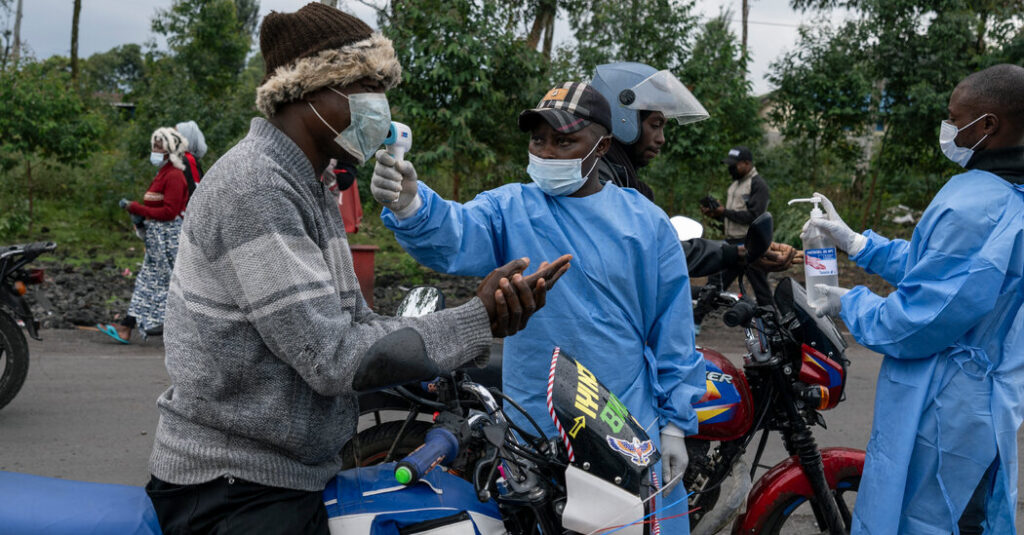
The response to the Ebola outbreak in East Africa, as troubled as it has been, offers signs that the world has learned key lessons from the last massive outbreak of the disease and from the Covid-19 pandemic, public health experts say.
Their conclusion comes despite the fact the Bundibugyo species of the virus spread unidentified in the Democratic Republic of Congo and Uganda for months, and that hastily erected treatment centers continue to lack even rudimentary medical supplies.
“If the world earned an F on the response to the West Africa outbreak — then we’re at maybe a C+ now,” said Suerie Moon, a global health researcher who led an international forensic review of the response to the Ebola outbreak in West Africa, which lasted two years and killed more than 11,000 people.
Among the improvements, she and other experts say, are increased coordination and cooperation among governments and scientists, and more investment in the infrastructure to make fast science possible. Money has already been raised for research on potential vaccines and treatments for Bundibugyo.
“The fact that we’re even talking about clinical trials is a world away from where we were in 2014,” said Dr. Daniel Bausch, who has responded to more than a dozen different hemorrhagic fever outbreaks in Africa over a career in infectious disease. “We have to remember that it’s not all doom and gloom.”
But there are conspicuous gaps, notably in sustained funding for research into treatments and guarantees they will be available to anyone who needs help.
What Has Improved
-
Transparency: Aid groups like Doctors Without Borders sounded the alarm in 2014 for months before the World Health Organization declared a public health emergency. W.H.O. leadership was excessively deferential to West African governments that did not want to face the economic fallout of declaring an outbreak, said Ms. Moon, the co-director of the Global Health Centre at the Geneva Graduate Institute. This time, the Congolese government and the W.H.O. declared the outbreak within days of confirming that Bundibugyo was causing a rash of suspicious deaths.
-
Leadership and coordination: Frustration with the mistakes of 2014 led to the creation of the Africa Centres for Disease Control and Prevention, which has led the response to Bundibugyo alongside the W.H.O. The two organizations work to ensure that scientists are not needlessly duplicating work. “There is a willingness to collaborate — we are all committed to avoiding having multiple research protocols, multiple initiatives that complicate things and bring no solution,” said Carmen Pérez Casas, the head of pandemic preparedness at the global health agency Unitaid, a W.H.O. partner.
-
Vaccine development: The failures in West Africa also spurred the creation of the Coalition for Epidemic Preparedness Innovation, which has international funding and a mission to develop effective and accessible vaccines within 100 days of identifying a new pandemic threat. CEPI has committed up to $61 million to get three vaccines against Bundibugyo into clinical trials, and is helping to pay for advance production of the experimental vaccines so that they can be deployed immediately if clinical trials show they work. “By the time we get to the end of the preclinical work there will be doses ready to go into trials,” said Dr. Nicole Lurie, CEPI’s executive director for preparedness and response.
-
Fast clinical trials: The vaccine now used against the Zaire species of Ebola, which caused the West African outbreak, was an experimental product that sat for years on a Canadian laboratory shelf with no money or mechanism to move it into trials until more than a year into the crisis. Since then, researchers have done advance work to design clinical trials and have them approved by governments in countries in which outbreaks are likely, so that vaccines and treatments can be tested fast. Those trials have streamlined designs that make them feasible in the high pressure environment of an Ebola outbreak, said Dr. Amanda Rojek, an associate professor of health emergencies at the University of Oxford. She worked on the first clinical trials for Ebola treatment, which were conducted in West Africa 12 years ago. Now she has helped design a rolling clinical trial that can synthesize data collected across different outbreaks.
-
African research at the core of the response: Laboratories across Africa can now perform molecular testing (though labs in northeastern Congo did not have a test for Bundibugyo early on.) African researchers pioneered open access data sharing on genomic sequencing during the last Ebola outbreak, said Dr. Christian Happi, director of the Institute of Genomics and Global Health at Redeemer’s University in Ede, Nigeria. Since then his institute has helped to train scientists in 52 of 53 sub-Saharan countries on the process.
What Is Still a Problem
-
The global leader is missing: The United States, under the Trump administration, has withdrawn from the W.H.O. and no longer funds CEPI. The administration also disbanded the U.S. Agency for International Development, which funded local health organizations that did key disease surveillance work and were trusted locally. The United States remains the single largest funder of emerging infectious disease research, but it has sharply reduced funding to the National Institutes of Health and other research groups. “We didn’t know what would work in 2014, but we also had the ability to throw a lot of spaghetti at the wall,” said Jeremy Konyndyk, who was the senior official for American foreign assistance during that outbreak. “The blueprint is much clearer, but the capacity to deliver, the capacity to execute, is much less.”
-
Lack of funding for prevention: The W.H.O. said Friday that the Bundibugyo response will cost $518 million. That’s just emergency spending, on supplies and logistics. Researchers complain that there is typically a surge of funding for Ebola treatment during an outbreak, but that money dries up when the epidemic is over — and it isn’t enough to finish research that may help curb the next outbreak. Only one percent of global research and development spending goes to emerging infectious diseases.
-
Access and equity: During the West Africa outbreak, health care workers from high income countries who contracted Ebola received experimental treatments, and they lived. Those same drugs were not offered to local medical workers, and several leading African infectious disease researchers died while trying to save their fellow citizens. Three American doctors have been evacuated from the current outbreak in East Africa to hospitals in Europe. Nevertheless, Dr. Moon said that the “access norm” — the idea that people in every country must have equal access to vaccines or other medical countermeasures — is now more firmly established. The experience of Covid, when vaccines took almost a full year longer to reach Africa than the rest of the world, helped entrench that idea. Some public funders, including the N.I.H., now require that any product developed with research it backs must have an access plan. But these improvements may not be enough, she said. “My fear is that if you start getting cases exported, popping up in Europe or in the U.S., then suddenly the inclination to hoard and to panic kicks in. That fear also weighs on the mind of African scientists who share data about new pathogens, Dr. Happi said, and wonder “will the company use the data to create a vaccine that I cannot afford?”
-
Punishment for honesty: Countries are still penalized for reporting outbreaks. The Trump administration slapped an economically damaging travel ban on several African countries after the current outbreak was declared, including some that have not recorded a single Bundibugyo case. “If you share information, you are a victim of your transparency,” Dr. Happi said.
Stephanie Nolen is a global health reporter for The Times.
The post The World Has Learned From the Last Ebola Outbreak, but Gaps Remain appeared first on New York Times.