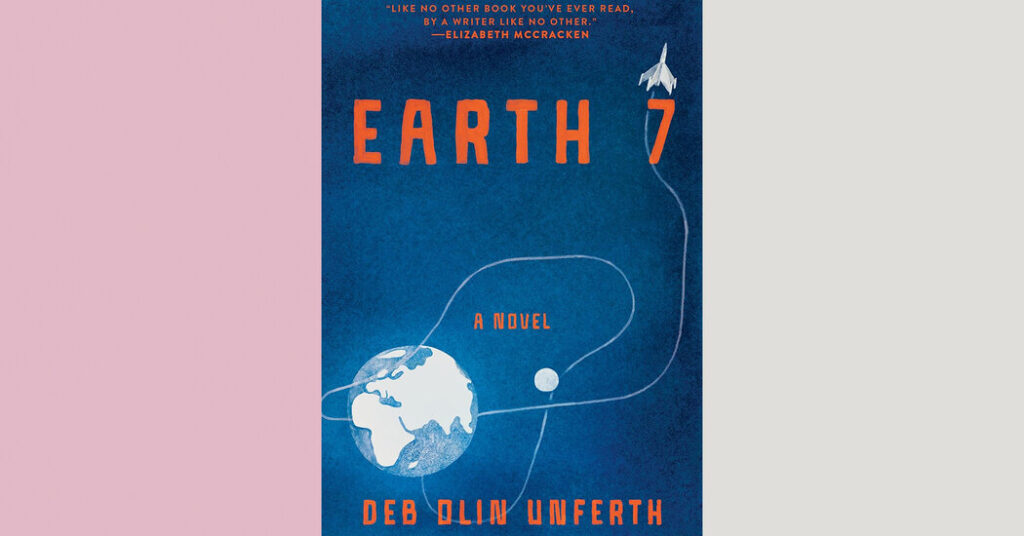
EARTH 7, by Deb Olin Unferth
Earth had a pretty good run, until humans came along. We poisoned the plants, destroyed the animals and generally ruined the place. This is the starting point of “Earth 7,” Deb Olin Unferth’s stellar and sweeping science fiction novel that is part cosmic comedy and part dirge to our dying world. “It’s the end-time,” Unferth writes. “Every part of the planet is done with us: the air, the ground, the water.” What to do now?
Dylan Stein is a young girl who dreams of living on our soiled planet. Except she sort of does. She and her scientist mother dwell in a “luxury model” pod in the community of Sea Garden — or, as Dylan puts it, “a vat at the bottom” of the ocean. Their undersea pod makes lonely Dylan feel that “fish are lucky to be extinct!”
The surface has its own problems. It’s mostly depopulated desert. When Dylan secures an internship at her mother’s employer, it’s less scientific than janitorial: She sweeps sand.
Then, on a holiday at the “fully terraformed resort” Vacationland, Dylan falls in love with a “robot” named Melanie. Melanie is not really an android but a former contestant on an experimental surgery show called “Celebrity Plastics.” She’s so full of implants that she’s nearly immortal: “Each of her cells was running through the system, altering and refreshing like a screen.” Together, Dylan and Melanie will work on securing a genetic database — an “Earth backup” — to one day recreate the world.
Unferth has honed a narrative voice that falls somewhere between mystic, stand-up comedian and fairy-tale teller. There are frequent funny asides and philosophical musings. “Earth had gotten the best the universe had to offer, in all categories,” Unferth writes, “and the achievement had nearly killed her.” The novel has a freewheeling spirit that recalls Italo Calvino’s space fables in “Cosmicomics.” While this might rankle a certain type of science fiction reader who expects rigorous world building and a straightforward plot, Unferth’s playfulness injects new life into some trusty old tropes that have calcified into clichés.
The homesick astronaut is lost not in outer space but in the ocean depths. The robot who wishes to be human is the human who is happy to be robotic. “Earth 7” consistently delivers surprises: a postapocalyptic cult, Martian rescue missions, modified tardigrades and “soul globules” traveling the edge of space-time. But the novel is more concerned with larger questions of humanity and our inhumanity to the natural world. How do we reckon with the damage we’ve wrought?
“Earth 7” presents many attempts to flee the consequences of our climate destruction. Humans shelter under seas, have their minds “transferred” to solar kites in outer space, try to recreate Earth in databases and fly to new lives on Mars. But none of these can truly satisfy us. Mars is “not as good as you think. Cold. Dark. Everyone lives underground.” What is lost is lost.
Unferth writes with haunting beauty about our reckless destruction. During a deep-sea field trip with other children, Dylan sees an underwater graveyard composed of “a thousand creatures the size of elephants, sea animals previously unknown, skeletons under spotlights.” “A new beginning was not on the way,” Dylan realizes. “She was part of the rubble.”
But “Earth 7” is a celebration as much as a lamentation. We’re part of this world, “a place where terrible and wonderful beauties are coming to pieces at every moment and others are constructing themselves out of the remains.” Unferth reminds us that while we may be facing microchip uploads and Martian colonies, our human and planetary heritage endures. Love, wonder, horror and all of life — it’s here in “Earth 7” and here on actual Earth. It’s our home, while we can keep it.
EARTH 7 | By Deb Olin Unferth | Graywolf | 232 pp. | $27
The post Earth Is Done For. ‘Earth 7’ Is About What’s Next. appeared first on New York Times.