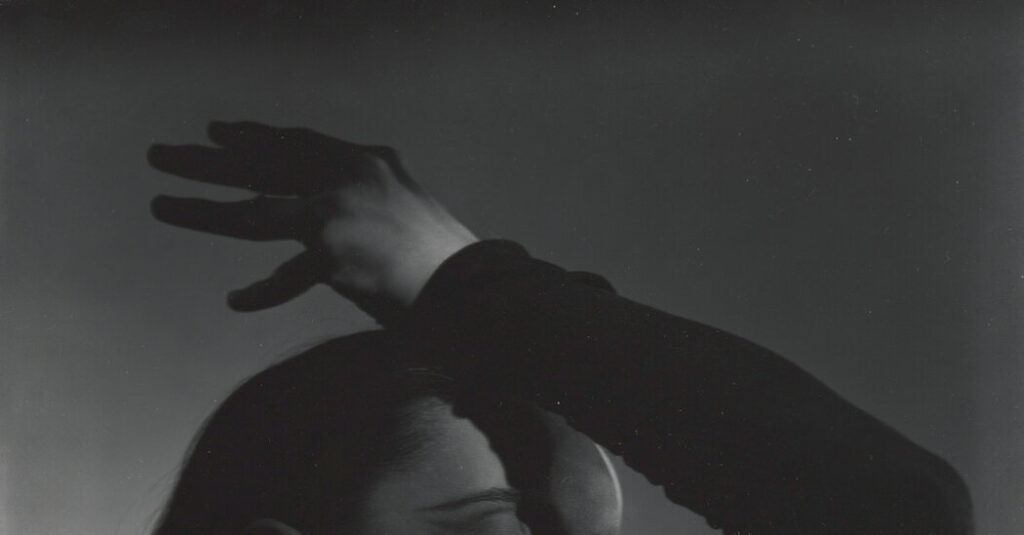
Martha Graham didn’t choose to be a dancer. She was chosen. “And with that,” she wrote in her memoir, “you live all your life.”
But there are dancers, and then there are dancers — the kind that shoot sparks through your insides, the kind that erase the tired from your eyes, the kind that quicken your pulse to the point that you feel you’ve just danced yourself.
This was Martha Graham. But she didn’t stop there.
“You’re like a horse that runs on a muddy track,” her father once told her. Through sheer force of will — she had to have been a little crazed — Graham, with a mud runner’s determination, invented an American art form. Modern dance wasn’t just a barefoot step away from popular forms like ballet and vaudeville. It was a new expression, and within its raw angles were psychological truths. Graham (1894-1991) distilled human emotion into moving, living shapes. She found a way for dance to take up serious space in a bigger artistic world.
She was a visionary, a choreographer who throughout her long career fought fascism, explored the American dream — and its inherent tensions — and stripped Greek myths to their bare essence. She pioneered a dance technique so formidable, so flowing and complete that it can be as fortifying to watch a class as it is to see a classic Graham dance.
In the 1920s and ’30s, Graham’s female-driven dances ran away from traditional notions of beauty. They sought emotional truths through unflinching movement, initiated from the pelvis. This alone was a radical shift. In her searing “Steps in the Street” from “Chronicle” (1936), created in response to the rise of fascism in Europe, rows of dancers in long dark dresses cross the stage, their bodies stark and stiff. They know suffering, they know the scent of death.
Graham became a luminary — she of the sculptural chignon and crimson lips — but insisted there was one thing she was not.
“No artist is ahead of his time,” Graham said. “He is his time.”
Or, in this case, she. Dance, ephemeral and fleeting, is often referred to as the orphan art. It lives in memories, not in objects. But Graham’s choreographic reach was long. She made an impact on the culture at large. She refused to dance at the 1936 Olympic Games in Nazi Germany. She was the first dancer reported to perform at the White House, in 1937. And she presided over the first major American dance company to be racially integrated.
This year is the 100th anniversary of Graham’s inaugural solo performance, a time to think about what she created as one of the most important American artists of the 20th century.
Her influence can be seen in the works of Alvin Ailey, Merce Cunningham and Paul Taylor, three renowned modern dance choreographers who trained under her. Madonna was once a student. (She named her “Madame X” tour for the nickname Graham had given her.) So was Twyla Tharp, who went on to forge her own brilliant path. Graham even lives in the experimental choreographers of today who use somatic methods that connect the mind and body, encouraging internal awareness. Their dances look different, but the impulses are not so far removed.
From that first performance in 1926, her choreography landed like a bomb in a landscape where vaudeville and ballet ruled the day. Graham’s legacy is still going strong, as made evident in the company’s recent season at New York City Center — her company is the oldest dance group in the country — even if newer repertory has been a consistent weak spot.
BORN IN ALLEGHENY, PA., in 1894, Graham spent her teenage years in Santa Barbara, Calif. It was in California that she saw her first dance performance, by Ruth St. Denis, a choreographer whose Orientalist works explored Asian mysticism. Graham went on to study at the Denishawn school, led by St. Denis and her husband, Ted Shawn, who would later make American virility in male dancers his thing.
Graham danced with the Denishawn company, along with two other modern innovators, Doris Humphrey and Charles Weidman. When she left, she performed in the Greenwich Village Follies and taught Denishawn technique. That is until Shawn, as Agnes de Mille wrote in her Graham biography, demanded that she pay $500 for the use of Denishawn exercises and material.
“It was on this small and perverse point — Shawn’s possessiveness and Martha’s penury — that the birth and development of modern dance hinges,” de Mille wrote. (Graham and de Mille had a long, complex friendship.)
Graham was barely making ends meet. Without Denishawn technique she had to create her own. During the 1920s, she conceived her principles of contraction and release, in which movement is initiated from the pelvis. In her technique, tension and release — fueled by the inhalation and exhalation of the breath — drives the body to indisputable strength or excruciating vulnerability.
She had important male collaborators — Louis Horst, her musical director in the early years, and later Erick Hawkins, the first male dancer to join her company. (They were briefly married.) She also worked closely with Isamu Noguchi, the Japanese sculptor whose spare designs matched her direct, unadorned choreography.
But modern dance was a female-driven art, and Graham was its leader. For the first 12 years, she worked only with women, building her technique from the ground up and choreographing works that were fortified by inner emotions, not decorative surfaces. Her dances didn’t hide struggle, and in the bodies of her devoted disciples, the female dancer was both reborn and liberated.
It wasn’t easy. “Certainly Martha could not have done what she did, what she felt she was destined to do, without them,” de Mille wrote. “They were her tool, the material of her craft, her bodyguard, her family, her means of existence.”
Rehearsals continued through the early morning hours; dancers, joining Graham, sewed costumes. And there were always new discoveries to make. While Graham’s life source emanated from the pelvis, the spine — its spiral — was also important.
“The flesh and body are wrapped around the bones,” Graham wrote. “The back of the head should be held high, not the face. For the animal brain is at the base of the head, and as dancing is animal in its source, we need to activate that part of our body.”
GRAHAM WAS A THEATER BEAST. With steely drive, she choreographed dances with searing, of-the-moment titles: “Revolt” (1927), “Immigrant” (1928) and “Heretic” (1929), a groundbreaking work that came after she developed her ideas about contraction and release.
In “Primitive Mysteries” (1931), a plotless triptych study of the Virgin (originally portrayed by Graham), women stride across the stage with stiff legs, bound together by silence. Their use of weight is brutally beautiful; the dance is held together not just by their tensile strength, but also their breath.
In describing its rehearsals, the dancer Gertrude Shurr spoke about how a vibration took over Graham’s entire being: “You saw it in her face, you felt it in her body. She didn’t see us, she made us become what she demanded of us by looking, if it was indeed looking.”
She passed that on in her movement classes at the Neighborhood Playhouse in Manhattan, where her students included Bette Davis, Joanne Woodward and Gregory Peck. Woodward recalled that she and her friends didn’t take the first class seriously; they wouldn’t quiet down. Graham stood still until they did and then said: “There are tears rolling down inside my cheeks.”
Graham wrote: “With that, I had them. They all wanted that kind of power and drama. Whether they got it or not was another matter.”
The woman had timing. And psychological insight. Jack Ferver has brought a sense of that theatrical timing and structure to the excellent exhibition “Martha Graham: The Mother of Psychological Dance” at the New York Public Library for the Performing Arts. It takes place in five acts. “I really wanted it to have a container feeling of this psychic energy,” Ferver said.
The Graham work that Ferver, a choreographer and director, responds to most and considers most necessary now involves Graham’s deep interest in psychology — how dance originating in an inner life was not only different, but radical — and how her dances opened up “the human experience in the contract of catharsis of live performance,” Ferver said. “There was such an ask that Graham had for her audience. I feel that what Freud gave to modern psychology is what Graham gave to dance.”
But her artistry could be spoofed, too — she was that well known — as Danny Kaye did in “Choreography,” in “White Christmas” (1954). In “The Birdcage” Robin Williams moves through the history of dance — from Bob Fosse to Graham to Tharp — in seconds. It’s loving, yet comedy fodder as he struggles to break free of invisible fabric.
Graham designed costumes for 135 of her dances — there were 181 in all — that revealed a body’s shape, despite floor-grazing hemlines, in sensuous, revealing ways. Later, Halston made costumes, and she wore his designs. With her arthritic hands covered in gloves, she was still glamorous. She modeled in a “What becomes a Legend most?” Blackglama ad with Rudolf Nureyev and Margot Fonteyn.
The ad met with less than enthusiastic reactions from those in the dance world. “They want the legend to remain safe for them and predictable, something they can follow,” Graham, then 83, said. “But they have made one fatal mistake: They have confused honesty with self indulgence.”
Graham never wanted to quit dancing. Eventually, she had to. “A dancer dies twice,” she said. “Once when they stop dancing, and this first death is the more painful.”
MOVEMENT WAS HER LIFE. Three famous words passed on to her by her father, a doctor, served her well: “Movement never lies.”
She took that phrase and ran with it as she explored, for decades, how the body could be a vessel to express the depths of the human experience. Life and dance could get ugly and uncomfortable, but that was the point. Dance is life, life is dance, and life is messy.
Graham saw dance as “the hidden language of the soul” and because of that, a pathway into the mind. Graham’s work doesn’t dwell on conventional beauty — though an austere beauty, rendered through the binding power of muscles and bones, was doing things, for sure — but relies on the body’s innermost secrets. In “Lamentation” (1930), a dancer wears a long piece of purple jersey, its material encasing her body in a tube.
As she stretches and contracts, her physical form becomes a container — of sorrow, of grief. For Graham, the fabric, as she wrote, is “to indicate the tragedy that obsesses the body, the ability to stretch inside your own skin.”
LOOKING AT “LAMENTATION” now, with women’s rights eroding, that fabric doesn’t seem to store emotions so much as seal them in. The dancer’s arms are pinned under the material as, seated, she exposes her bare feet, her hands and her face. Even if her body is a river of emotion, she’s bound.
Graham’s early works, with their armies of women fighting for themselves and others, feel particularly relevant right down to that tube of purple jersey. It’s dystopian: You can writhe, you can thrash, but you can’t break free because you aren’t really free.
A contraction, in dance and in life, is a tightening that always needs to be released. “For the contraction I see the heavens; for the deepening over, I see the earth,” she wrote. “For the release, I view earth over a cliff. For the high lift, I dwell within.”
Graham’s use of the torso, that body part capable of forcefulness and sensuality, was no accident. It is the place from which power emanates. In the Graham technique, every fall is an excuse to rise.
Gia Kourlas is the dance critic for The Times. She writes reviews, essays and feature articles and works on a range of stories.
The post Why the Radical Vision of Martha Graham Still Matters appeared first on New York Times.