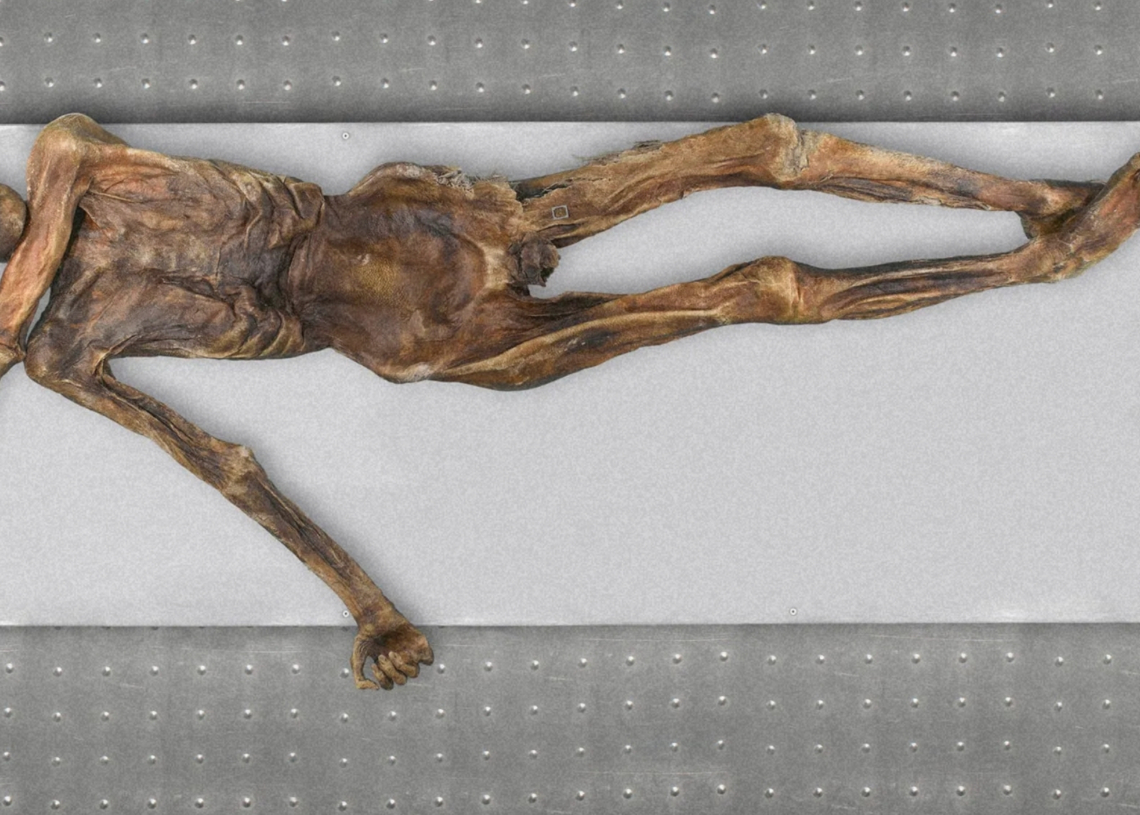
Have you met our ancient, dead caveman friend Ötzi the Iceman? He died 5,300 years ago, but his body was shockingly well preserved by the glacier in which he was trapped in what is now northern Italy’s Ötztal Alps. Ötzi was so well preserved, in fact, that some parts of him were still alive thousands of years later.
According to a new study published in Microbiome by researchers at Eurac Research, the Iceman’s corpse is a small but thriving ecosystem.
Discovered in 1991 by hikers who at first thought he was a poor, unfortunate modern-day mountaineer who romantically met his fate on the very mountains that he so loved. But it was much more than that. Ötzi turned out to be a Copper Age man who lived around 3300 BCE.
He was about 46 when he died, likely from an arrow wound to the shoulder. His final meal consisted of wild meat and grains. He wore stitched animal skins and carried a copper ax. Previous research mapped his tattoos, and even an ancient strain of Helicobacter pylori in his gut, which meant that this guy probably had some tummy issues.
5,300-Year-Old Ötzi the Iceman Is Still Home to Living Organisms, Study Finds
Latest analysis goes even deeper. Scientists gathered all sorts of samples from all over his body, including a skin swab and a sample of meltwater from within his body, and were able to sequence his DNA and RNA to distinguish between the kinds of microbes floating around in our bodies and the ones inside of him, the ancient dude who was frozen in a glacier.
Researchers found three distinct microbial worlds. The first was remnants of his original gut bacteria from his preindustrial diet. The second was cold-adapted yeasts that were introduced into his body by the glacier. The third was modern microbes picked up during the three decades he spent in a museum storage room in the South Tyrol Museum of Archaeology.
Some of the ancient gut bacteria showed severe DNA damage, confirming they were indeed quite old. But the cold-loving yeasts were metabolically active. Two separate samples taken nearly a decade apart show that at least one yeast species is slowly reproducing even if it’s been in cold storage that reaches temperatures of only 21 degrees Fahrenheit.
There were some slight mishaps in his preservation. After he was first discovered, Ötzi was treated with phenol to prevent fungal growth. Over the years, many of the identified yeasts learned to metabolize phenol, so now they are thriving and feeding on the preservation techniques that kept them around for study.
Ötzi was once a living ancient artifact of who we used to be. But now, years later, he’s become something of a petri dish we can use to study microbes both ancient and modern.
The post Scientists Just Discovered Something Still Alive Inside Ötzi the Iceman 5,300 Years Later appeared first on VICE.