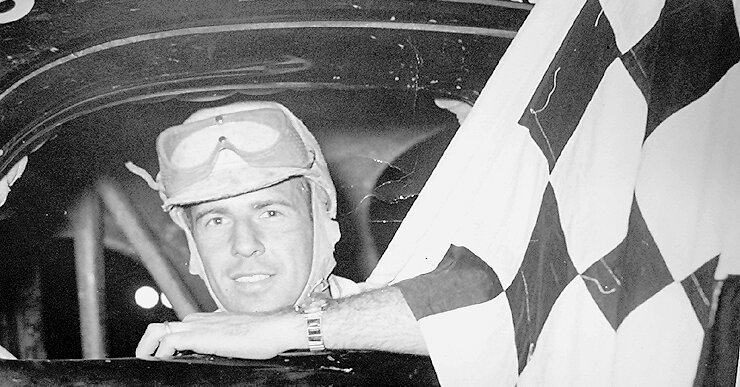
Ned Jarrett, a champion stock-car racer who in the 1960s won the sport’s most important series, NASCAR’s Grand National, twice, clinching the second title by nursing an overheated car to a record-setting victory, died on Thursday at his home in Newton, N.C. He was 93.
His death was announced by his family.
Jarrett’s son Dale followed in his footsteps, winning the title in 1999. Father and son were both inducted into the NASCAR Hall of Fame, Ned in 2011 and Dale in 2014.
From 1953 to 1966, Jarrett drove 75,653 laps — almost 54,000 miles — in 353 Grand National races, winning 50 of them. He won the Grand National series (now called the NASCAR Cup Series), which was held on various tracks across the country, in 1961 and 1965.
Jarrett considered the second of the two titles to be his greatest accomplishment. The winning race, the Southern 500 at Darlington Raceway in South Carolina, NASCAR’s first superspeedway, was a wild and tragic one. Buren Skeen, a rookie driver, was killed in one accident, and Cale Yarborough’s car sailed over a guard rail and flipped six times in another. (Yarborough was hardly injured.)
When Jarrett’s car started overheating with 100 miles to go, he accelerated as fast as he could on straightaways and let momentum sweep him around the turns. He won by 14 laps, and his winning margin of 19.25 miles remains the widest in NASCAR history.
Ned Miller Jarrett was born on Oct. 12, 1932, in Conover, N.C., just outside Newton. His father, Homer, owned a saw mill. One of four children, Ned first got behind the wheel at age 9, when his father let him drive the family car to church one Sunday.
As a teenager, Ned worked in a garage that serviced racecars and had ambitions to drive one. But his father viewed people who raced cars as unsavory and forbade his son to become one of them.
“My father couldn’t see me participating with that group,” Jarrett told The Charlotte Observer in 2001, adding: “Most of the racers were bootleggers, and my dad couldn’t see how that could help do too much with the positive image he’s worked so hard to build up in the community. They were good people, but they were outlaws.”
Ned and his brother-in-law later bought a racecar, and Ned drove it, finishing 10th in a race. When his father heard about it, he was angry, but Ned kept racing under another driver’s name, and when his father learned about the alias, he gave in, telling his son that if he was going to race, he should at least use his own name.
Jarrett did, and endured in an era of little prize money and even less help from sponsors. One Friday, as he recalled, although he was broke, he bought a Ford from the driving champion Junior Johnson for $2,000 and waited for the bank to close before he wrote a check. By the time the bank opened on Monday, he had won two races over the weekend to cover the cost of the car.
His career earnings totaled not quite $350,000; by contrast, his son Dale earned a total of $59.8 million before retiring from competition in 2008. Ned Jarrett retired at his peak at 34. He had never been the same after he broke his back in a 1965 racing crash, and he drove his last season wearing a back brace.
In later years, he was a businessman and track promoter, and a television and radio race analyst for CBS, ESPN and other outlets. (Dale became a television commentator, too.)
His wife of 67 years, Martha (Bowman) Jarrett, died in February 2023. In addition to his son Dale, his survivors include another son, Glenn, and a daughter, Patti Makar.
Ned Jarrett’s most memorable moment may have come when his son Dale was competing in the 1993 Daytona 500, NASCAR’s premier race, and Jarrett was one of three television announcers. When Dale Jarrett passed Dale Earnhardt Jr. to take the lead on the last lap, a CBS producer told Ned to call that lap by himself. His voice became more and more excited as he purred into his microphone:
“Come on, Dale. Go, buddy, go … All right, come on … Bring her to the inside, Dale. Don’t let him get there … He’s going to make it. Dale Jarrett’s going to win the Daytona 500.”
He did, by one-sixth of a second, and a relieved Ned said, “I called Dale home.”
Days later, Ned apologized to Dale Earnhardt Sr., another driving star, for his broadcasting partiality. The older Earnhardt brushed off the incident.
“Don’t you ever forget,” Mr. Earnhardt said, “I’m a daddy, too.”
Frank Litsky, a longtime sportswriter for The Times, died in 2018.
Ash Wu contributed reporting.
The post Ned Jarrett, Champion Stock Car Racer in the 1960s, Dies at 93 appeared first on New York Times.