Formula 1 travels around the world, and conveying the fast-paced action to its TV audience is vital to the sport’s success.
Unlike most other sports, Formula 1 controls its own broadcast feed, transmitting the video for a global television audience, and the majority of the work is done from Biggin Hill, a rural town in southeast London, once an Royal Air Force base.
It is one of the most challenging sports to broadcast.
“Formula 1 is all about stuff happening very fast around a large piece of track,” Dean Locke, director of broadcast, digital and media, said during a tour of its facility in April. “Instead of two teams, one ball, small pitch, we have a massive pitch. And 22 ‘balls’ go around all doing their own stories.”
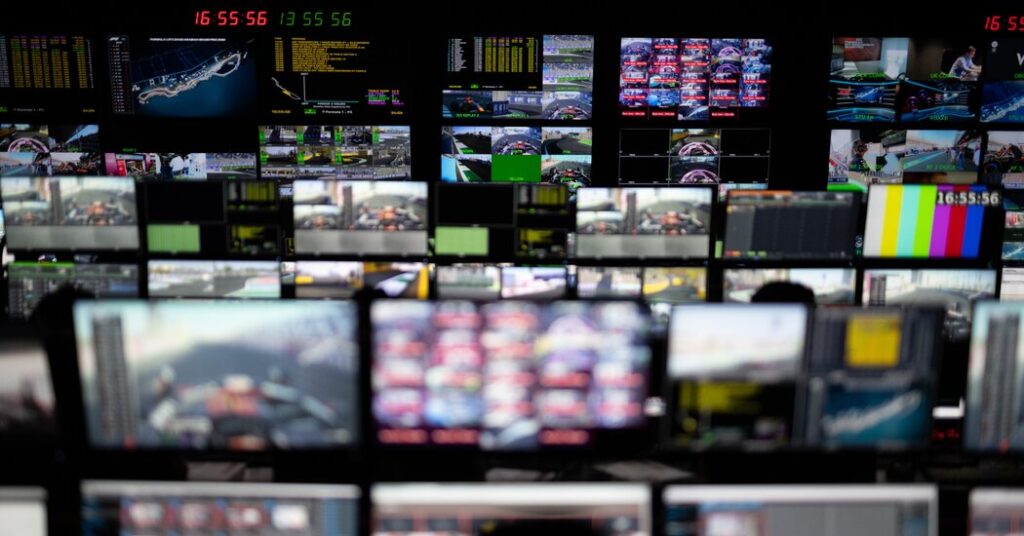
Formula 1 has a TV mobile unit that travels to each Grand Prix, but it works in tandem with the command center at its Media and Technology Center at Biggin Hill. Around 150 technicians are spread across dimly lit rooms in the Biggin Hill center, each with a plethora of screens, akin to a space launch, tasked with selecting videos, preparing replays, creating graphics and grabbing radio messages from drivers.
There are around 150 potential feeds, Locke said, about 100 of which come from the four or more cameras on board each car. The crew works four days at Grands Prix and also covers Formula 1’s support races, like Formula 2, as well as other weekend action, like news conferences and entertainment events. There are high-pressure moments, such as the end of qualifying and the start of the Grand Prix itself.
“It’s very difficult to direct them when they’re trying to pan it, 200 miles an hour,” Locke said. “But you trust them. And we do use some really experienced motorsport camera operators that have been doing it for a really long time all around the world.”
Other members of the broadcast team monitor the action elsewhere on the field to show other events behind the lead cars. Finding a suitable gap in which to show other events can be tricky, Locke said.
“We don’t get that sort of easy bit, like at Wimbledon or something where they sit down,” Locke said, and there’s a pause in the action.
Formula 1 has also developed its ability to show a separate feed in the corner during replays or replays in the corner as the race continues.
Oftentimes the editorial director, onboard director and replay coordinate in real time, Phil Rorke, broadcast executive director, said. And they are all saying, “I’ve got the best angle ever,” he added. “Dean might come through and say, ‘No, you can only do one.’ So we’ve got that constant sort of paring down of how we’re going to show the story, how we show it in only one angle, for people to be able to understand it at home.”
Conveying that story remains one of the biggest challenges. Ahead of qualifying sessions, the production crew holds a strategy meeting to evaluate which drivers to follow at critical junctures. During the race that might change, and the team has to quickly work out which battles to broadcast live, given how multiple events are playing out simultaneously, and how to use the graphics to tell the narrative.
“Fans love tire strategy, love all of that stuff,” Locke said. “Then we’ve got this kind of newer fan who wants to be entertained, wants to know what’s going on in a complex race.” So the graphics team is trying to explain complicated stories, “but also not making it sound too simple for the hard-core fans,” he added.
Such is the reliance on those on-screen graphics, most notably the timing tower on the left-hand side of the screen, which shows the drivers’ position and time gaps. Locke is at his busiest when it malfunctions.
The timing requires that it is always present, and when that tower goes down, “my phone rings, my radio rings, and it’s only down for about 12 seconds.”
There are occasional setbacks elsewhere. There are backups to produce everything locally in the event of a lost connection to Biggin Hill, and each Thursday before a Grand Prix the team rehearses. There are procedures in the event of a major accident on track — and to cover potential injuries sensitively — and mechanisms in case cameras get damaged.
If a piece of tire gets onto the lens of a camera that sits atop one of the cars, for instance, they can send a signal from Biggin Hill to move a clear lens into place while the car is going around the track at 200 miles an hour, Locke said.
There is also constant development of video technology and how coverage is used. Formula 1 continues to refine advertisements that appear on sides of the track, which can be tailored regionally for local broadcasters. There are also innovations such as the ghost car, which allows viewers to compare two laps against each other.
Some onboard footage is not live and must be downloaded after an event, but experts are working to make it available faster. Other engineers are working on a live version of the 360-degree camera and more reliable rear-facing cameras that can withstand the cars’ hot exhaust.
The cameras are also continually getting lighter, with the one inside a driver’s helmet weighing only 75 grams. But race teams need to know weights and camera locations far in advance because of the long lead time involved in car design, so Locke and his team must think 18 months ahead.
But perhaps the biggest change has been off the track, as Formula 1 races become equal parts sporting events and festivals.
“There’s 460,000 people in Austin going to that. Melbourne is half a million,” Locke said. “We’ve got to bring in that environment.”
Locke admitted that sometimes he gets jealous of people who film stadium sports. But then he reminds himself how boring it would be to be locked into one spot.
“Once you’re in a stadium, no matter what stadium that is in the world, it pretty much looks the same once you’re in it,” he said. “We’re kind of fortunate.”
The post Putting Formula 1 on TV Is a Complex Operation appeared first on New York Times.