Matthew Lynn is a financial columnist and author. He writes for the Daily Telegraph and the Spectator in London.
The price that the U.S. government has to pay to borrow money for 30 years has already punched through 5 percent a year, its highest level since the financial crisis of 2007. For 10-year money, the annual price is 4.6 percent and climbing. Amid all the noise about the rise of artificial intelligence and the booming space economy, something far more significant is happening in the financial markets. The cost of borrowing is being reset. And that raises some intriguing questions. Could the politics of deficit reduction stage a comeback? And are voters in any mood to pay attention if it does?
The rising cost of money has turned into a global phenomenon. In the “through-the-looking glass” economics of the post-crash era, yields sank to zero. In some countries, including Japan and Switzerland, they even went into negative territory for a few years: In effect, citizens had to pay the government for the privilege of letting it use their savings. (In decades to come, economics students will be scratching their heads trying to figure out how that ever happened.)
But those days of cheap — or free — money are long gone, and the consequences for the cash flow of the U.S. government are staggering. The national debt now totals $39 trillion. According to an analysis by the Peter G. Peterson Foundation, this year interest payments on all the money owed will pass $1 trillion. It will keep on rising relentlessly, reducing the amount that can be spent on other programs, cutting the amount that is available for investment and crowding out the money that could be spent or saved by the private sector. It is a catastrophe in the making.
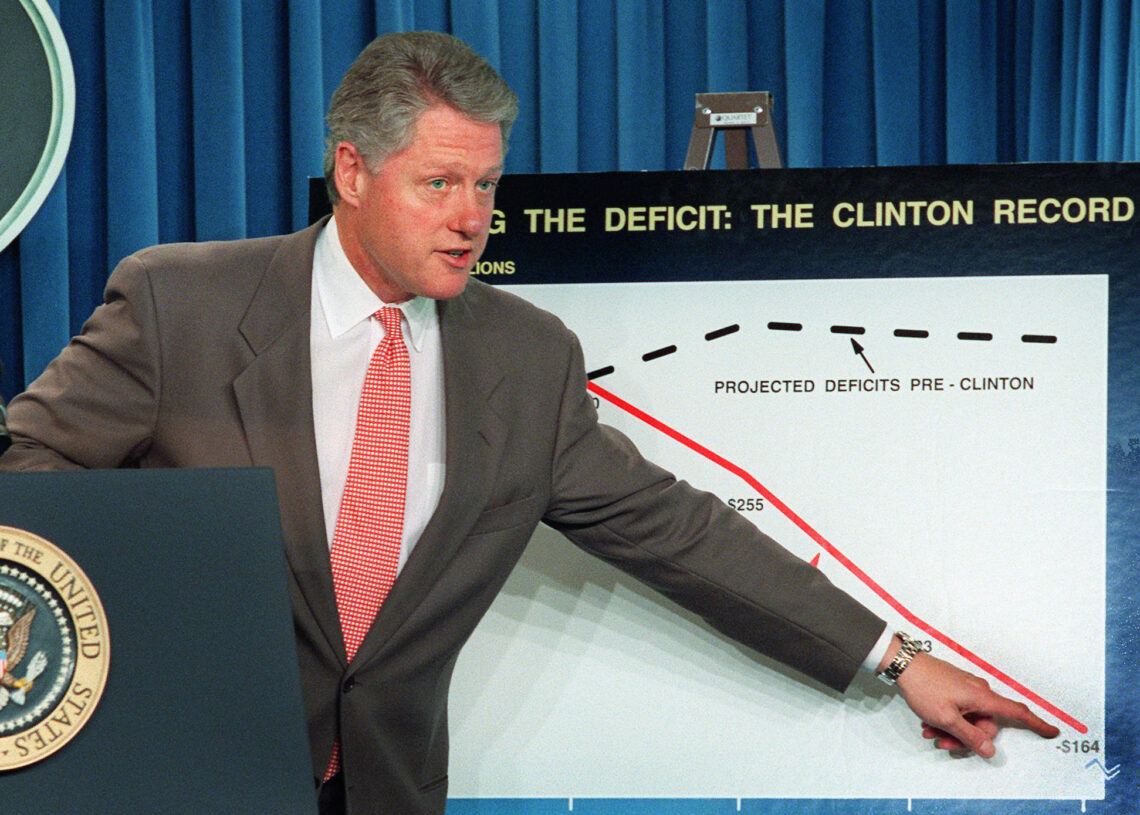
Does anyone care? It might seem as quaint and old-fashioned as a landline phone or a vinyl record, but political leaders used to talk about reducing the deficit all the time. “The time has come for your public servants to bring spending down into line with tax revenues,” President Ronald Reagan told the nation in April 1985. Eight years later, President Bill Clinton warned, “Without deficit reduction, we can’t have sustained economic growth.”
Unfortunately, deficit reduction was a little like you or me getting to the gym more often — a proclaimed goal, rarely lived up to. Clinton was the last president to actually balance the books, in 2000.
In the quarter-century since, that goal has been completely forgotten. Can you remember the last time you heard a major national leader pledge to borrow less? Me neither. Even when the federal government gets a major new source of revenue, as it did when it imposed tariffs on imports last year, almost no one argues for using that revenue to reduce the deficit. The debate is always about how it can be spent, either with tax cuts or more generous social programs. To quote one of Reagan’s better jokes, the assumption is always that the deficit is “big enough to take care of itself.”
When money was cheap, it didn’t make any sense to worry about how much this sinkhole was costing the country. But things have changed. As the national deficit cuts into programs Americans care about, or forces higher taxes just to keep up the interest payments, it will be a very different picture. Delusional politicians, and even more delusional voters, might choose to ignore it. But that is going to get steadily harder.
It is just possible that for the first time in decades, the politics of deficit reduction will be back. The big space in American politics will be waiting for a leader who can steadily balance the books while restoring competitiveness, keeping inflation under control and maintaining government services.
That won’t be easy. The U.S. deficit came in at 5.8 percent of gross domestic product in 2025, and it is not likely to be any lower this year. Bringing it down will require sustained hard work, lots of patience and the ability to tell hard truths. Those are not qualities that Washington has in abundance. Even so, it would be a big prize. The only real question is whether there is a leader out there who is willing to step up and take it.
The post A financial catastrophe is looming. America forgot to care. appeared first on Washington Post.